

Why Scientists Use Rats for Experiments: A Key to Human Biology
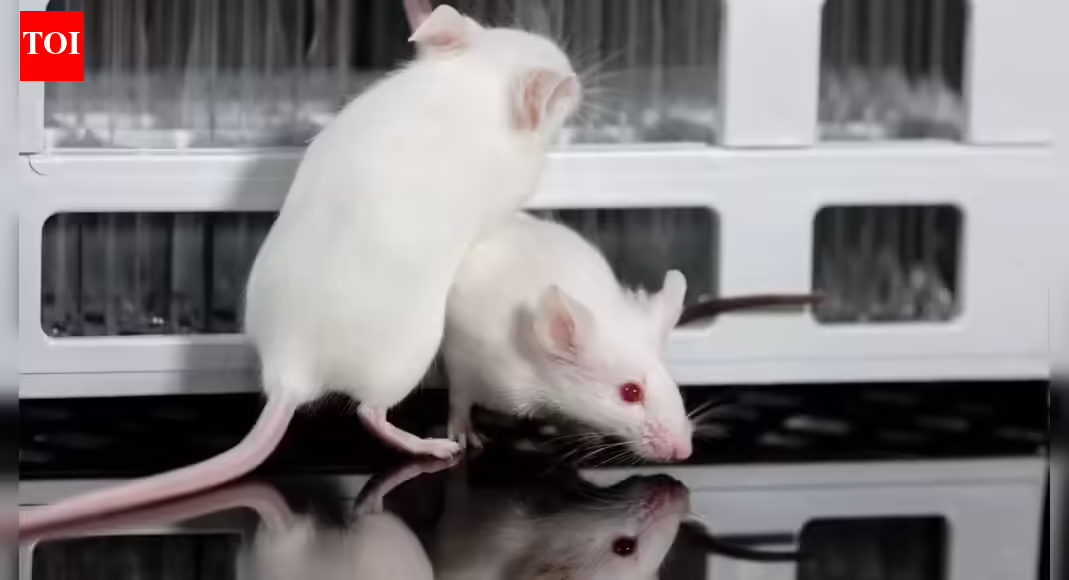

Walk into any biomedical research facility in the world, and you’re likely to find them: rats and mice in carefully controlled environments. For over a century, these rodents have been the cornerstone of medical and psychological research. Why scientists use rats for experiments is not a matter of convenience alone; it is a carefully considered choice rooted in remarkable biological, practical, and genetic similarities to humans.
The Biological and Practical Blueprint
The primary reason why scientists use rats for experiments stems from a powerful combination of biological practicality and genetic relevance.
1. Striking Genetic and Biological Similarities
Despite the obvious size difference, rats share approximately 90% of their genes with humans. Their bodily systems—nervous, circulatory, digestive, and endocrine—operate on fundamentally similar principles. This means diseases like diabetes, hypertension, and cancer manifest in rats in ways that closely mirror human conditions, allowing researchers to study disease progression and potential treatments effectively.
2. Short Lifespan and Rapid Reproduction
A rat’s lifespan is about 2-3 years, and they reach sexual maturity in weeks. This allows scientists to study the effects of treatments or environmental factors across an entire lifespan—or even multiple generations—in a relatively short time frame, something impossible with longer-lived species.
3. Manageable Size and Cost
Rats are large enough for surgical procedures and repeated blood sampling, yet small enough to house efficiently in large numbers. Their cost of care is significantly lower than that of larger mammals, making large-scale, statistically significant studies feasible.

How Rats Reflect Human Biology: The Critical Discussion
The core of the topic—how they reflect human biology—is where both the power and the limitation of rodent models lie. The reflection is strong, but it is not a perfect mirror.
- Neurology and behaviour: The rat brain, while simpler, shares a similar structure as the human brain. This makes them excellent models for studying addiction, learning, memory, and neuropsychiatric disorders. Drugs that affect rat brain chemistry often have analogous effects in humans.
- Genetic Manipulation: Scientists can create “transgenic” rats—animals with specific genes added, removed, or altered. This allows for precise study of genetic diseases like cystic fibrosis or certain cancers.
- The Translation Gap: This is the crucial discussion point. A treatment that works in rats does not always work in humans. Differences in metabolism, immune response, and complexity mean that rodent studies are a vital first step, not a guaranteed final answer. Scientists use rats for experiments to identify promising leads, which must subsequently undergo rigorous testing in human clinical trials due to their variability.
Ethical Considerations and Future Directions
The use of animals in research is governed by strict ethical frameworks known as the “3 Rs”: Replacement (using non-animal methods when possible), Reduction (using the minimum number of animals), and Refinement (minimising pain and distress).
Today, the field is evolving. Advanced techniques like human organ-on-a-chip models and sophisticated computer simulations are being developed to complement and, where possible, reduce animal testing. However, for understanding the complex interactions within a whole living system, rodent models remain an indispensable tool.
Conclusion: An Indispensable, Imperfect Mirror
In summary, why scientists use rats for experiments is because they offer a unique and powerful combination: a biological system that closely echoes our own, packaged in a practical, ethical, and efficient model. They reflect human biology in profoundly useful ways, providing insights that have led to nearly every major medical advance, from vaccines to cancer therapies.
However, researchers are acutely aware that the reflection is not perfect. The ongoing discussion ensures that rodent research is conducted thoughtfully and ethically, as one critical link in the long chain of discovery that leads from the lab bench to the hospital bedside.




One thought on “Why Scientists Use Rats for Experiments: A Key to Human Biology”
Comments are closed.