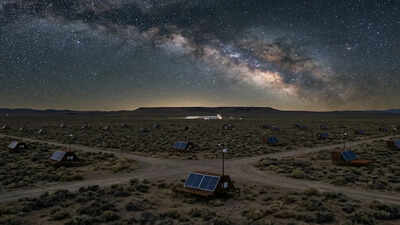
In May 2021, scientists detected one of the most powerful cosmic rays in history in Utah. 1.
Amaterasu strikes Earth’s atmosphere and causes a large shower of secondary particles. By 2023, scientists had determined that it was the second strongest particle, after the famous oh-my-God cosmic ray observed in 1991.
What makes this observation particularly interesting is that despite measuring its impact on Earth, researchers could not determine where it originated.
Thus, it raises many questions for future study.
How was Amaterasu discovered? Amaterasu was discovered by the Large Observatory Telescope Array, located in the Utah desert.
According to the University of Utah, it is the largest cosmic-ray detector in the Northern Hemisphere and is designed to study ultra-high-energy particles. Scientists detected not the particle but the air shower generated by it.
When an outer space cosmic particle hits Earth’s atmosphere, it collides with other particles, setting off a chain reaction of particles that scatter in different directions and are detected through various ground-based instruments.
In this process the energy and direction of this elementary particle can be determined. However, there will be no actual image of the cosmic ray source.
This peculiarity became the focus of Amaterasu studies. Why is it difficult to find the source of cosmic rays
One of the main concerns when analysing the event was the source of the cosmic ray itself.
In one of the studies published in Nature, the source of the particle came from a region of outer space where there was no known source of high-energy radiation, which was described as “void-like.”
Cosmic rays typically originate from highly energetic locations in outer space. Such a place could be an active galactic nucleus, the remains of a supernova, or a jet from a black hole. None of the above was evident in the Amaterasu incident.
So, what remained was a challenge for the scientists. How could this compelling particle come from a region that appears to be devoid of any matter?
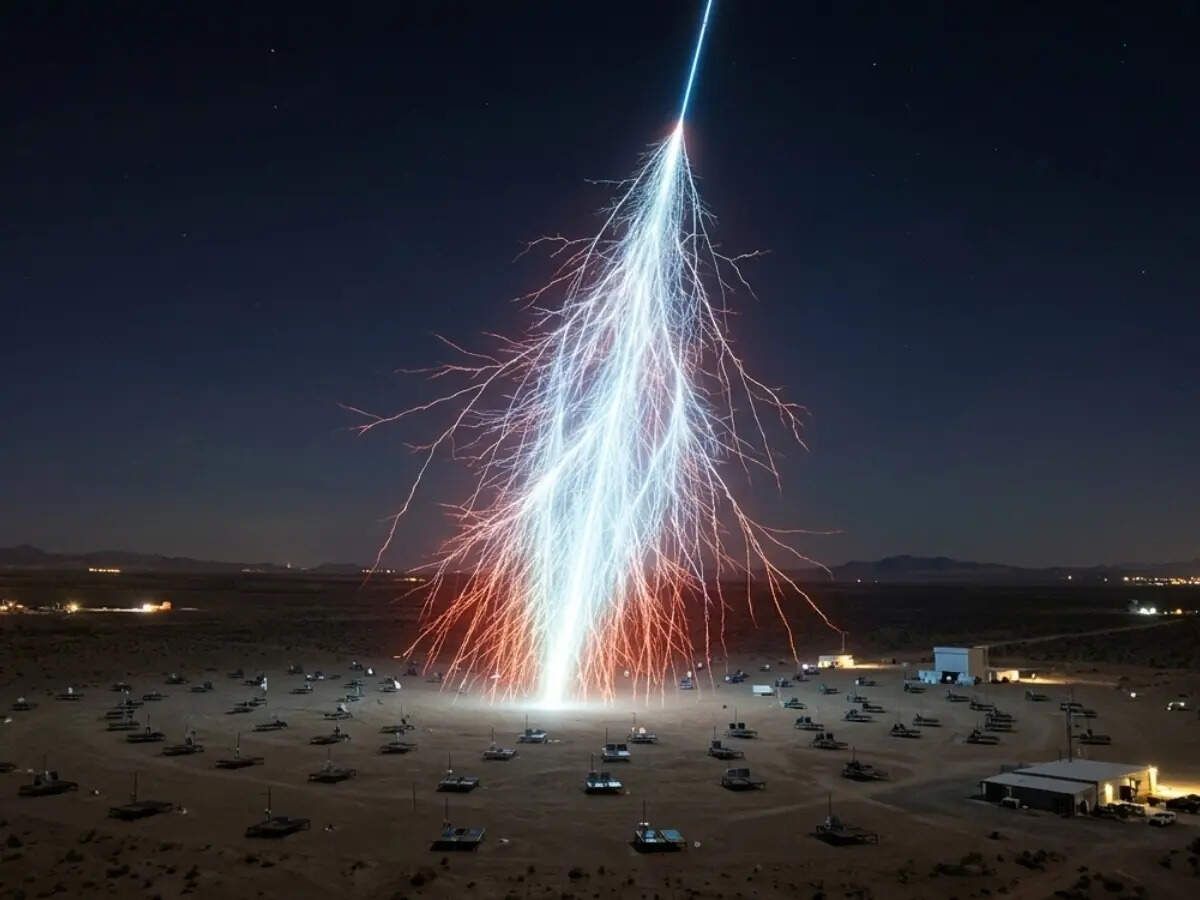 Scientists observing the sky recorded a huge energy burst. Image Credit – Gemini
The complexity of finding the origin of Amaterasu: Since cosmic rays are known to interact with magnetic fields, tracing the origin of these particles can be quite difficult.
Charged particles travelling in space will be affected by magnetic fields, which affect their path and trajectory.
Various literary studies have shown that high-energy cosmic rays can bend before entering our atmosphere. Thus, their path does not always point to their origin.
Therefore, even a satisfactory detection will not solve the problem, since it will accurately indicate the energy of the rays, but it is difficult to determine their path.
Amaterasu’s origins become a little clearer. However, after Amaterasu, things may be a little clearer now. In 2025, it became clear that a possibility might exist.
A 2025 nature research highlights suggested that the blazar PKS 1717+177 could be a possible source. Astronomers think that blazars are active galaxies that emit jets of high-energy particles toward Earth.
Such jets are fuelled by supermassive black holes, which can emit radiation and other high-energy particles.
According to this study, protons emitted from the blazar’s jet may collide with ambient photons, producing these high-energy particles.
Some of those particles will be able to travel through space and eventually reach Earth in the form of cosmic rays.
This model provides an explanation rather than a final solution because it is consistent with what we know about such astronomical objects.
Furthermore, it helps to connect the Amaterasu phenomenon to a certain type of source of cosmic events. Role of neutrinos in identifying the source of cosmic rays. Scientists use neutrinos to investigate the sources of cosmic rays.
Neutrinos are massless subatomic particles that move in straight paths unaffected by magnetic fields. This phenomenon explains why high-energy neutrinos often appear along with cosmic rays.
In multi-messenger astronomy, scientists attempt to analyse multiple types of particles simultaneously.
Such an approach makes the process much easier for researchers. The discovery of the Amaterasu cosmic ray represents a major breakthrough in mankind’s achievements.
At the same time, it also points out some limitations of our capabilities. Scientists have detected and quantified one of the most powerful cosmic rays, but tracing its origin has been difficult.
This pattern is common for research in astrophysics, and even the most advanced detectors cannot establish the origin of cosmic rays.
However, each new discovery brings science one step closer to solving the mysteries. From mystery to explanation: At this point, the scientific world continues to unravel the mystery of the cosmic ray known as Amaterasu.
The event became another interesting cosmic phenomenon registered by Earth-based observatories. For some time it seemed as if it had no origin.
Nowadays, researchers are trying to find out the real source of the signal. Regardless of whether the blazar theory is valid or not, this phenomenon has already helped advance cosmic ray research significantly.
This case proves that there are still many mysteries that need to be solved. Just one particle could pave the way for discovery.