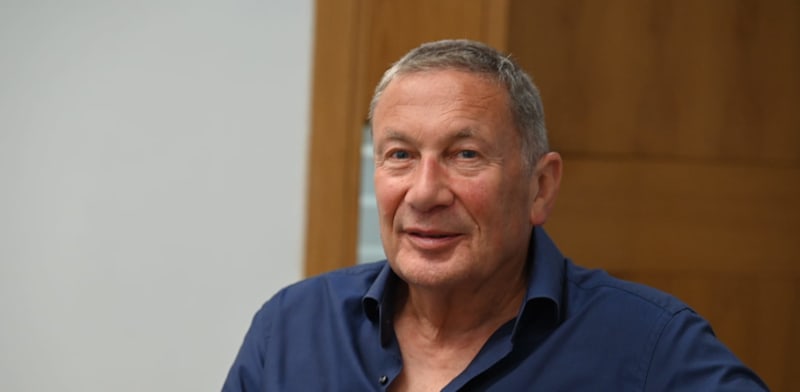

The loan agreement signed with the banks three months ago by IDB Group’s former controlling shareholder Nochi Dankner has collapsed. As a result, the banks today filed a request to declare Dankner bankrupt in the Tel Aviv Magistrate’s Court. Dankner recently failed to pay the banks as part of the new debt settlement.
Dankner allegedly failed to make the payments because the expected investment in his food tech company, Hoshen, did not materialise, leaving him without the funds that were supposed to finance the ongoing payments to the banks.
Last January Dankner revised the loan agreement it signed in 2016 with Bank Leumi, Bank Hapoalim, Israel Discount Bank, Mizrahi Tefahot Bank, Credit Suisse and Union Bank. According to the new arrangement, Dankner pledged to immediately pay the banks NIS 5 million, pledge all his rights in the will of his late father, Yitzhak Dankner, and give the banks the right to appoint an external supervisor to attend the sale of the central property in the will – Beit HaShinhav in Jerusalem. According to banks’ estimates, Dankner’s rights in the property are worth between NIS 90–150 million. However, Dankner was unable to meet his debts beyond the initial payment of NIS 2.5 million.
Originally, Dankner owed more than NIS 500 million to the banks for loans previously made to two private companies through which he controlled the IDB. To date, Dankner has repaid approximately NIS 110 million of the NIS 180 million he promised to repay as part of the debt settlement. The amount of money Dankner has repaid so far includes the NIS 20 million interest it paid on the total of the settlement, as well as a final payment of NIS 5 million. As a result, Dankner has another NIS 90 million to repay as part of the settlement.
“He repeatedly breached his obligations.”
The request submitted to the court by the banks states that Dankner “was given several opportunities to repay his debts to the banks, but from time to time he violatedobligations while requesting a postponement oftpone the signed debt settlement.”
“Now, since the debtor has exhausted all options and does not appear to be able to meet its obligations, it appears that the only way to protect the interests of its creditors and other stakeholders is to initiate insolvency proceedings against the debtor,” the bank says.
The banks’ request details how, since the original loan settlement was signed in 2016,
They have granted him four deferrals of payment: in July 2017, June 2019, August 2020 and July 2023.
Related Articles
Nochi Dankner Reinvented
Tycoon turns his back on Nochi Dankner
The banks are therefore asking the court to appoint a trustee for Dankner’s estate, stating that this would “benefit all creditors and help his creditors maximise the repayment of their debts”.
The request also reveals that Dankner’s total debt to banks, including interest, amounts to NIS 419 million. The largest creditor is Bank Hapoalim, which Dankner owes NIS 175 million; Bank Leumi then loaned NIS 162 million to the private companies Gandon Holdings and Gandon Investments, through which they held the IDB. Dankner was a personal guarantor for these loans, as well as for the loans of his cousin Danny Dankner.
Ankner’s other loans are to Discount Bank (approximately NIS 120 million) and Mizrahi Tefahot Bank (approximately NIS 90 million).
The banks stressed that for almost two years they had given Dankner “repeated extensions” and negotiated with him to repay the loan, but according to them, he had not fulfilled his obligations.
Dankner: I will continue to act in good faith and transparency
Nochi Denkner said, “I have worked to the best of my ability for many years to repay my obligations with the view that this debt is a moral obligation of the highest level. Over the past decade, I have worked tirelessly; taken initiative; worked day and night; and paid out a significant cumulative amount of approximately NIS 110 million.
“In recent months, I have reached an agreement with an investor to sell some of my shares in the foodtech company I founded in exchange for his additional investment in the company as well as millions of shekels. I intended to use these proceeds to repay my debts and continue to grow the company. Unfortunately, the investor reneged on his commitment. As I have acted so far in good faith, with transparency and full cooperation, I will continue to act from now on. “My hope is that the process will be conducted with respect and fairness.”