


 PA Media
Despite not being able to save all jobs during the Covid-19 pandemic, Rishi Sunak asserts that the government successfully prevented mass unemployment.
The former prime minister, who was chancellor at the time, said it “wasn’t going to be possible to save every person’s job”.
But he said the government was “successful in preventing mass unemployment” and the impact of the pandemic on employment was “considerably better than what anyone had forecast at the early stages of the pandemic”.
Sunak said there was “no playbook” for the economic shock from COVID, and ministers were “dealing with something no one had dealt with before.”
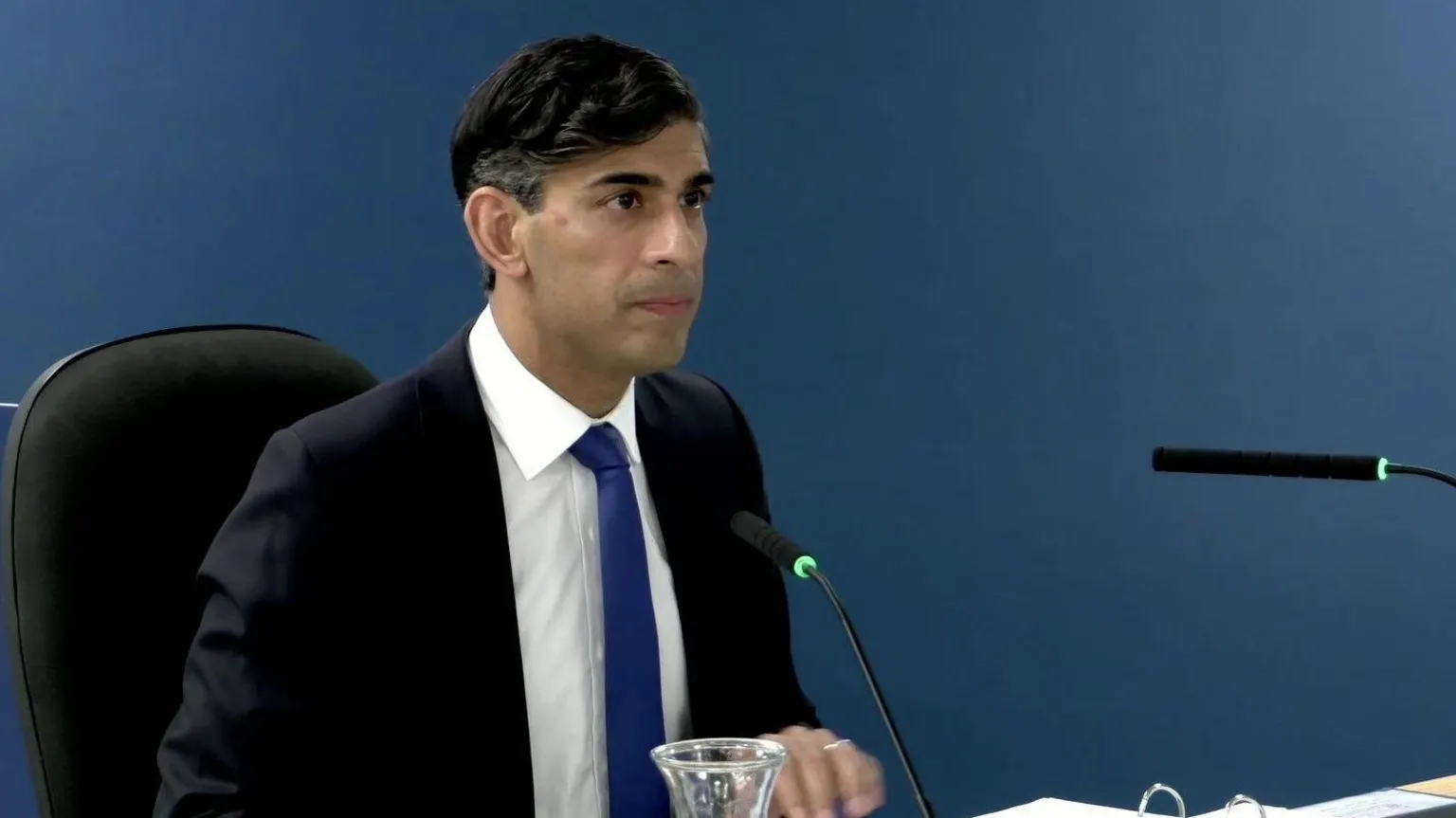
The former PM provided evidence to the public inquiry into the pandemic on Monday, answering questions about the policies he set out to support workers’ incomes and keep businesses afloat.
He said that during the crisis, there was “enormous uncertainty,” with policymakers and experts unsure of the virus’s scale and duration and how the public would respond to government measures.
He said that there was no toolkit or playbook available with instructions on how to handle pandemics like other economic or financial crises.
Over the past three weeks, the inquiry has been focussing on the economic response to the pandemic and hearing from former ministers, Treasury officials, and central bankers.
A key finding from the COVID inquiry last month was that the government did not take the virus seriously enough until it was “too late,” making February 2020 a “lost month” for action.
Sunak’s appearance on Monday was the second time he has taken the stand, after previously providing evidence in December 2023 when he was still prime minister.
He was appointed chancellor of Boris Johnson’s government on 13 February and was preparing to present a budget before the pandemic hit UK shores and the country was put into lockdown a month later.
Sunak told the inquiry that one of his priorities was to prevent mass unemployment and said “speed was paramount” in the government’s response.
He said there was an “acknowledgement” in the Treasury that they were not going to “get everything right away.”
“We could not allow perfection to stand in the way of progress,” he stated. “We had to get things out fast.”
Sunak said, “I’m proud that the impact on living standards, especially for the most vulnerable, was stronger than I would have perhaps anticipated going into this.”
Sunak announced the coronavirus furlough scheme in March 2020.
At his previous appearance in front of the inquiry, Sunak defended his Eat Out to Help Out policy, which was one of the government’s policy measures aimed at supporting businesses reopening after the first lockdown.
Medical officials advised Sunak not to intervene “too early” when the pandemic struck, he told the inquiry.
“Especially in those early conversations, a lot of what the medical and scientific community were advising us at that time was not to go too early with the various interventions, because they were worried about public acceptance of them,” he said.
The furlough scheme was the centrepiece of Sunak’s intervention in the UK economy, designed to stave off a wave of job losses as the country shut down in the face of the virus.
Richard Wright KC, counsel to the inquiry, said hearings to date had received “generally positive evidence” in relation to the policy.
Sunak stated that after the original scheme was implemented, the government created a targeted version of it that “never saw the light of day.”
“We spent an inordinate amount of time over the summer iterating a more targeted version of furlough; hours and hours of work to do exactly that, on the basis that we were moving to a different phase of the pandemic,” he said.
“We developed the JSS (Jobs Support Scheme), but we never implemented it due to another lockdown.”
Sunak added there “wasn’t a way of targeting that I felt comfortable with.”.
The former chancellor responded to criticism that the furlough scheme could have been shorter or longer by saying, “I think this is something where we have to be really careful about hindsight,” but he added that he believed the approach was balanced correctly.
He said, “If this happens again, I don’t see how that time would help someone like me find that balance.”
On support for self-employed workers, Sunak said there were challenges with the scheme, given that those applying had to self-certify.
But he said it was appropriate to support self-employed people and that he would “do it again” if in the same position.