TCL NXTPAPER 11 Gen 2 Android Tablet, 11″ Drawing Pad & Digital Notebook, 4096-Level Stylus & Case Included, NXTPAPER 4.0 Display, Android 15, AI Tools, 6+6GB RAM, 64GB Storage, 8000mAh Battery, Gray
Price: $249.99 - $199.99 (as of Jul 12,2026 22:19:29 UTC – Details)
Inspire Greatness with TCL
TCL is a global tech leader in display panels, TVs, home comfort, and mobile devices, operating in over 160 countries since 1981.
We strive to enhance lives through innovative technology, bringing joy, safety, and convenience to families and empowering people to pursue greatness.
Phone & Earbuds Series
Tablet Series
Tablet & Accessories Series
Tablet, Drawing Pad & Digital Notebook in One:
The TCL NXTPAPER 11 Gen 2 seamlessly combines creativity, productivity, and entertainment in a single device. Featuring an 11-inch 2K display and a T-PEN stylus with 4096 pressure levels, it is ideal for drawing, note-taking, reading, and media viewing—designed for students, artists, professionals, and everyday users
NXTPAPER 4.0 Display for Eye Comfort:
Unlike traditional tablets, the upgraded NXTPAPER 4.0 display reduces blue light and features an anti-reflective, flicker-free surface for extended reading and work sessions. The Eye Care Assistant automatically adjusts brightness and provides break reminders to help minimize eye fatigue
AI-Enhanced Productivity:
The TCL NXTPAPER 11 Gen 2 tablet with pen features smart voice memos, real-time bilingual subtitles, writing and text assistants, and a smart translator that turns speech into text, refines writing, and translates conversations and images. “Circle to Search with Google” lets you instantly find info, boosting work and study efficiency
Three Display Modes for Every Scenario:
The TCL NXTPAPER 11 Gen 2 tablet lets you easily switch between three display modes in Settings. Regular Mode delivers crisp visuals for videos and everyday tasks. Ink Paper Mode offers a paper-like experience perfect for reading and handwriting. Color Paper Mode softens tones for drawing, comics, and creative work while preserving fine details
Ample Storage and High Performance:
TCL Electronics tablets come with 128GB storage, expandable to 1TB, providing plenty of room for multimedia and large files. Powered by MTK Helio G80 with 8GB RAM plus 8GB virtual RAM and running Android 15 with TCL’s custom interface, it ensures smooth multitasking with support for screen mirroring, extended displays, floating windows, and split-screen
Long-Lasting Battery with Reverse Charging:
The TCL NXTPAPER 11 Gen 2 Android tablet has an 8000mAh battery supporting a full day of study, work, and entertainment. 18W fast charging (compatible charger required) allows quick recharging, and reverse charging lets you power phones, earbuds, and other devices when needed
Clear Video and Crisp Audio:
Featuring a 5MP front and 8MP rear camera with autofocus and flash, this tablet supports 1080p video recording for online meetings, classes, and everyday moments. Dual speakers and microphones deliver clear sound even in noisy environments, while CenterFace technology keeps you naturally framed on Zoom, Google Meet, and Microsoft Teams.
Slim, Lightweight, and Built for Everyday Use:
Measuring just 0.29 inches thick and weighing 1.1 lbs, this drawing tablet is exceptionally portable to carry wherever inspiration strikes. Its slim metal body feels sturdy yet light, and the included flip cover provides protection and hands-free support for sketching, writing, or creative work on the go
Tash Farrant hailed Heather Knight as “one of the greats” after the former England captain announced her retirement from international cricket.
Knight, 35, will be out of England alongside Tammy Beaumont at the end of the first women’s Test against India at Lord’s this week.
Making her debut in 2010, Knight went on to win 320 caps for England while she captained the team from 2016 to 2025, most notably leading the team to a memorable victory on home soil in the 2017 Women’s Cricket World Cup.
Heather Knight explained her decision to retire from international cricket, saying the time felt right and shared a special moment in the dressing room announcing the news yesterday.
“It’s a giant moment, isn’t it? She’s been one of the greats to play for England,” said former team-mate Farrant. Sky Sports Cricket.
“She has been so integral to England cricket and women’s cricket in general over the past 16 years that her career has spanned quite a bit.
“She wanted to go out on her own terms. Not many people are able to do that, and she also loves Test match cricket, so to be able to play a Test match at Lord’s – the first – I’m not surprised by the decision.”
“England will truly miss him.”
The ‘gritty’, ‘hardy’ knight loved hard times.
Farrant added: “I think it will be the 2017 World Cup title here [at Lord’s], which will always be remembered.
“And indeed, she came in at a difficult time. It is not an especially straightforward task to follow Charlotte Edwards as England captain. She has to mobilise this team quickly and win the World Cup.
Image: Heather Knight led England to victory in the 2017 50-over World Cup
“One thing I always admired about her is that she was so charming on the pitch, such a tough cricketer.
“She loved those tough times and felt that’s what made her a better cricketer.”
Knight is currently the third highest run-scorer in England in T20I and ODI cricket, while she was also the first English player to score centuries in all three formats.
But Farrant also stressed that it was Knight’s often ‘overlooked’ work off the field that she will remember most.
“Playing under her, she was such a good leader – more so than for the things she did off the field,” Farrant added.
“As a young player, you can succeed in international cricket, can’t you? And you can lose pieces of your life – your friends, your family – because you’re so immersed in it.
“I always admired Heather because she always had such a beautiful balance between working hard – making sure you’ve done everything, so you’re ready to be on the pitch – and also other things when we went on tour, making sure that as a captain we got to go and immerse ourselves in the culture of the new country we were in.
“Those are the memories I’ll have of him. Not just on the pitch, but the things he did off the pitch. Things that sometimes go unnoticed.”
Image: Heather Knight was the first English player to score a century in all three formats.
‘Good time for night retirement.’
Fellow former England international Ebony Rainford-Brint also hailed Knight as “brilliant” but believes he should retire now.
“My first thought was to have a good time, to be honest,” Rainford-Brent said. “I think it’s critical to go high.
“He has done a lot for the game. He has captained us here to win the World Cup final at Lord’s.
‘He’ll be hoping they can win on home soil again [in the T20 World Cup], but she got to the final, and I think she’s just waiting, thinking, “I’ve got a lot to leave and I’ve given it my all.”‘
“Get out while your name is still at its peak. There’s nothing worse than players who hang on too long.
Make sure our latest headlines always appear at the top of your Google searches by adding us as a favourite source. Click here to activate. Or add us as your preferred source to your Google Search settings.
Scientists have uncovered an unexpected source of food in the deep ocean that could change how researchers understand both marine ecosystems and Earth’s carbon cycle. A new study from the University of Southern Denmark (SDU) suggests that deep ocean microbes are not living in such a nutrient-starved environment after all.
The research found that tiny sinking particles known as marine snow release dissolved carbon and nitrogen as they descend into the deep sea. Those leaked nutrients become an immediate food source for microbes living in the surrounding seawater.
Deep ocean pressure unlocks hidden nutrients
Marine snow is made up of tiny clumps of dead algae, microbes, and other organic material drifting through the ocean. According to the study, once these particles reach depths of about 2 to 6 kilometres, the enormous hydrostatic pressure begins forcing dissolved organic matter out of them.
“The pressure acts almost like a giant juicer,” says the first author of the study, biologist and associate professor Peter Stief from research centres Nordcee and the Danish Centre for Hadal Research. “It squeezes dissolved organic compounds out of the particles, and microbes can use them immediately.”
The findings were published in Science Advances in the paper “Hydrostatic pressure induces strong leakage of dissolved organic matter from ‘marine snow’ particles.”
The researchers estimate that sinking marine snow can lose as much as 50% of its original carbon and between 58% and 63% of its original nitrogen during its descent through the deep ocean.
Discovery could reshape understanding of the carbon cycle
The results also have important implications for Earth’s carbon cycle.
Scientists have long assumed that much of the carbon carried by marine snow eventually buries itself in deep ocean sediments. However, if large amounts of carbon leak out before the particles reach the seafloor, less carbon may permanently remain in sediments than previously believed.
Instead, much of that dissolved carbon remains suspended in deep ocean waters, where it can stay for hundreds or even thousands of years before gradually returning to the surface ocean and eventually the atmosphere. Carbon that does become buried in seafloor sediments, by contrast, can remain locked away for millions of years, accumulating over vast stretches of time. Much of the oil and natural gas extracted today formed through this long-term burial process.
“This process affects how much carbon the ocean can store and for how long,” says Peter Stief. “It’s relevant for understanding climate processes and for improving future models.”
Simulating marine snow under extreme pressure
To investigate the process, the researchers recreated marine snow in the laboratory using diatoms, microscopic algae that naturally clump together as they sink through the ocean.
The team placed these artificial particles inside specially designed rotating pressure tanks that kept the marine snow suspended instead of allowing it to settle. This setup allowed the researchers to measure how much carbon and nitrogen escaped under conditions similar to those found in the deep ocean.
Their experiments showed that up to half of a particle’s carbon content leaked out while sinking. Most of the released material consisted of proteins and carbohydrates that free-living deep ocean microbes can readily consume.
Within just two days, bacterial abundance increased 30-fold, while respiration rates rose dramatically. These results indicate that dissolved organic matter released from marine snow provides a rapid and valuable energy source for microbes living at great depths.
The researchers also observed the same leakage pattern across multiple species of diatoms, suggesting that this mechanism is likely widespread throughout the world’s oceans.
Next stop: The Arctic Ocean
The next phase of the research will move from the laboratory to the open ocean.
The team plans to search for molecular fingerprints of this process in both surface and deep waters during a future expedition to the Arctic aboard the German research vessel Polarstern. Detecting those signatures in nature would help confirm that the pressure-driven leakage observed in the laboratory is occurring throughout the deep ocean.
The study, “Hydrostatic pressure induces strong leakage of dissolved organic matter from “marine snow” particles”, was authored by Peter Stief, Jutta Niggemann, Margot Bligh, Hagen Buck-Wiese, Urban Wünsch, Michael Steinke, Jan-Hendrik Hehemann, and Ronnie N. Glud.
The research was supported by the Danish National Research Foundation, the European Union’s Horizon 2020 Research and Innovation programme, and the Independent Research Fund Denmark.
Make sure our latest headlines always appear at the top of your Google searches by adding us as a favourite source. Click here to activate. Or add us as your preferred source to your Google Search settings.
For young Iranians, cafes are a refuge — a safe place to mingle and unwind in a country where social freedoms are restricted.
“I like going to cafes because you see all kinds of people with different personalities, yet they’re all socialising in the same place,” Ainaz, a 19-year-old woman living in the capital, Tehran, told RFE/RL’s Radio Farda.
“I have my favourite spot, but I also enjoy trying out cafes with different vibes. I feel freer in cafes than I do on the streets,” added Ainaz, who only gave her first name for security reasons.
But a deepening economic crisis and renewed pressure from the authorities are squeezing Iran’s once-booming cafe culture, a fixture of urban social life, particularly among young people.
Economic Strain
Coffee and food prices have soared amid runaway inflation. The International Monetary Fund forecasts that Iran’s overall inflation will reach nearly 69 per cent this year, the highest since the Islamic Revolution in 1979.
Years of international sanctions and government mismanagement have crippled the economy. Iran’s war with the United States and Israel since late February has pushed the country of 90 million people to the verge of economic collapse.
Iran’s cafe scene has felt the impact, with owners grappling with rising costs and customers scaling back their spending.
A woman in Tehran said the price of 250 grams of coffee is as much as 15,000,000 rials ($8) — double what it cost last year.
“Just imagine how expensive coffee in a cafe has become,” the woman, who spoke on condition of anonymity for security reasons, told Radio Farda.
A Tehran cafe in May 2025
Another resident of Tehran, a 41-year-old man, said he was going to cafes “almost every day” during the nearly three-month-long Internet shutdown, when the authorities cut off access following the launch of US and Israeli attacks on February 28.
“Cafes were the only place where we could keep our spirits high, hang out, and avoid feeling isolated,” the man told Radio Farda on condition of anonymity, adding that he has not stopped going to cafes.
“Instead, I made changes to the things I order, such as ordering cheaper drinks like tea,” he said.
Political Scrutiny
The authorities have also targeted cafes as part of a widening crackdown on dissent following mass anti-government protests in January and the war with the United States and Israel.
For years, cafes have been regularly shut down for playing Western music, hosting mixed-gender dancing, or permitting women who do not wear the mandatory hijab, or Islamic head scarf — which are all banned in the country.
The last few months have seen another wave of cafe closures.
In early June, police forcibly closed a cafe in downtown Tehran after it played live music. Police did not disclose the name of the cafe, but they accused it of promoting “deviant sects” and “satanic activities.”
Iranian women chat in a cafe in Tehran in September 2025.
In March, the authorities ordered the closure of a popular cafe chain, Lamiz, after they deemed the designs on its takeaway cups politically offensive.
For the authorities, the issue goes beyond individual cafes. These spaces have come to represent lifestyles that do not always align with the values promoted by Iran’s clerical establishment.
The pressure on cafes is part of a broader pattern of restrictions on individual freedoms. Rights groups have long criticised Iran for limiting freedom of expression, imposing strict rules on women’s clothing, and restricting public and cultural activities that are viewed as inconsistent with official Islamic values.
Prominent hard-line politician Saeed Jalili publicly attacked cafe culture as a Western project aimed at undermining traditional family values.
“They define three spaces: the dormitory, the workplace, and a ‘third space’, like a cafe, to escape loneliness,” Jalili said in December 2025.
“In this concept, the family loses meaning. This stands in opposition to Islam’s philosophy of marriage,” he said, sparking outrage among some Iranian social media users.
A 33-year-old cafe owner in Tehran, speaking on condition of anonymity, said the “risk of getting closed down still exists over issues such as the hijab.”
Iranians sit at a cafe in Tehran in May 2025.
Despite the challenges, many cafes remain crowded.
“People say, ‘We don’t have money to save or travel anymore, so we enjoy an evening at a cafe instead,’” a 40-year-old woman in Tehran, who spoke on condition of anonymity, told Radio Farda. “For many, cafes are the only places where happiness and life still exist.”
Beyond serving coffee, tea, and snacks, many cafes have evolved into cultural hubs, hosting book readings, film screenings, art workshops, live music, and other events that draw young Iranians seeking community and creative expression.
“It is like a second home for customers and for us,” said the cafe owner in Tehran.
The Centers for Disease Control and Prevention’s offices in Atlanta were photographed in 2022. The agency is investigating a rise in cyclosporiasis cases.
It’s common for cyclosporiasis infections to surge in the spring and summer, but the CDC said Friday that several states have reported a larger jump in cases over the past two weeks than the same period last year.
Federal health officials have found outbreaks of the intestinal disease that causes diarrhoea, nausea, and fatigue in 31 states, but the source is still under investigation.
As of Thursday, the Centers for Disease Control and Prevention said it had received reports of 843 cases of cyclosporiasis, a gastrointestinal disease caused by the parasite. Cyclospora.
But the actual number of infections is likely much higher, as the figure only represents cases reported directly to the CDC by states. There is also a lag between symptom onset and reporting, and many people recover from the disease without medical treatment. Michigan alone reported 1,562 cases of cyclosporiasis as of Friday.
As of Thursday, there were 86 hospitalisations nationwide and no deaths, according to the CDC.
People can contract this disease by eating food or drinking water contaminated with the parasite. Previous outbreaks have been linked to fresh produce. In 2018, McDonald’s removed lettuce from restaurants in 14 states after federal health officials linked it to dozens of cases of cyclosporiasis, and tainted lettuce imported from Mexico was suspected of sickening 400 people in the US in 2013.
Where are cyclosporiasis infections occurring?
Health officials from California to Texas and Florida have reported cases of cyclosporiasis since early May.
Some of the hardest-hit areas appear to be in the Midwest and Northeast, including Michigan and New York.
The Ohio Department of Health reported 177 cyclosporiasis cases as of July 2, the majority of which occurred in June. Ohio Department of Health Director Dr Bruce Vanderhoff said cyclosporiasis is a “serious disease that can cause dehydration and require people to seek emergency medical care, and it should be taken seriously.”
According to the CDC, the age of people suffering from this disease ranges between 5 and 88 years.
Due to an estimated six-week lag between the onset of illnesses and their reporting to federal health officials, the total number of cases nationwide is expected to rise.
What is the cause of the outbreak?
The cause is still unclear. The CDC says it is continuing its efforts to identify the source or sources of the recent surge in cyclosporiasis infections.
Investigators do their work in part by interviewing people who have become ill to find out what they ate. But then symptoms may appear between two days and two weeks or more after a person becomes infected; they may not remember everything they ate during that period.
previous US outbreaks According to the Food and Drug Administration, cyclosporiasis has been linked to raspberries, basil, cilantro, snow peas and lettuce.
How to Prevent Cyclosporiasis
Cooking food is an effective way to avoid infection, as heating food to temperatures of 158 degrees Fahrenheit or higher results in death. Cyclospora.
Public health officials also recommend that people thoroughly wash all their fresh produce, including herbs, even if there are parasites. difficult to wash.
It is also important for home cooks to follow standard food safety rules, such as washing their hands with soap and water before and after handling fresh produce.
Anyone who suspects they have become ill with cyclosporiasis and is experiencing dehydration or severe diarrhoea should see a doctor. Cyclosporiasis infection is usually treated with antibiotics.
Make sure our latest headlines always appear at the top of your Google searches by adding us as a favourite source. Click here to activate. Or add us as your preferred source to your Google Search settings.
England have a chance to return to the World Cup finals for the first time since 1966 as they face defending champions Argentina in the semi-finals.
England’s performance was a stark contrast to the shock they showed when they beat Mexico in the last 16 at the Estadio Azteca, and things won’t get any easier after a tough encounter in the semi-finals.
Date, start time and location
England v Argentina is scheduled for kick-off at 8pm BST on Wednesday 15 July 2026.
This match will be played at Atlanta Stadium.
Where to look: England vs Argentina For free
TV Channel: In the UK, the game will be broadcast live on BBC One, with coverage starting at 7pm BST before kick-off at 8pm.
Live stream: UK viewers can also watch the competition live online via BBC iPlayer.
Live Blog: You can follow all the action on match day. Standard game‘s live blog, with expert analysis from Dom Smith on the ground.
Free highlights: World Cup highlights are available on FIFA’s official YouTube channel, as well as BBC iPlayer, the ITVX app and their websites.
England vs Argentina: Team news
Concerns remain around Declan Rice as he limped off at half-time of England’s win over Norway after struggling with illness in the lead-up to the match. Thomas Tuchel insists that the change was strategic.
Mark Gehey shrugged off injury to start the match, while Reece James came off the bench for the first time since nursing his hamstring in the group stage.
Jerel Kwansa will serve the remainder of his two-match ban in this match and will be available for the final if England qualify.
Tuchel may be tempted to turn around after a gruelling 120 minutes of football in hot and humid conditions against Norway.
England Squad: Jordan Pickford, Dan Henderson, James Trafford, Ezri Konsa, Nico O’Reilly, John Stones, Mark Gehey, Trevo Chalobah, Dan Byrne, Rhys James, David Spence, Jerel Kwansa, Declan Rice, Elliott Anderson, Jude Bellingham, Jordan Henderson, Morrison, Morrison, James, and Declan Rice. Eze, Bokayo Saka, Harry Kane, Marcus Rashford, Anthony Gordon, Ollie Watkins, Noni Maduki, Ivan Toni
Hooked: Declan Rice played just 45 minutes against Norway, although Thomas Tuchel insisted he was fit.
Getty
Argentina has reached this stage of the World Cup without any serious injuries but has survived several scares in the tournament.
Lionel Messi is also expected to be fit despite picking up a knock to the eye against Switzerland, which required treatment at the time. Tottenham defender Cristian Romero was sent for scans last week amid concerns about a shin injury but was cleared and started against Switzerland.
As with Tuchel, Lionel Scaloni may be forced to freshen up his starting XI after their gruelling quarter-final was settled in extra time.
Argentina Team: Juan Musio, Geronimo Rulli, Emiliano Martinez, Marcos Senisi, Nicolas Tagliafico, Gonzalo Montiel, Lisandro Martinez, Cristian Romero, Nicolas Otamendi, Facundo Medina, Nahuel Molina, Leandro Paredes, Rodrigo De Paul, Valentin Lucio Barco, former Lucio Barco, Valentin Lucio Barco. Gonzalez, Alexis McAllister, Enzo Fernandez, Julian Alvarez, Lionel Messi, Thiago Almada, Giuliano Simeone, Nicolas Paz, Jose Manuel Lopez, Lautaro Martinez
No worries: Lionel Messi will be fit to face England.
Getty
England vs Argentina Prophecy
Both England and Argentina arrive at this point in the World Cup after tumultuous, dramatic campaigns, and the question is which team has weathered the twists and turns of their run better.
Two of Argentina’s knockout ties have gone to extra time and the third required a tiring late comeback, and the odds will surely go to the soon-to-be reigning champions. It seems they are already impressing Messi.
Head-to-head (h2h) history and results
It has been 21 years since England last faced Argentina, winning 3-2 in a friendly in Geneva as Michael Owen scored twice.
This will be their sixth World Cup meeting, but the breakdown is only for the last five clashes. England has won three (1962, 1966, 2002) and Argentina two (1986, 1998).
England vs Argentina: Odds of the match
We aim to offer every online gambler and reader of The Standard a safe and fair platform through unbiased reviews and offers from the UK’s best online gambling companies.
Gambling can be addictive; always play responsibly and only bet what you can afford to lose. Gambling sites have several tools to help you stay in control, including deposit limits and timeouts. If you think you have a problem, advice and help are available to you now. BeGambleAware or Game Care.
Make sure our latest headlines always appear at the top of your Google searches by adding us as a favourite source. Click here to activate. Or add us as your preferred source to your Google Search settings.
In a new lawsuit that reads like a corporate crime thriller, Apple accuses OpenAI of poaching former Apple employees, conducting “show and tell” interviews and accessing confidential documents to accelerate its consumer hardware push.
The complaint centres on OpenAI’s hiring of an Apple employee, who Apple says kept a company laptop, exploited a security bug to access internal systems after leaving, downloaded confidential files and helped others who went to OpenAI avoid Apple’s exit investigation.
The complaint also says OpenAI asked candidates to bring physical components to interviews and used a shared supplier to replicate the proprietary Apple metal-finishing process.
In a brief statement Friday, OpenAI said it had “no interest” in other companies’ secrets. “We’re focused on building innovative technology that empowers people everywhere,” a spokesperson said.
The bomb trial between two of the world’s leading technology companies, who were once partners, has generated a lot of reaction. What smart people are saying about the latest legal battle in Big Tech.
Jean Gan, AI governance leader
Jean Gan, Director of Legal, Compliance and Enterprise Risk at Savills Singapore Group and Ph.D. The researcher focused on AI and law and said that protecting trade secrets, especially in California, is difficult.
“Look at how Apple argued its case. California courts have largely rejected the inevitable disclosure doctrine, and the state won’t enforce non-competes, so Apple can’t do anything about the now 400 former employees at OpenAI,” he wrote on LinkedIn. “So each allegation is based on conduct: kept devices, unauthorised access, misuse of documents, and trained theft. In a jurisdiction where talent runs free by design, trade secret law is the only legal perimeter left around institutional knowledge, and Apple has pleaded fully inside it.”
He also said the complaint highlights a serious risk to company secrets: the supply chain.
“Apple alleges that OpenAI demonstrated a proprietary Apple metal-finishing technology to a manufacturing partner and misled that partner to believe that Apple had consented. That leak occurred through a shared supplier. No employee was required to carry anything out the door. Supply chains transfer trade secrets just as easily as departing employees do, and few privacy frameworks would treat them with the same rigour. Are.”
Paul Semenza, professor and technical analyst
Paul Semanza, professor and chair of the department of engineering management and leadership at Santa Clara University and an analyst who focuses on tech hardware, said Apple is unlikely to settle the case quietly.
“Taking the risk of having a current Apple employee attend an interview feels more like a test of how desperate they are to work at OpenAI than anything else,” he wrote on LinkedIn. “Targeting Apple’s supply chain is a declaration of war. And given that Apple has roundly fought Samsung for years, it’s hardly a surprise to see Apple listing metal finishing as an example of IP theft. The question here is how this is decided, given that, unlike Samsung, Apple is unlikely to be interested in cross-licensing anything from OpenAI.”
Alistair Barr, author of BI’s Tech Memo newsletter
Alistair Barr, author of Business Insider’s Big Tech newsletter, expressed some sympathy for Apple in a post on Saturday.
He wrote, “Note the little violin; someone may have stolen something from Apple.” “It’s a sorry story, but the tech giants know it well. Maybe too well.”
Barr details similar lawsuits filed against Apple. “For years, Apple has faced lawsuits by the companies themselves accusing them of using remarkably similar tactics: hiring key employees and then using their knowledge to create competing products.”
Rohit Mittal, Co-Founder of Helium Ventures
Rohit Mittal, co-founder and CEO of Helium Ventures, a company that acquires software businesses, wrote on X:
“Apple hasn’t sued OpenAI on my bingo card for years. They were the first to partner and integrate ChatGPT into their ecosystem. It’s strange that Apple couldn’t resolve the issue amicably and had to sue. Apple and Google have been partners for decades, but I’ve never heard of a lawsuit between them.”
Parker Ortolani, Product Manager
Parker Ortolani, associate director of product development at Penske Media, wrote, X: “Well, Sun Valley just got even weirder.”
Last week, tech and media executives gathered in Sun Valley for the annual Allen & Company conference, an invite-only gathering often described as “summer camp for billionaires”.
The event is often a place of bargaining behind closed doors. As the conference was ending and executives were leaving, Apple’s lawsuit became public.
Stephen Robles, podcaster
Primary Tech Podcast co-host Stephen Robles responded to a post by Drew Pusateri, OpenAI’s director of strategic communications, on X, in which he shared the company’s statement that “we have no interest in other companies’ trade secrets”.
Robles pushed back, arguing that OpenAI’s decision to hire famed iPhone designer Jony Ive, whose company OpenAI also acquired and who is named in Apple’s suit, suggests an interest in Apple’s products.
“‘We’re not interested in other companies’ secrets’ sounds pretty hollow when you hire Jony Ive to build a device for you.”
Ive, the designer of many of Apple’s most iconic products, left the company in 2019 and later partnered with OpenAI CEO Sam Altman to develop AI hardware. OpenAI acquired Ive’s startup, IO, in 2025, positioning Ive as a potential competitor to his former employer.
Max Weinbach, technology journalist
Technology journalist and analyst Max Weinbach of Creative Strategies wrote on X that the lawsuit focuses more on the alleged conduct of Apple’s former senior electrical engineer Chang Liu and Apple’s former vice president Tang Tan rather than OpenAI.
“It actually appears that this lawsuit is against Liu and Tan individually and, by extension, OAI,” he wrote. “It seems like Apple is really pushing Liu and Tan as bad actors and OAI as bad actors, since it owns IO, rather than OAI asking them to do all the work. Nuance, but it seems worth mentioning.”
Paul Lembo, Technical Executive
Paul Lembo, Broadcom’s chief technology officer, wrote on LinkedIn:
He wrote, “Apple sued OpenAI for trade secret theft. Damn it. Tim Cook isn’t Elon. He doesn’t play. Knowing it was imminent was another reason for OpenAI not to IPO.” “The ex-employee theft aspect may be difficult to prove in court, but still, I expect Apple to bring heavy fire to the BBQ. We’ll see.”
Livia Judith Szabo, venture capitalist
Livia Judith Szabo, founder and executive chair of venture capital firm Moshulu Enterprise Partners, wrote on LinkedIn:
“The Apple vs. OpenAI lawsuit is a masterclass in partner-competitor risk for VCs and M&A professionals.
Yesterday’s filing (July 10, 2026) looks like a due diligence nightmare. Trade secrets, more than 400 illegal engineers and a hardware chief are accused of teaching new employees how to avoid exit security checks. Just weeks before OpenAI’s expected IPO, two close partners are now suing each other in federal court.
The lesson for founders raising serious capital: Your IP and talent-transition protocols will be diligently read line by line. Fix them before someone else’s lawyer finds them for you. This is exactly the type of risk we flag before the term sheet is signed, not after.”
Peter Rojas, technology and media executive
Peter Rojas, Mozilla’s senior vice president who leads new products, wrote on LinkedIn:
“I don’t know how strong Apple’s claims are, but I doubt they would have been so aggressive if they weren’t deeply concerned that OpenAI was planning to build a phone. I still think this is a better move for OpenAI than some kind of AI wearable.”
Sahil Patel, Marketing Executive
Sahil Patel, Social Lead, AI Marketing Agent at Okara, wrote on X:
“Apple is probably the last company you want to fight against in court. They have some of the best lawyers in the tech sector and $140 billion in cash. Apple doesn’t get sued very often and doesn’t lose. They certainly have a very strong case and they will fight it aggressively. This is not going to end well.”
Make sure our latest headlines always appear at the top of your Google searches by adding us as a favourite source. Click here to activate. Or add us as your preferred source to your Google Search settings.
According to the World Health Organization, more than 800 million people around the world suffer from presbyopia – the age-related loss of near vision – and need basic reading glasses to help them see. Yet, according to the WHO, in many low-income countries, less than one in four people who need glasses have them.
In recent years, Sangeeta Kalita has watched as her mother and mother-in-law visit a local temple – called a ‘Namghar’ – in the Indian state of Assam and return disappointed.
On each visit, he hoped to read sacred Hindu texts, but due to vision problems, he faced a lot of problems recognising small letters in the book, explains Kalita.
Kalita says that for her family, getting reading glasses was too complicated and expensive. While in many high-income countries, readers are available in all types of stores, in low-resource settings, obtaining a pair often requires a trip to a hospital or a specialised optical shop, usually in a large city.
Kalita is trying to change that.
In northeastern India, he is part of a team testing a new effort to tackle the challenge of vision care in remote areas. The idea involves the country’s vast network of post offices.
Quick eye test at an unusual location
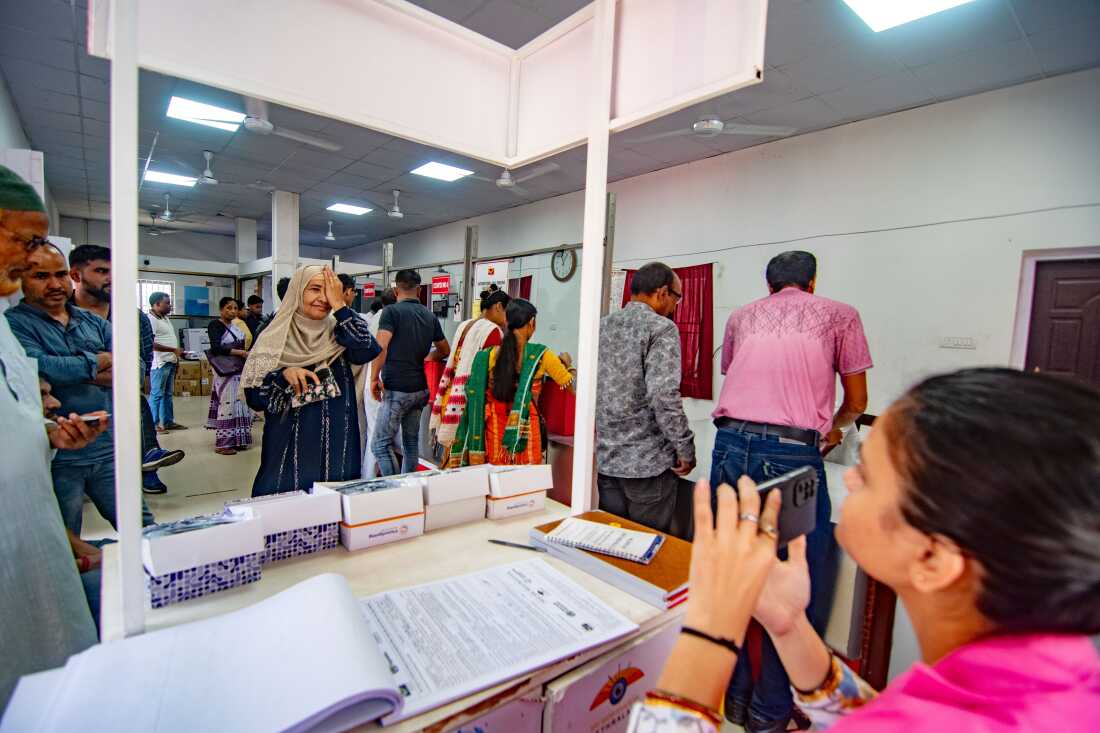
Kalita used to be a school teacher. Now, she spends her days at a red and white kiosk that faces the bright white walls of the post office in Rangia town.
From that vantage point, she keeps track of customers arriving. Some come there for mail packages, while others make use of the variety of services offered at Indian post offices, such as opening and accessing small savings accounts. Kalita notices how they do their work.
“Many old people come in who are not even able to fill out the deposit forms,” she says.
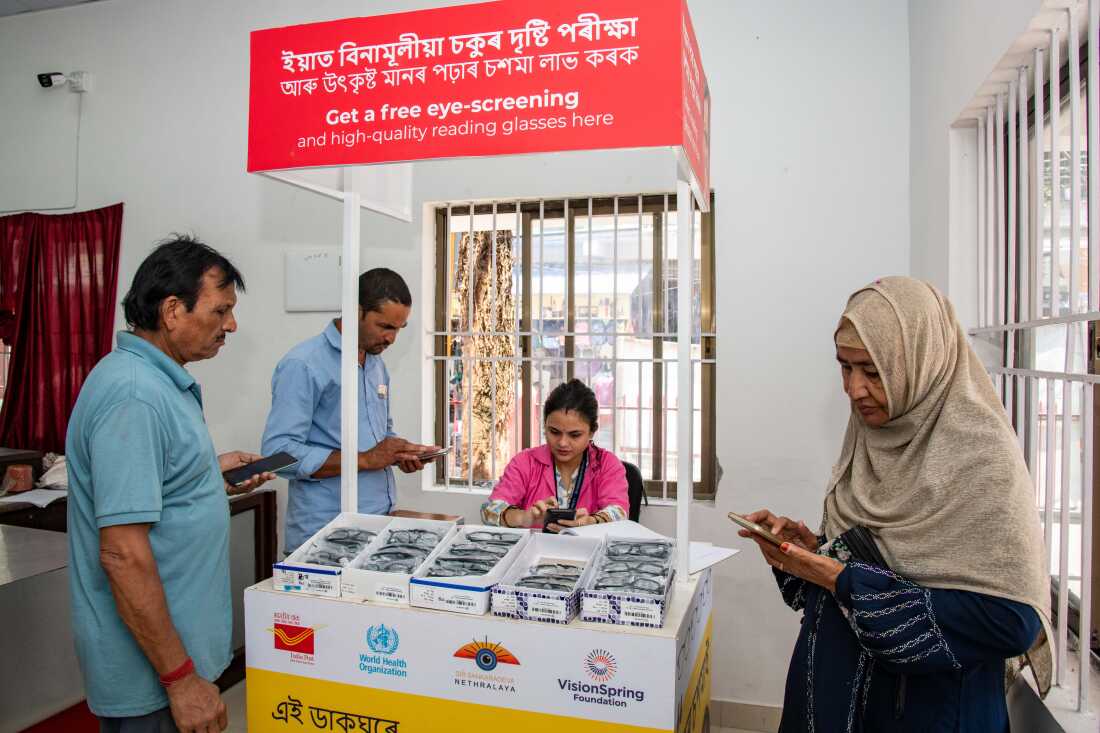
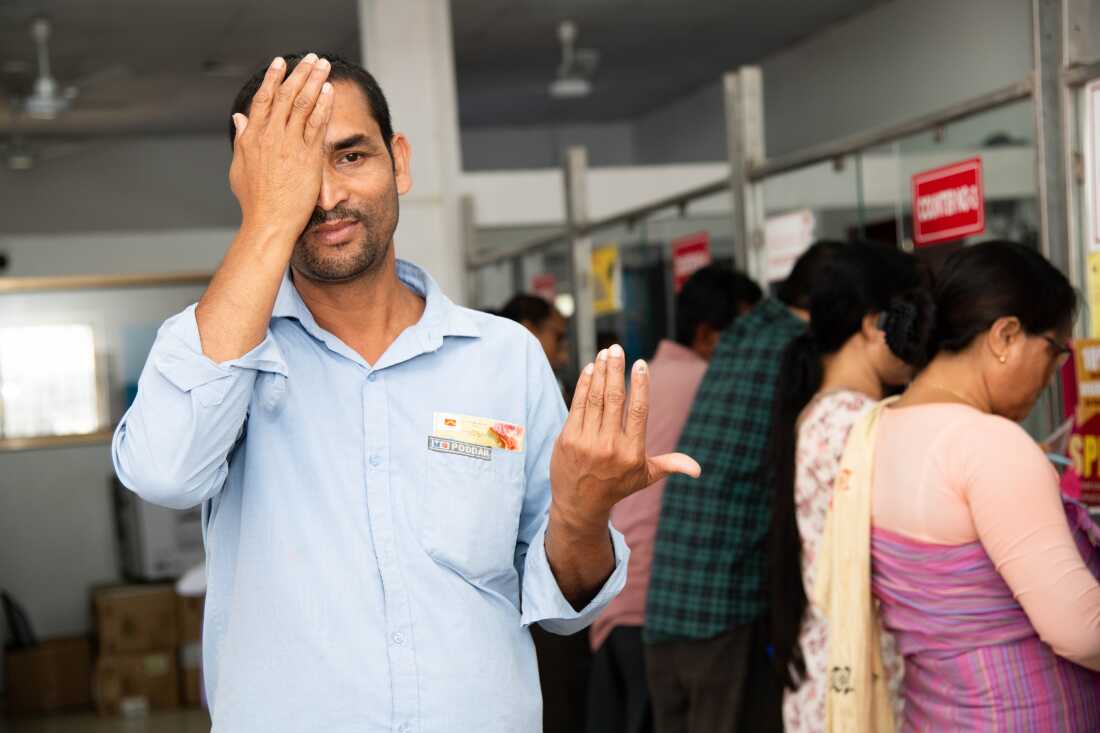
Only when she sees them struggling does she come forward. She comes over and asks if they would like to have a quick eye test. If so, she invites them to a kiosk with the words “Get a free eye exam and high-quality glasses here” written across the top. Kalita can tell if she needs reading glasses after working through some simple tests in the spiral-bound book. And if they do, they walk out with a free pair.
Sangeeta Kalita, an eye check-up volunteer, helps customers at Rangia Post Office.
The idea for this model came from a partnership between the WHO and the Universal Postal Union or UPU. “With an estimated 680,000 post offices in operation globally, postal services offer a unique opportunity to reach remote and underserved areas,” the report states.
The plan was to enter the world’s largest postal network: India Post, which has over 150,000 offices.
“The whole idea was that we focus on an established channel that has reach, that has infrastructure, that has people,” says Shweta Verma, deputy director of programmes and operations. VisionSpring India.
Under a pilot program run by VisionSpring, more than 5,000 people were screened across five post offices in the state of Assam between December 2025 and May 2026, according to Verma.
Verma says that 80% of those who received glasses were first-time wearers. “This evidence tells us that there was no screening or programme for eye health in the area before the pilot,” she says.
convincing the skeptics
In addition to making everyday tasks easier, getting reading glasses can make a big difference to a person’s income. This is especially true in the state of Assam, which is known for tea production.
A study published in Lancet Global Health found that reading glasses increased the productivity of tea pickers by about 22% because they have to see which leaves to pluck and are paid based on the quality of their harvest.
Verma says, during the post office pilot, he had to earn the support of postal employees and postmasters.
Initially, she says, “We got a lot of buy-in from higher-ups,” but postal workers were sceptical and worried about how this new venture would affect their workloads. So Verma’s team hired and trained outsiders, including Kalita, to implement the programme. “Once the programme was launched, there was also a lot of enthusiasm from the postmasters,” Verma says.
Babul is the borough postmaster where Kalita works. Since the pilot project began in December 2025, he says more than 1,000 people have come to his post office for eye tests, and many have started using postal services. He says this boost to his business is enough to give him hope that the pilot will become permanent.
The current pilot is scheduled to end in September. Then, Ella Goodwin, VisionSpring’s CEO, says they will look at all the data and consider funding before deciding whether to continue or expand. WHO and UPU have expressed interest in taking this model worldwide.
beyond vision care
While VisionSpring says the model is a first for eyeglasses, the hope is that the venture shows POs can be used “for a wide range of health-related services around the world,” the WHO and UPU report said.
Dr Elizabeth Rosenthal, a physician and a senior contributing editor to KFF Health News, has written about rebuilding post offices to meet medical needs. She says France and Japan are strong examples where such initiatives are already happening.
In France, for a small fee, letter carriers can check on elderly individuals, she says, “just stopping in and chatting and seeing if there’s food in the house?” Are they able to get around properly?”
Mantu Das, Rangia, conducts vision tests at the post office.
Something similar also happens in Japan. And in some parts of the US, carriers may see a pile of mail and alert a local agency to initiate a welfare check.
She says one thing inspires her at Kalita’s post office in India: the smiles she sees on people’s faces after they deliver their glasses. She says it makes her feel “very accomplished and also happy.”
She says she is thinking of the teacher who no longer has a headache every day. Her mother and mother-in-law can now read holy scriptures. And the tailor never knew that reading glasses could be so life-changing – that getting them could be as easy as swinging by the post office.
Make sure our latest headlines always appear at the top of your Google searches by adding us as a favourite source. Click here to activate. Or add us as your preferred source to your Google Search settings.
Jude Bellingham hit back at boss Thomas Tuchel’s scathing assessment of England’s performance in their 2-1 World Cup quarter-final win over Norway and stressed the positives.
Bellingham was the star of the show with two goals as England overcame a blistering Miami heat from behind, earning his fourth man of the match award in six games.
Tuchel’s side struggled against the Scandinavians, eventually needing extra time to reach their fourth World Cup semi-final, and the German said he was “not happy with the performance.”
The Real Madrid star did not accept it and challenged his manager’s approach.
Jude Bellingham (right) and England manager Thomas Tuchel (Getty)
“Maybe he doesn’t know what it’s like to play against Erling Haaland, Martin Ødegaard, Antonio Nusa, and Alexander Sørloth in those kinds of conditions.
“It’s not an easy team to play against.
“So, I think we’ve tried to create a positive environment.
We should continue to go to the final four. I can’t speak highly enough about the boys.
“You’re not going to win every game by popping the ball and making a thousand passes. Occasionally you have to win dirty, and we did that again tonight.”
Asked if he agreed with Tuchel’s assessment that England were lucky, he replied: “No comment.”
Tuchel responded to Bellingham’s comments and insisted there was no disconnect between him and the players.
“Absolutely, no one disputes that. I’m impressed with the turnaround they’ve put in,” he said, referring to playing in the scorching heat.
“The effort, team spirit, belief and determination to overcome adversity and find ways to win are at an all-time high.”
“In general, I think it wasn’t a high-level game. I think we had better games in general.”
He continued: “We had a lot of momentum swings for both teams, so, yeah, full credit to the team. We found a way. We’re in the last four.
“Of course, that’s the most important thing, but the analytical head of football, the coach in me, still thinks we can play better football and have to play it.”
Tuchel was unsatisfied with England’s performance against Norway. (Reuters)
“My heart, no doubt about it, I’m proud and happy and I feel very connected to this team as they do whatever it takes to take the next step.
There are a lot of things we can do better, which is fine, and I feel completely aligned with my team. I am full of heart and completely in love with my players and my team and with their performance.”
Bellingham tied Harry Kane with six goals for the tournament, almost single-handedly leading his team to a second straight brace.
The 23-year-old said it was beyond his wildest dreams to star on such a big stage, but he is ready to share the accolades.
“Yeah, maybe a little further, to be honest,” he said. “I’m a confident guy, but I don’t think you sleep at night dreaming of games like these.”
“So, it was nice to make an impact and help my team. But my God, the effort those guys put in was incredible.
“I’m very proud of how they keep fighting, regardless of the situations we find ourselves in.
“They can be really proud, and I know they are. And I’ll make sure they feel the same way.”
Make sure our latest headlines always appear at the top of your Google searches by adding us as a favourite source. Click here to activate. Or add us as your preferred source to your Google Search settings.
WASHINGTON — The US launched a new wave of military strikes early on July 12 against Iran after Tehran declared the Strait of Hormuz closed and Iranian forces struck a Cyprus-flagged container ship, sharply escalating tensions in one of the world’s most strategically important waterways.
US Central Command (CENTCOM) said it had begun a third round of strikes this week after Iran’s Islamic Revolutionary Guards Corps (IRGC) attacked the M/V GFS Galaxy while it was transiting the Strait of Hormuz.
“A civilian crew member is missing and the vessel is unable to continue the journey due to an onboard fire and significant engine room damage,” CENTCOM said in a statement.
“The United States is imposing a heavy cost by continuing to degrade Iran’s ability to attack civilian mariners and commercial ships freely transiting the strait,” it added, saying the strikes were being conducted on the orders of President Donald Trump.
US Defence Secretary Pete Hegseth underscored Washington’s message in a post on social media, writing: “Iran made a poor choice. Now they pay.”
A senior US official told reporters that American forces targeted Iranian air surveillance radars, maritime surveillance systems, missile and drone storage facilities, missile and unmanned aerial vehicle launch sites, and surface-to-air missile launchers in an effort to weaken Tehran’s military capabilities.
Iranian state media reported explosions across southern Iran following the strikes. State broadcaster IRIB said three explosions were heard in Bandar Abbas and two in Sirik, while additional blasts were reported on Qeshm Island, all overlooking the Strait of Hormuz.
Iran Closes Waterway, Warns Of Retaliation
The latest US operation followed one of Iran’s most consequential moves in the confrontation with Washington: the closure of the Strait of Hormuz until further notice.
In a statement carried by IRIB, the IRGC navy said several vessels had attempted to transit the strait using what it described as an “unauthorised” or “unapproved route” despite repeated warnings.
“A vessel that had jeopardised maritime security by switching off its systems was struck and brought to a halt,” the IRGC said, without identifying the ship.
The IRGC said it hit one vessel with what it described as a warning shot before stopping it.
“The Strait of Hormuz will be closed until further notice and until the end of the US interventions in this area and no vessel will be allowed to pass,” the statement said.
The IRGC warned that any further military action against Iran would trigger a “severe response” and that additional regional bases could be targeted.
The UK Maritime Trade Operations (UKMTO) separately said it had received a report of an incident nine nautical miles off the coast of Oman.
“Military authorities have reported that a container ship has sustained damage to the rear of the vessel which has caused a fire onboard,” UKMTO said.
The maritime security report matched CENTCOM’s account that the Cyprus-flagged ship suffered significant damage and could not continue its voyage.
Diplomatic Efforts Falter Amid Military Escalation
The military escalation came as diplomatic efforts in Oman appeared to falter.
Iranian Foreign Minister Abbas Araqchi met Omani Foreign Minister Sayyid Badr Albusaidi to discuss mechanisms for ensuring safe navigation through the Strait of Hormuz, according to Tehran.
Earlier, Oman said discussions with Iran would continue at both the technical and political levels to reach agreements consistent with international law regarding navigation through the waterway.
There were no US officials participating in those discussions.
RFE/RL has learned from diplomatic sources that Omani mediators handed proposals to the Iranian delegation aimed at resolving disputes over maritime navigation. Senior officials declined to comment on the substance of the proposals.
According to diplomatic sources familiar with the discussions, Iran left the negotiations saying it would return after reaching a unified internal position on proposals that would have allowed freedom of navigation through Omani waters in the southern part of the strait without tolls.
Shortly afterward, Iran’s national security apparatus responded by firing on a commercial vessel and announcing the closure of the waterway.
In recent months, Trump has promoted what he has called the ‘Southern Highway” — a shipping route that keeps vessels closer to Oman’s coastline and farther from Iranian territorial waters.
Tehran has repeatedly insisted that only its preferred route, running closer to the Iranian coast, is considered safe and has previously been accused of targeting vessels using the Omani route.
War Of Words Raises Risks Of Wider Conflict
The latest confrontation unfolded against an increasingly volatile political backdrop. Iran’s new Supreme Leader, Mojtaba Khamenei, vowed revenge for the killing of his father and predecessor, Ali Khamenei, saying retaliation “must inevitably be carried out”.
“This matter depends neither on my personal existence nor on that of other officials. Whether we are present or not, it will come to pass,” he said, adding that Iran had compiled a list of individuals to be targeted.
Hours earlier, Trump warned that any assassination attempt against him would trigger overwhelming US military retaliation.
“1,000 missiles are locked and loaded and aimed at the Islamic Republic of Iran, with thousands more to immediately follow,” Trump wrote on Truth Social, saying the United States would “completely decimate” Iran if such a threat materialised.
The exchanges follow an interim cease-fire that briefly paused fighting after the war erupted in late February due to large-scale US-Israeli strikes on Iran. Trump has since declared the cease-fire effectively over while saying he remains open to renewed negotiations.
Analysts See Diplomatic Window Narrowing
Analysts said Iran’s decision to close the Strait of Hormuz and attack commercial shipping marked another setback for diplomatic efforts.
“The Iranian regime is proving once again that when the US outstretches a hand in the spirit of diplomacy, it is met with a clenched fist from Tehran,” Jason Brodsky, policy director at United Against Nuclear Iran, told RFE/RL.
“The US will need to escalate to send a message to the Islamic Republic.”
The closure of the Strait of Hormuz, through which roughly one-fifth of global oil supplies typically pass, significantly raises the risk of broader regional instability and could have major consequences for international energy markets if the disruption persists.
With diplomacy struggling to gain traction and both Washington and Tehran hardening their positions, the latest military exchanges underscore the growing danger that the confrontation could expand well beyond the Gulf.