Datele Institutului Național de Statistică (INS) confirmă discrepanțe uriașe în piețele agroalimentare din România, prețul aceleiași sacoșe de legume variind masiv în funcție de județ. Cea mai frapantă diferență raportată recent este la cartofi, care au ajuns să coste de peste 4 ori mai mult în anumite regiuni (de exemplu, 10,33 lei/kg în Bistrița față de doar 2,30 lei/kg în Slatina)
Aceeași sacoșă de legume poate costa cu zeci de lei mai mult, în funcție de orașul în care mergem la piață. Datele INS pentru …
Aberdeen vs Rangers Ends in Dramatic 1-0 Victory for Gers
Aberdeen vs Rangers ended in a hard-fought1-0 victory for Rangers at Pittodrie as Lawrence Shankland’s second-half penalty secured Derek McInnes’ first Scottish Premiership win as Rangers manager.
The match on Sunday, 30 August 2026, was decided in the 69th minute, when Aberdeen defender Daniel Happe brought down Djeidi Gassama inside the penalty area.
Rangers captain Shankland stepped forward and confidently fired the resulting spot-kick into the top corner.
However, the biggest drama was still to come.
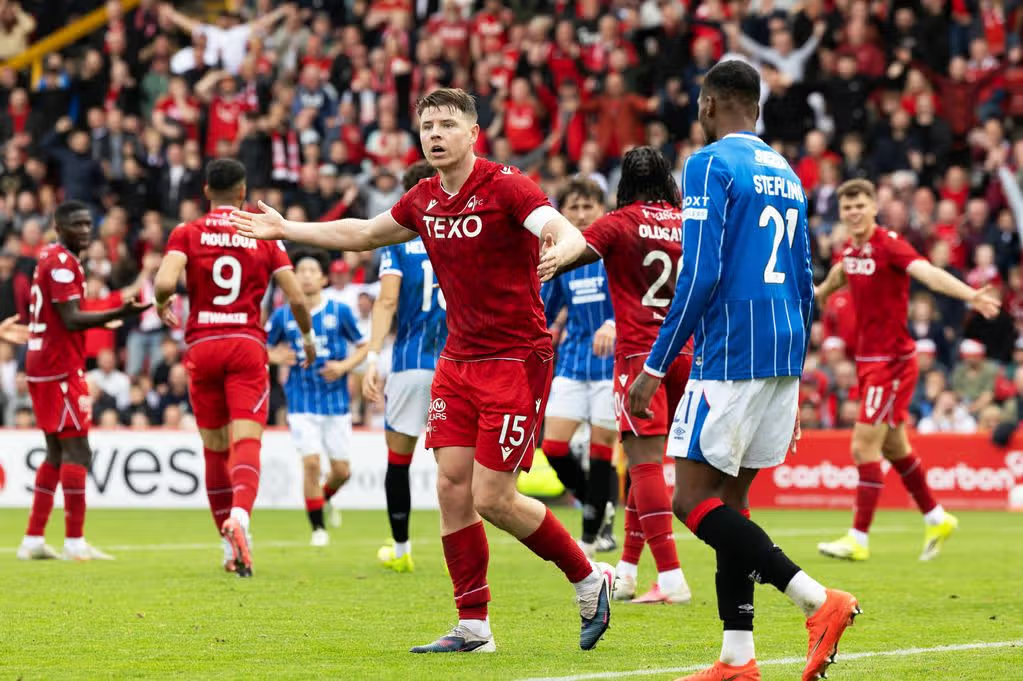
Aberdeen captain Kevin Nisbet appeared to have rescued a late equaliser, sending the Pittodrie crowd into celebration. VAR intervened, though, and referee Matthew MacDermid eventually disallowed the goal after reviewing an incident involving Nisbet and Rangers defender Dujon Sterling.
The decision left Aberdeen frustrated but allowed Rangers to escape with three hugely important points.
For McInnes, the result could hardly have come at a more decisive moment following a difficult opening to the season and Rangers’ disappointing European exit.
Lawrence Shankland celebrates scoring in Aberdeen vs Rangers at Pittodrie.
Shankland Penalty Makes the Difference
The decisive moment arrived midway through the second half.
Gassama received the ball inside Aberdeen’s penalty area and attempted to move beyond Happe.
The Aberdeen defender clipped the Rangers attacker, and the referee awarded a penalty.
There was enormous pressure on Shankland.
Rangers desperately needed a victory and had struggled to find a breakthrough despite enjoying periods of possession.
The captain showed no sign of nerves.
Shankland struck his penalty powerfully into the top corner in the 69th minute, giving goalkeeper Marius Müller little opportunity to stop it.
The goal was particularly notable because Shankland previously played for Aberdeen earlier in his career.
It ultimately proved to be the only goal of the afternoon.
Aberdeen Make Bright Start at Pittodrie
Aberdeen had opportunities to take control before Rangers eventually found their breakthrough.
Dan Happe was presented with an early chance following a Kevin Nisbet delivery, but he could not direct his effort towards goal.
Toyosi Olusanya then created space before finding Mitchy Ntelo approximately 25 yards from goal. Ntelo attempted an ambitious first-time effort, but Rangers goalkeeper Ivor Pandur made a comfortable save.
Nisbet also headed over from a Connor Ronan delivery as Aberdeen tried to take advantage of their energetic opening.
Rangers gradually gained more possession, although Aberdeen initially prevented them from creating many clear opportunities.
The visitors came close to breaking the deadlock in the closing stages of the first half.
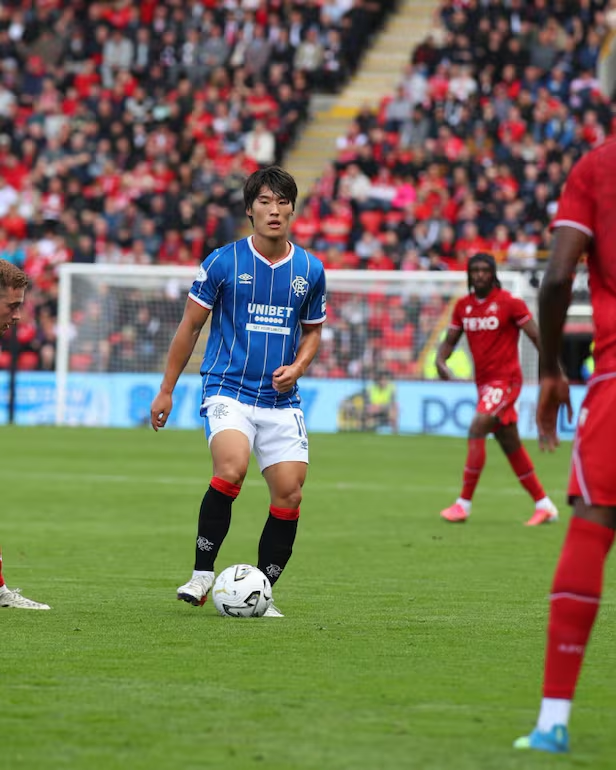
Gassama made an excellent run and then found new signing Kim Min-su inside the penalty area.
Kim’s attempt was deflected, leaving Shankland seemingly presented with an unchallenging finish, but Afeez Aremu produced an important defensive intervention.
Pandur and Müller therefore went into half-time with their clean sheets intact.
Kim Min-su Makes Rangers Debut
One of the biggest talking points before kick-off was the inclusion of Kim Min-su.
The South Korean youngster made his Rangers debut after joining from Girona.
Kim immediately demonstrated why Rangers were interested in bringing him to Scotland.
He looked lively in attacking areas and almost opened the scoring during the first half after Gassama released him.
Kim went even closer after the break.
The youngster unleashed a powerful effort from a Rangers free-kick that appeared destined for the top corner.
Müller reacted brilliantly, producing a full-stretch diving save to prevent Rangers from taking the lead.
Kim was eventually replaced in the 72nd minute, but his performance provided an encouraging glimpse of what he could offer McInnes during the season.
Kim Min-su in action for Rangers against Aberdeen during his debut at Pittodrie.
Aberdeen Denied Penalty After VAR Check
Aberdeen believed they should have been awarded a penalty as they searched for an equaliser.
Lewis Smith delivered a dangerous cross towards the back post, where Nisbet went down while trying to reach the ball.
VAR examined the incident.
However, no penalty was awarded.
The decision became particularly significant because another VAR intervention followed only minutes later – and this time it ruled out what Aberdeen believed was their equalising goal.
Kevin Nisbet Equaliser Ruled Out by VAR
The most controversial moment of Aberdeen vs Rangers arrived late in the second half.
Stuart Armstrong delivered an excellent ball to the back post.
Nisbet rose to meet it and directed a powerful header towards the goal.
Pandur pushed the effort across the goalmouth before Ayoub Mouloua headed the loose ball back towards goal.
The Rangers goalkeeper reacted again to keep it out.
Nisbet followed the play and finally headed the ball into the net from close range.
Pittodrie erupted.
For a moment, Aberdeen appeared to have secured a dramatic equaliser.
But VAR began reviewing the build-up.
Officials examined contact between Nisbet and Sterling before the Aberdeen striker’s initial header.
After the review, the goal was disallowed because Nisbet was judged to have pushed the Rangers defender.
Aberdeen’s celebrations quickly turned into frustration.
The decision proved decisive, as the home side could not create another equaliser before the final whistle.
Stephen Robinson Frustrated by Decisions
Aberdeen manager Stephen Robinson was understandably disappointed after the game.
Robinson believed there was very little separating the two teams and was particularly frustrated by the major refereeing decisions during the second half.
The Aberdeen boss pointed to both Nisbet’s unsuccessful penalty appeal and the later disallowed goal.
Robinson nevertheless acknowledged that his side could have defended the situation leading to Rangers’ penalty better.
For Aberdeen, the result will feel particularly painful because they were only moments away from taking something from the game.
Their performance demonstrated that they could compete with Rangers, but the decisive moments ultimately went against them.
Huge Relief for Derek McInnes
For Rangers manager Derek McInnes, the victory carries significance far beyond three league points.
Rangers entered the game under considerable pressure following a difficult start to the campaign.
Their European performances had been particularly disappointing, and their league campaign had not begun as expected.
McInnes therefore needed a response from his players.
He got one at a ground he knows extremely well.
The Rangers manager previously spent several years in charge of Aberdeen, making his return to Pittodrie with his new club an intriguing subplot.
His Rangers side did not dominate Aberdeen throughout the afternoon, but they showed the resilience required to protect their narrow advantage.
McInnes celebrated with the travelling Rangers supporters after the final whistle.
The victory will not solve every problem at Ibrox, but it gives Rangers something desperately needed: momentum.
Rangers Secure First Premiership Win of the Season
That made Shankland’s penalty considerably more important.
Another draw or defeat would have increased pressure on McInnes and his players.
Instead, Rangers leave Pittodrie with three points and an opportunity to begin rebuilding confidence.
Their performance was far from perfect.
Aberdeen caused problems, Rangers required important saves from Pandur and the visitors benefited from the VAR decision that cancelled Nisbet’s equaliser.
Nevertheless, winning difficult away games is essential for any club hoping to challenge near the top of the Scottish Premiership.
Ivor Pandur Plays Important Role
Although Shankland will receive much of the attention because of his winning goal, goalkeeper Ivor Pandur also deserves credit.
Pandur remained composed throughout the game and produced several important interventions.
His involvement in Aberdeen’s disallowed equaliser was particularly significant.
He first prevented Nisbet’s header from going directly into the net before reacting again when Mouloua attempted to convert the rebound.
Nisbet eventually got the ball beyond him, only for VAR to rescue Rangers by identifying the earlier infringement.
Keeping a clean sheet away at Pittodrie should give Rangers’ defence confidence as they attempt to improve their league form.
Kevin Nisbet reacts after Aberdeen’s equaliser against Rangers is ruled out by VAR.
What Next for Rangers?
Rangers now need to build on the result.
One victory does not erase the concerns created by their difficult start, but winning at Pittodrie provides an important foundation.
McInnes will also be watching developments in the transfer market closely as the window approaches its conclusion.
The Rangers manager has indicated that further business could take place as he continues reshaping his squad.
New arrival Kim’s encouraging debut may provide another reason for optimism.
Most importantly, Rangers finally have their first league victory.
Their next challenge is proving that the performance in Aberdeen can become the beginning of a sustained improvement rather than an isolated result.
Conclusion
Aberdeen vs Rangers delivered exactly the kind of drama expected from a fiercely contested Scottish Premiership encounter.
Lawrence Shankland ultimately became the match-winner, converting a 69th-minute penalty after Gassama was fouled inside the Aberdeen box.
However, Rangers had to survive a dramatic finish.
Kevin Nisbet appeared to have rescued Aberdeen with a late equaliser, only for VAR to intervene and rule out the goal following his challenge on Sterling.
The final whistle confirmed a hugely valuable 1-0 Rangers victory.
For Aberdeen, there will be frustration over the decisions that shaped the second half.
For Rangers, however, the bigger story is finally securing their first Premiership win of the seasonand giving Derek McInnes some much-needed breathing space.
Whether this proves to be the turning point in Rangers’ season remains to be seen, but after a difficult start to the campaign, three points at Pittodrie could hardly have arrived at a better time
The Nepal floods have triggered a huge search-and-rescue operation as emergency teams race to find thousands of people still missing following catastrophic flash flooding across the Himalayan border region.
The disaster struck on Wednesday, 26 August, sending an enormous surge of water, mud, ice and rock through river valleys and communities in Nepal and neighbouring Tibet.
By Saturday, the confirmed death toll had reached 676 across Nepal and Tibet, according to AP reporting, including 669 deaths in Nepal and seven reported by Chinese authorities in Tibet. Nearly 3,000 people remained missing across the affected region.
The numbers have changed repeatedly as rescuers reach previously inaccessible areas, so the final scale of the disaster may remain unknown for some time.
More than 3,700 people had been rescued in Nepal by Saturday, while helicopters continued carrying survivors from isolated communities and delivering food and other emergency supplies.
Nepal’s government says locating those who remain unaccounted for is now a national priority.
Rescue workers search flood-damaged areas after the deadly Nepal floods in August 2026.
What Happened in the Nepal Floods?
The catastrophe began high in the Himalayas near the Nepal-Tibet border.
Scientists examining the disaster say a huge collapse involving rock and glacier ice sent material crashing down the mountain and into the river system below.
The resulting surge travelled through valleys with extraordinary force, carrying water, rocks, ice, trees and other debris.
In some locations, the disaster overwhelmed settlements and infrastructure before residents had much opportunity to escape.
The Trishuli River rose dramatically, while communities across Rasuwa, Nuwakot and Dhading were among those badly affected.
The US Geological Survey initially examined whether an earthquake had triggered the disaster. Subsequent analysis indicated that the seismic signal detected at the time was generated by the enormous landslide itself rather than an earthquake causing the collapse.
The disaster damaged or destroyed roads, bridges, homes and hydropower infrastructure.
Death Toll Continues to Rise
Establishing an accurate death toll has been particularly difficult.
Figures increased sharply as rescuers recovered bodies from mud, debris and rivers and gained access to previously isolated communities.
By Saturday, AP reported 669 confirmed deaths in Nepal, while Chinese authorities reported seven deaths in Tibet.
Nepal’s Foreign Ministry had reported earlier on Saturday that 626 bodies had been recovered and approximately 2,400 people were still unaccounted for, demonstrating how quickly the situation was changing.
That is an important point for anyone following the Nepal floods: casualty figures should be treated as provisional while rescue and recovery operations continue.
Some victims may also have been swept considerable distances downstream, further complicating identification and recovery.
Nearly 3,000 People Remain Missing
Perhaps the greatest concern is the enormous number of people who remain unaccounted for.
By Saturday, authorities had reported nearly 3,000 people missing across Nepal and Tibet.
The missing include local residents, hydropower employees, tourists, foreign workers and pilgrims.
Hundreds of foreigners were in the region when the disaster occurred, partly because routes through the area are used by people travelling towards Mount Kailash, which is considered sacred by Hindus, Buddhists and followers of other religions.
Families are now desperately searching for information.
At hospitals and relief centres, relatives have gathered around lists containing the names of people reported missing, rescued, injured or dead.
In Kathmandu, families have placed photographs and details of missing relatives around hospital areas as they search for any information about loved ones.
Dramatic Rescue From Hydropower Tunnels
One of the most difficult parts of the rescue operation has involved workers trapped inside hydropower tunnels.
Floodwater and huge quantities of mud and debris struck several energy projects along the river corridor.
There was some remarkable positive news on Saturday when the Nepali Army reported rescuing 208 people alive from the Trishuli-III Hydropower tunnel, including 43 foreign nationals.
The authorities have deployed thousands of military personnel across the affected districts.
Other tunnel sites remain a major focus for rescuers, and specialist teams and equipment are arriving to determine whether people remain trapped underground.
Difficult Terrain Makes Rescue Operation Dangerous
The geography of Nepal makes disaster response particularly challenging.
Many affected communities sit between steep mountains, narrow valleys and fast-flowing rivers.
Roads have been buried under mud or washed away completely.
Bridges have been damaged, while landslides and enormous boulders block access to some communities.
That means helicopters have become essential.
Poor weather, however, has repeatedly complicated aerial operations.
Helicopters were temporarily prevented from flying in parts of Nuwakot on Saturday before conditions improved enough for operations to resume. Aircraft have subsequently carried survivors out and transported rice, noodles, clothes and other emergency supplies into affected areas.
Emergency workers evacuate a survivor following catastrophic flooding in Nepal.
Thousands of Soldiers and Emergency Workers Deployed
Nepal has mobilised a large number of personnel in response to the catastrophe.
The Nepali Army said more than 7,000 military personnel were involved in operations across Rasuwa, Nuwakot and Dhading, working on searches, rescues, emergency medical treatment and recovery of victims.
The government has also been coordinating police, disaster-response agencies, medical personnel and private helicopter operators.
Prime Minister Balendra Shah said that 16 army and private-sector helicopters were conducting shuttle flights between affected locations.
International assistance is also arriving.
India has supplied substantial quantities of relief materials, while assistance has also come from China and several other countries. In particular, Nepal has sought specialist expertise for difficult operations, such as tunnel rescues and technology capable of locating survivors.
Authorities have also been watching a newly formed lake high in the mountains.
The original collapse changed the landscape dramatically and created a body of water held back by unstable debris.
Concerns that this natural barrier could fail forced rescue workers in some locations to temporarily move away from dangerous areas.
The situation later improved enough for operations to resume, while monitoring indicated the lake’s water level was falling.
Nevertheless, authorities continue to monitor the area closely.
Another sudden release of water could put survivors and rescue teams at serious risk.
More Than 90,000 People May Be Affected
The humanitarian impact extends far beyond those killed or missing.
The Red Cross estimates that the disaster may have affected around 90,000 people or more.
The disaster has destroyed homes, displaced families and damaged vital infrastructure.
Some survivors escaped with little more than the clothes they were wearing.
Communities now require drinking water, food, temporary shelter, medical assistance and sanitation facilities.
Damage to healthcare facilities also raises longer-term concerns about access to treatment and the possibility of disease spreading among displaced populations.
Once the immediate rescue phase ends, Nepal will face the enormous challenge of rebuilding roads, bridges, homes, electricity networks and damaged public services.
Climate Change Raises Questions About Himalayan Glaciers
The disaster has also renewed concern about the vulnerability of Himalayan communities to climate change.
The Hindu Kush-Himalayan region is warming rapidly, contributing to major changes in glaciers, snow cover, permafrost and mountain stability.
Scientists caution that warming can create interconnected hazards. Retreating glaciers can create unstable lakes, while changes in ice and permafrost can destabilise steep mountain slopes.
Reuters reported that Nepal has lost nearly a third of its glacier ice during the past three decades.
It would be premature to attribute every individual element of this disaster solely to climate change. However, scientists have repeatedly warned that warming is increasing instability across high-altitude environments.
Nepal’s foreign minister has also warned that the catastrophe demonstrates the growing climate threat facing the Himalayan region.
Families Wait for News of Missing Loved Ones
Behind the enormous casualty figures are thousands of families waiting for answers.
Some are searching hospitals. Others are checking lists at military camps and relief centres.
Many still do not know whether missing relatives escaped, remain trapped in inaccessible areas or were swept away by the flood.
That uncertainty is one of the most painful consequences of the catastrophe.
Even four days after the disaster, rescuers were continuing to find survivors, providing families with some reason to maintain hope.
But with such a large number of people still missing, officials have warned that the death toll could rise further as teams reach areas previously inaccessible because of damaged roads, deep mud and unstable terrain.
Emergency workers evacuate a survivor following catastrophic flooding in Nepal.
What Happens Next?
The immediate priority remains finding survivors.
Search teams will continue working through destroyed settlements, riverbanks, hydropower facilities and areas buried beneath mud and debris.
Specialist tunnel-rescue teams are particularly important because workers may have survived underground in spaces protected from the initial flood.
At the same time, humanitarian agencies must provide food, water, shelter and healthcare to displaced communities.
The longer-term challenge will be enormous.
Nepal will need to rebuild critical infrastructure and examine how to better protect communities vulnerable to glacial floods, landslides and other Himalayan hazards.
Conclusion
The Nepal floods have become one of the country’s most devastating natural disasters in recent years.
By Saturday, authorities had reported 669 deaths in Nepal and seven in Tibet, while nearly 3,000 people remained missing across the border region. Thousands have nevertheless been brought to safety, including people rescued from flooded and mud-blocked hydropower tunnels.
Rescue workers are now under intense pressure.
Difficult terrain, damaged infrastructure, poor weather and the continuing possibility of further flooding are making their work extraordinarily challenging.
For thousands of families waiting for news, every successful rescue provides a reason to keep hoping while Nepal continues one of the largest search-and-rescue operations in its recent history
The Kanter-Natasha Cloud clash has become one of the WNBA’s biggest off-court talking points after former NBA player Enes Kanter Freedom was removed from a Chicago Sky game following a heated courtside confrontation with guard Natasha Cloud.
The incident happened on Sunday, August 23, 2026, during the Chicago Sky’s home game against the Indiana Fever at Wintrust Arena.
Kanter Freedom was sitting close to the baseline, wearing a black T-shirt that read “WOMAN noun. adult human female.” The shirt reflected his opposition to transgender women participating in women’s sports and was part of his broader public campaign around the issue.
Late in the third quarter, Cloud approached the area where Kanter Freedom was sitting and the two became involved in a heated verbal exchange. Security and Sky players intervened, and Kanter Freedom was subsequently escorted from the arena.
The controversy has continued well beyond the game. The Chicago Sky have since banned Kanter Freedom from future home games, while Cloud has publicly addressed the incident and strongly defended the transgender and LGBTQ+ communities.
Enes Kanter Freedom and Natasha Cloud confront each other during Chicago Sky vs Indiana Fever
What happened between Enes Kanter Freedom and Natasha Cloud?
Cloud had just scored before celebrating with teammate Aicha Coulibaly. She then turned towards Kanter Freedom, who was sitting along the baseline.
Cloud approached him while yelling and pointing. Kanter Freedom stood and responded, and video showed him taking a step onto the court while holding out his arms as security personnel and Chicago players moved between them.
The exchange did not develop into a physical fight, but Kanter Freedom was removed from his courtside seat and escorted away.
As he was leaving, he continued drawing attention to the message on his shirt.
Kanter Freedom later disputed the circumstances surrounding his removal and requested a review of the incident from the WNBA, as well as a refund for his ticket.
The disagreement therefore quickly expanded from a brief courtside confrontation into a much larger argument about political expression, spectator behaviour, player safety and transgender participation in women’s sports.
What Did Enes Kanter Freedom’s Protest Shirt Say?
At the centre of the controversy was Kanter Freedom’s black shirt, which bore the message:
“WOMAN noun. adult human female.”
The former NBA centre has increasingly spoken about sex and gender eligibility in women’s sports, arguing that female sporting categories should be protected on the basis of biological sex.
His critics see his recent actions differently. They argue that the campaign is deliberately provocative and targets transgender people rather than encouraging a serious discussion about sporting rules.
That disagreement is important when understanding the reaction to the shirt.
To Kanter Freedom and his supporters, it represented a statement about protecting women’s sport. To many critics, it was a political message aimed at transgender inclusion.
Those competing interpretations have fuelled much of the debate since the incident.
Why Was Enes Kanter Freedom Ejected?
There has been considerable argument online over whether Kanter Freedom was removed because of his shirt.
However, the Chicago Sky’s explanation focused more broadly on his conduct.
Sky owner Michael Alter said the organisation believed Kanter Freedom had attended the game intending to be provocative and attract attention. Alter subsequently described him as a potential threat unless he could demonstrate that he would follow the organisation’s rules.
Kanter Freedom has challenged that interpretation and portrayed his removal as a response to his advocacy for women’s sports.
The distinction matters.
There is a difference between removing someone solely because of a political message on clothing and removing a spectator because officials believe their behaviour has crossed a line.
The two sides clearly disagree on how the incident should be characterised.
Chicago Sky Ban Kanter Freedom From Future Home Games
The Chicago Sky banned Kanter Freedom from their home games, marking a significant development in the story.
Alter announced the decision two days after the confrontation.
The owner said Kanter Freedom would not be permitted to attend Sky games at Wintrust Arena unless, at some point in the future, he could satisfy the organisation that he would follow its rules without being considered a potential threat.
The decision transformed what could have been a short-lived courtside argument into a continuing dispute between the former NBA player and the WNBA franchise.
Cloud has welcomed the organisation’s response, saying she appreciated the Sky protecting its players.
What Has Natasha Cloud Said About Enes Kanter Freedom?
Cloud initially responded to the controversy by expressing solidarity with transgender people.
On August 29, she addressed the issue publicly in greater detail while preparing for Chicago’s game against the New York Liberty.
Cloud said she would not continue to spend time discussing someone she considered “irrelevant.”
Instead, she sought to redirect attention towards issues she believes represent more serious threats to women and children, highlighting domestic violence, sexual assault and food insecurity.
She also reaffirmed her support for transgender people and the wider LGBTQ+ community.
Cloud’s response illustrates why theKanter-Natasha Cloud clash has developed into something larger than a disagreement between a former NBA player and a current WNBA star.
The two are approaching the broader question of protecting women from fundamentally different perspectives.
Chicago Sky guard Natasha Cloud during the 2026 WNBA season.
Why Has Transgender Participation Become Part of the Story?
Kanter Freedom has been publicly challenging the WNBA over transgender eligibility.
He and former NBA player Royce White announced their intention to enter the 2027 WNBA Draft, saying they identify as women. The moves have been widely characterised by critics as political stunts designed to challenge how eligibility rules are defined.
It is worth adding an important piece of context: the WNBA currently has no known transgender players. Reuters reported that the league also does not have a publicly stated policy specifically setting out transgender participation rules.
That means the highly charged public debate should not give readers the misleading impression that the league currently has a large number of transgender athletes competing.
The controversy is primarily about what the rules should be if such an eligibility question arises.
Debate Over Fairness and Inclusion in Women’s Sports
The dispute touches on a much broader and difficult sporting question.
Those who favour sex-based eligibility rules argue that physiological differences resulting from male puberty can create competitive advantages and that women’s sporting categories exist specifically to preserve fair competition.
Supporters of transgender inclusion argue that blanket exclusion can unfairly marginalise transgender athletes and that sporting organisations should develop evidence-based policies that balance fairness, inclusion and individual circumstances.
Different sports organisations have adopted different approaches, often considering factors including puberty, hormone exposure, competitive advantage and the particular physical demands of each sport.
Because these issues involve both sporting fairness and people’s identities, discussions can quickly become politically and emotionally charged.
The Kanter-Natasha Cloud clash demonstrates exactly how rapidly that wider culture debate can spill directly into professional sport.
WNBA Players Push Back Against Kanter Freedom
Cloud is not the only WNBA player to have criticised Kanter Freedom’s recent actions.
Los Angeles Sparks star Cameron Brink strongly criticised his campaign and argued that his declaration for the WNBA Draft targeted the transgender community rather than contributed constructively to the discussion.
The controversy has therefore created a wider argument about who should shape conversations concerning women’s professional basketball.
Some critics of the league believe questions surrounding sex-based eligibility deserve serious discussion regardless of whether a transgender athlete is currently playing in the WNBA.
Others argue that the league is being dragged into a political battle surrounding a hypothetical issue while more immediate concerns affecting players and women generally receive less attention.
Cloud clearly belongs to the latter camp.
Free Expression Versus Arena Rules
Another important part of the controversy concerns the difference between free expression and rules governing spectators at private sporting venues.
Fans regularly wear clothing expressing political, social and cultural opinions at sporting events.
However, professional teams and arenas also have rules intended to prevent disruption, protect players and ensure games can continue safely.
Kanter Freedom argues that he was expressing a legitimate opinion about women’s sports.
The Sky, meanwhile, has focused on his behaviour and what it viewed as an intentionally provocative presence.
That distinction will probably remain central to arguments about whether his ejection and subsequent ban were justified.
Chicago Sky guard Natasha Cloud during the 2026 WNBA season
Why the Kanter Natasha Cloud Clash Matters
This story has attracted so much attention because it sits at the intersection of several major debates: women’s sport, transgender inclusion, freedom of expression, political protest and athlete safety.
It also demonstrates how professional sporting events increasingly become arenas for wider cultural disagreements.
Kanter Freedom believes he is drawing attention to fairness in women’s competition.
Cloud believes the focus on transgender participation distracts from much more immediate problems facing women and vulnerable communities.
The Chicago Sky, meanwhile, say their priority is to protect players and maintain appropriate behaviour at their games.
Those sharply different interpretations explain why a confrontation lasting only a matter of moments has generated days of national discussion.
Conclusion
TheKanter-Natasha Cloud clash began with a protest shirt and a heated courtside exchange, but it has developed into a much broader WNBA controversy.
Enes Kanter Freedom attended the Chicago Sky-Indiana Fever game wearing a shirt that defined a woman as an “adult human female.” Security removed Enes Kanter Freedom from the arena after he argued with Natasha Cloud and moved to the edge of the court. The Sky subsequently banned him from future home games.
Cloud has now made clear that she does not want Kanter Freedom to dominate the conversation. Instead, she has redirected attention towards domestic violence, sexual assault, food insecurity and her support for transgender and LGBTQ+ people.
The debate is unlikely to disappear quickly. At its heart are difficult questions about fairness and inclusion in women’s sports, but also questions about how those disagreements should be expressed inside professional sporting venues.
For the WNBA, the challenge will be keeping the focus on basketball while navigating a cultural and political debate that has quite literally reached courtside.
The Andy Burnham snap general election speculation has been firmly addressed by the prime minister, who has ruled out calling an early nationwide vote as his government concentrates on Britain’s difficult economic outlook.
Burnham made his position clear during a visit to Kyiv, saying his priority is to provide stability rather than send voters back to the polls months after another significant period of political change.
The decision is politically important because speculation about an early election had followed Burnham for months. Before entering Downing Street, reports suggested that he might consider seeking his own electoral mandate if he became prime minister.
He has now rejected that approach.
Instead, Burnham appears determined to use Labour’s existing parliamentary mandate while concentrating on the economy, public services and the cost of living.
The decision also comes at a sensitive moment for the government. ChancellorJohn Healey is preparing an autumn budget for 28 October, while ministers are facing difficult choices over taxation, public spending and Britain’s fiscal position.
For Burnham, calling an election would add another layer of political uncertainty at precisely the moment when his government wants to project economic stability.
Andy Burnham Rules Out Snap General Election
Why Was There Speculation About a Snap Election?
The possibility of an early election had a clear origin.
Before Burnham became prime minister, reports suggested that people close to him had considered whether a general election could provide a new government under his leadership with a direct mandate from voters.
That argument has an obvious political logic.
When a new prime minister enters Downing Street between scheduled general elections, opponents sometimes argue that the new leader should seek approval from the electorate.
However, Britain’s parliamentary system does not require a prime minister to call an election simply because the governing party changes leader.
A government derives its ability to govern from the confidence it commands in the House of Commons.
Burnham therefore has no constitutional requirement to immediately seek another national vote.
The political question was whether he might choose to do so anyway.
His latest comments indicate that he will not.
Burnham Had Already Signalled Opposition to an Early Election
Burnham’s current position is consistent with comments he made earlier in the summer.
During his rise back into Westminster politics, he faced questions about whether becoming prime minister would lead to another election.
He dismissed the idea and joked about the amount of campaigning voters had already experienced.
That was significant because earlier reporting had suggested an election was being considered.
By early June, however, Burnham was publicly distancing himself from the idea.
His latest comments from Kyiv remove much of the remaining uncertainty.
Unless circumstances change dramatically, Britain’s next general election therefore appears unlikely to be triggered simply because Burnham has taken over as prime minister.
Why Burnham Wants Political Stability
The word running through Burnham’s argument is stability.
Britain has experienced considerable political and economic turbulence in recent years.
Changes of government leadership, inflation, higher borrowing costs, international conflicts and pressure on household finances have all contributed to uncertainty.
Burnham’s government now wants to demonstrate that it can provide a more predictable political environment.
That matters domestically.
It also matters to financial markets.
Investors generally dislike uncertainty because businesses and financial institutions make long-term decisions based partly on expectations about taxation, regulation, government borrowing and interest rates.
A surprise general election could introduce uncertainty across all of those areas.
Burnham appears unwilling to take that risk.
UK Economy Is Central to Burnham’s Decision
The prime minister’s remarks about an election cannot be separated from Britain’s economic position.
Burnham has acknowledged that the country faces a challenging financial outlook.
The government must balance several competing pressures.
Households continue to struggle with living expenses.
Public services require substantial investment.
Defence spending is becoming increasingly important due to international instability.
At the same time, government borrowing and debt restrict how much additional money ministers can spend without raising taxes or finding savings elsewhere.
Burnham, therefore, enters his first major budget period with limited room for manoeuvre.
Calling an election would not solve those problems.
It could make them harder to manage.
October Budget Becomes Burnham’s Biggest Domestic Test
The next major event is therefore not an election.
It is the October budget.
Chancellor John Healey is expected to present the government’s fiscal plans on 28 October 2026.
The budget will provide the clearest indication yet of how Burnham intends to translate his political promises into economic policy.
Several difficult questions are already emerging.
How will the government support households struggling with living expenses?
Can public services receive additional funding without significantly increasing borrowing?
Where will the money come from for higher defence spending?
And can Burnham deliver his domestic agenda while remaining within the government’s fiscal rules?
These questions are likely to dominate Westminster over the coming weeks.
Andy Burnham Rules Out Snap General Election
Burnham Promises Not to Raise Three Major Taxes
One important constraint comes from Labour’s existing tax commitments.
That commitment protects three of the government’s most politically sensitive taxes.
But it also significantly reduces the chancellor’s options if additional revenue is required.
The Treasury could potentially look elsewhere.
Business taxes, property taxation, capital taxes or changes to allowances and thresholds could all attract attention when ministers search for additional revenue.
However, every option comes with economic and political consequences.
That explains why the upcoming budget could prove considerably more difficult than the decision over whether to hold an election.
Burnham Says Government Must Avoid Market Instability
Burnham has also emphasised that his government will not pursue policies that unnecessarily increase borrowing costs or destabilise financial markets.
That message is particularly significant given Britain’s recent political history.
Governments can announce ambitious spending or tax programmes, but financial markets ultimately assess whether those plans are credible.
If investors become concerned about government borrowing, gilt yields can rise.
That can increase the government’s debt-servicing costs.
Higher market interest rates can also eventually affect mortgages and business borrowing.
Burnham therefore faces a delicate balancing act.
He wants to demonstrate that his government represents political change while simultaneously convincing financial markets that economic policy will remain disciplined.
Cost of Living Remains a Major Challenge
For voters, however, the most immediate issue is not government bond markets.
It is household finances.
Energy bills, food prices, housing costs and other essential expenses remain major concerns for millions of families.
Inflation has also recently moved higher, adding another complication to the government’s economic strategy.
Burnham has made clear that he wants to provide additional support where possible.
His government has already pursued measures aimed at easing household costs, including intervention on energy bills.
But additional support costs money.
That creates the central tension facing the government.
Burnham wants to improve household finances without making Britain’s wider fiscal position less stable.
Labour’s Poll Position Adds Another Dimension
There is also an interesting political calculation behind the decision not to hold an early election.
Recent polling suggests the British political landscape remains extremely competitive.
A YouGov Westminster voting-intention poll conducted on16–17 August placed Reform UK on 24%, Labour on 22%, the Conservatives on 19%, the Greens on 13% and the Liberal Democrats on 12%.
Individual polls should never be treated as predictions of an election result, particularly under Britain’s constituency-based electoral system.
However, those figures demonstrate why an early election would carry substantial uncertainty.
Even if a new prime minister sees a brief rise in popularity, turning personal approval into parliamentary seats is a different challenge.
Burnham has apparently decided there is little reason to take that risk.
Burnham’s Personal Ratings Have Improved
The prime minister nevertheless enters this period with encouraging personal polling.
YouGov’s August favourability research found that Burnham’s net favourability rating was unusually strong by recent prime-ministerial standards.
That has contributed to the discussion of a so-called “Burnham bounce.”
New leaders often receive an initial polling lift because voters reassess the governing party through a different personality and political style.
The important question is whether that improvement lasts.
Governments are eventually judged less on the novelty of a new leader and more on measurable outcomes.
Economic growth, wages, public services, taxation and living standards will ultimately determine whether Burnham can convert early goodwill into lasting political support.
Why Calling an Election Could Have Been Tempting
There would have been arguments for seeking an early mandate.
Burnham could have presented an election as an opportunity for voters to endorse his programme directly.
A victory would potentially have strengthened his authority inside Labour and given him greater freedom to pursue reforms.
It could also have allowed him to distinguish his government more clearly from the administration he inherited.
But the potential downside is enormous.
Elections are unpredictable.
A prime minister who already commands a workable parliamentary position has little guarantee that an early election would improve it.
Burnham appears to have concluded that governing effectively is a better route to strengthening his position.
Andy Burnham Rules Out Snap General Election
What Happens to Labour’s Existing Mandate?
Nothing automatically changes because Labour has changed prime minister.
The government continues to operate on the parliamentary mandate obtained at the previous general election.
This is entirely normal within Britain’s constitutional system.
The UK elects Members of Parliament rather than directly electing a prime minister.
The leader who commands the confidence of the Commons forms the government.
Britain has repeatedly changed prime ministers between general elections.
That does not mean arguments about democratic legitimacy disappear.
Opposition parties can still politically argue that Burnham should seek a personal mandate.
But constitutionally, he is not required to do so.
Electoral Reform Could Become a Bigger Issue
Although Burnham has ruled out an immediate election, questions about how Britain conducts future elections are becoming increasingly important.
Nearly 100 Labour MPs have backed calls for a commission examining alternatives to the first-past-the-post electoral system.
Burnham himself has previously expressed support for proportional representation.
However, his government has so far stopped short of immediately committing to changing the Westminster voting system.
That creates an intriguing political dilemma.
Electoral reform supporters argue that the current system can produce parliamentary majorities that do not closely reflect the national share of votes.
Opponents argue that first past the post creates clearer constituency representation and can produce more stable governments.
Burnham has indicated that major reform should be considered through the manifesto process rather than rushed through immediately.
House of Lords Reform Also Remains on the Agenda
Electoral reform is not the only constitutional question facing the government.
Burnham has previously advocated significant changes to the House of Lords.
He has argued that Britain’s second chamber should become more representative of the country’s nations and regions.
One proposal associated with his thinking involves creating a Senate of Regions and Nations, potentially giving greater representation to different parts of the UK.
That fits with Burnham’s long-standing support for devolution.
His years as Greater Manchester mayor shaped his argument that too much political and economic power is concentrated in Westminster.
The question now is how much of that philosophy he can implement from Downing Street.
Burnham Faces Pressure From Across Labour
Ruling out an election does not remove Burnham’s political challenges.
Labour contains MPs with very different views on taxation, welfare, public ownership, electoral reform, defence and immigration.
Some want the new prime minister to move rapidly away from policies associated with the previous government.
Others worry that dramatic changes could damage business confidence or increase government borrowing.
Burnham therefore needs to balance competing factions while maintaining parliamentary discipline.
That task could become increasingly difficult as the October budget approaches.
Money has a habit of turning political disagreements into very real choices.
Business Community Watching the Government Closely
British businesses are also paying close attention.
Companies want clarity over taxes, employment regulation, energy costs and government investment.
Burnham has attempted to reassure business leaders that his economic philosophy supports wealth creation.
At the same time, he has argued that economic growth should produce wider benefits for communities rather than simply increasing corporate profits.
That approach represents an important part of his political identity.
He describes the objective as creating “beneficial growth”—economic expansion that improves wages, communities and public services.
The challenge is designing policies that achieve those goals without discouraging investment.
International Crises Add Pressure
Domestic economic problems are not occurring in isolation.
The international security environment remains volatile.
Conflict involving Iran has created uncertainty in global energy markets, while the continuing war in Ukraine and Russia places additional pressure on European defence budgets.
Burnham’s visit to Kyiv demonstrates how quickly foreign policy has become central to his premiership.
Britain continues to provide significant support to Ukraine, including growing cooperation in defence technology and artificial intelligence.
Those commitments cost money.
Higher defence expenditure therefore competes with domestic priorities for limited government resources.
That makes the upcoming budget even more consequential.
When Will the Next UK General Election Take Place?
Burnham’s refusal to call a snap election means voters should not expect an immediate national contest.
The precise timing of the next election remains a political decision within the limits established by UK law.
Unless someone eventually calls an early election, the government can continue governing through the existing parliamentary term.
Burnham’s current position strongly suggests he intends to do exactly that.
Of course, politics can change quickly.
Economic crises, parliamentary difficulties or unexpected political events can alter calculations.
But based on the prime minister’s latest comments, an early election is not part of the government’s current plan.
What Burnham Needs to Deliver Before the Next Election
Ruling out an early election buys the government time.
It does not guarantee political success.
Burnham now needs to demonstrate that his administration can deliver improvements voters actually notice.
That means economic growth that translates into higher living standards.
It means reducing pressure on household budgets.
It means improving public services.
It means managing immigration and welfare debates.
And it means maintaining confidence in Britain’s finances while dealing with international security pressures.
These are considerably harder tasks than winning headlines during the first weeks of a premiership.
The government’s electoral prospects will ultimately depend on whether voters believe their lives have improved.
Why the Decision Matters
The decision to rule out a snap election tells us something important about Burnham’s early strategy in Downing Street.
He appears to believe stability is more valuable than attempting to capitalise on political momentum.
That approach reduces one immediate source of uncertainty.
But it also removes an escape route.
Without an early election, Burnham must govern using the parliamentary position he inherited and accept responsibility for the economic and political circumstances facing Britain.
The October budget, therefore, becomes the next major test.
It will reveal far more about Burnham’s premiership than speculation about an election ever could.
The prime minister has ruled out calling an early election and instead emphasised the importance of economic and political stability.
That decision comes as Britain faces a difficult financial environment, with higher inflation, substantial government debt, pressure on household finances and growing demands for public spending.
Burnham and Chancellor John Healey must now prepare for the 28 October budget, which is likely to become the first defining domestic event of the new government.
Burnham has reiterated Labour’s commitment not to increase the main rates of income tax, employee National Insurance or VAT, while also promising to maintain confidence in Britain’s finances.
Those commitments leave the government with difficult choices.
For now, voters will not be asked to make another immediate choice at the ballot box.
Instead, Burnham is betting that governing first—and asking voters for judgement later—is the stronger route.
Whether that strategy succeeds will depend less on election timing than on what happens to living standards, public services, economic growth and household financesduring the months ahead.
Frequently Asked Questions
Has Andy Burnham ruled out a snap general election?
Yes. Burnham has said he will not call an early general election and has stressed the need for political and economic stability.
Why was a snap election being discussed?
Reports before Burnham became prime minister suggested that an early election could be considered as a way to secure a direct electoral mandate for his government. Burnham subsequently rejected that approach.
When is the next UK budget?
Chancellor John Healey is preparing the government’s autumn budget for 28 October 2026.
Will Burnham raise income tax?
Burnham has reiterated Labour’s commitment not to increase the main rates of income tax, employee National Insurance or VAT. Other potential tax measures remain a major subject of speculation ahead of the budget.
Does a new prime minister have to call a general election?
No. The UK does not directly elect its prime minister. A change of governing-party leader does not automatically require a general election as long as the government can command confidence in the House of Commons.
What is Burnham’s priority instead of an election?
His immediate priorities include economic stability, household living expenses, public services, government finances and preparing for the autumn budget.
Could Burnham still call an election later?
Political circumstances can change, but his current position is that the
Care Leaver Deaths Expose a Serious Crisis After Young People Leave Care
Care leaver deaths have exposed a deeply troubling problem in England, with young people who have spent part of their childhood in care dying at a substantially higher rate than other young adults.
A government-commissioned independent review published on 25 August 2026 examined deaths among care-experienced young adults and identified loneliness, inadequate preparation for adulthood, sudden reductions in support and weaknesses in services as recurring concerns.
In 2025, the Department for Education received notifications of 112 deaths of care leavers aged 18 to 24. The government said these figures represented an estimated mortality rate of around 130 per 100,000, approximately three to four times the rate among other people of the same age.
These figures raise a fundamental question about what happens when young people who have spent years within the care system are expected to begin independent adult lives.
For many young adults, turning 18 does not mean becoming completely independent overnight. Parents and relatives often continue providing somewhere to stay, financial assistance, advice, transport, food and emotional support well into adulthood.
For some care leavers, however, adulthood can bring a very different experience.
We can see from the independent review that providing accommodation or assigning a professional is not necessarily the same as giving a young person the enduring relationships and security they need.
young care leavers dying early: a national tragedy
What Is a Care Leaver?
A care leaver is someone who was previously looked after by a local authority and has subsequently left care.
Young people enter the care system for many different reasons and can have completely unique experiences. They may have lived with foster families, relatives, in residential children’s homes or other forms of accommodation.
Some have experienced neglect, abuse, bereavement, instability or family breakdown before entering care. Others may be unaccompanied young people who arrived in the UK seeking asylum.
It is therefore important that we do not treat care leavers as a single group with identical experiences.
However, the transition into adulthood can create particular challenges for young people who do not have the family safety net that many of their peers enjoy.
How Many Care Leavers Are Dying?
The latest evidence makes the scale of the problem difficult to ignore.
The independent review states that 112 deaths involving care leavers aged 18 to 24 were notified during 2025. According to the government’s assessment, the figure equates to an estimated rate of approximately 130 deaths for every 100,000 care leavers, around three to four times the comparable rate for other young people.
Separate Department for Education official statistics covering the reporting year from 1 April 2025 to 31 March 2026 recorded 106 care-leaver death notifications. Of these, 63 involved people aged 16 to 21, and 43 involved those aged 22 to 24.
These figures should be interpreted carefully. The Department for Education explains that care-leaver death notifications are provided voluntarily and therefore may not represent every death. The statistics also relate to when incidents were notified, rather than necessarily when the deaths occurred.
That distinction matters when comparing different reporting periods or figures.
What does not change is the underlying concern: young people with experience of the care system are dying far too early.
Why Leaving Care at 18 Can Be Such a Difficult Transition
Turning 18 is an important legal milestone, but it does not suddenly give someone all the skills, relationships and emotional resilience required to live independently.
Before leaving care, a young person may have regular contact with foster carers, residential workers, social workers, teachers and other professionals.
Afterwards, the structure around them can change dramatically.
A young person may move into a flat, supported accommodation or another unfamiliar property and suddenly become responsible for rent, bills, food, appointments, education, employment and household management.
These responsibilities would be demanding for many 18-year-olds.
They become considerably harder when combined with previous trauma, unstable relationships, mental-health difficulties or the absence of trusted family members.
Ofsted has previously highlighted variations in the quality of support available to young people transitioning out of care, including concerns about preparation for independence, suitable accommodation and access to mental-health services.
it was lonely growing up in care
Loneliness Emerges as a Major Risk for Care Leavers
One of the most striking themes identified by the independent review is loneliness.
The review was led by care-experienced author and broadcaster Ashley John-Baptiste and social-work leader Clare Chamberlain. It examined notifications of care-leaver deaths and explored six individual cases in greater detail to understand the circumstances surrounding young people’s lives and deaths.
The government’s response highlighted a disturbing pattern: young people can obtain the independence they want but discover that independence also means profound isolation.
This is not simply about living alone.
It is about whether somebody has a trusted person who notices when they stop answering their phone, miss an appointment, become ill, lose their job or begin struggling emotionally.
Government evidence published separately on enduring relationships shows the scale of the problem. Among care leavers aged 16 to 24, 22% reported feeling lonely always or often, compared with 10% of the general population of the same age. Some 14% said they did not have someone they trusted, compared with 4% among other young people.
These figures demonstrate why relationships must be considered part of the support young people need when leaving care.
The Sudden Drop in Support After Care
Another major theme identified by the review is the drop in support levels as young people move towards adulthood.
The independent review identified three central areas of learning: being alone and readiness for adulthood, reductions in support, and the workforce responsible for helping young people make the transition.
We should not think of independence as simply handing someone the keys to a property.
A young person can have a roof over their head and still lack the practical and emotional support necessary to build a stable life.
Support needs to reflect the reality that becoming independent is a gradual process.
Young people may need help understanding bills, managing money, dealing with landlords, accessing healthcare, finding work, continuing education or simply knowing who to contact when something goes wrong.
Housing Can Determine Whether Leaving Care Feels Safe or Isolating
Suitable housing is another crucial part of the transition.
Moving into independent accommodation may initially appear to be a positive milestone. But a flat can become an isolating environment if the young person is separated from friends, trusted adults, education or familiar services.
Ofsted has reported concerns about some care leavers being placed in temporary or unsuitable housing, while insufficient preparation for independent living can contribute to instability.
The issue is therefore not simply whether accommodation exists.
We also need to ask whether it is safe, appropriate and connected to a community.
A successful housing arrangement should help a young person establish stability rather than merely prevent immediate homelessness.
aged 18-25 have previously accessed a GP.
Mental Health Support Must Continue Into Adulthood
Mental-health support is another important element of the picture.
Care-experienced young people may enter adulthood carrying the consequences of traumatic or unstable childhood experiences.
For some, turning 18 also coincides with major changes in the services available to them.
Ofsted has found inconsistent access to mental-health services for care leavers, including cases involving long waits or young people not receiving the assistance they needed.
The independent review also shows why services must recognise that some groups of care leavers face overlapping vulnerabilities.
The six cases explored in greater depth included young people in adult prisons, young women whose children had been removed, young people undergoing transgender transitions, asylum seekers, murder victims and young people who died from medical conditions.
There is therefore no single intervention capable of addressing every risk.
Support must respond to the individual young person.
Care Leavers in Prison Need Greater Support
The review specifically identifies improved support and awareness for young people in custody as one of the areas requiring change.
A care leaver entering an adult prison may lose access to relationships and services that previously provided some stability.
Professionals across social care, prisons and probation therefore need to recognise care experience and understand the additional vulnerabilities that can accompany it.
The responsibility for supporting care-experienced young adults cannot stop with children’s services.
Government Announces £25 Million Expansion of Support
Following publication of the review, the government announced £25 million of investment in 2026 to expand connected housing options for young people leaving care.
The government says the strengthened Staying Close approach will expand models including Supported Lodgings, Shared Lives Plus and the House Project, with the aim of providing young people with accommodation that also offers stronger relationships and community connections.
The policy response recognises one of the review’s most important lessons: accommodation alone is not enough.
Young people need people.
From 30 September 2026, councils will also face new requirements to publish how they intend to support care leavers in their transition to independent living. The government says a care leaver will also no longer be able to be found intentionally homeless under the new arrangements.
The Children’s Wellbeing and Schools reforms also extend corporate parenting responsibilities to more public bodies, including parts of the NHS, job centres, prisons and probation services.
Why Personal Advisers Alone Cannot Replace Family Relationships
Professional support remains essential, but the review raises a broader question about what care should ultimately achieve.
A personal adviser can help someone navigate housing, education, employment and services.
But professional contact cannot automatically reproduce the relationships many other young adults have with parents, siblings, grandparents and long-standing family friends.
Clare Chamberlain, reflecting on the review, described cases involving acute loneliness and young people without a trusted adult available to help them cope with major difficulties.
This points to an important shift in thinking.
Success should not be measured only by whether a care leaver has accommodation, attends appointments or receives statutory services.
We also need to consider whether they have lasting human connections.
What Needs to Change to Reduce Care Leaver Deaths?
Reducing care leaver deaths will require more than a single programme or policy announcement.
The independent review identifies five broad areas for change: improving the workforce, strengthening support for care leavers in custody, improving supported accommodation, improving health services for young people with medical conditions and ensuring lessons are properly learned following a young person’s death.
But there is an even broader principle running through these recommendations.
We need to stop treating adulthood as a cliff edge.
Support should reduce gradually according to an individual’s circumstances rather than disappearing because of a birthday.
Housing should provide stability and connection.
Health and mental-health services should recognise care experience and ensure that young people do not fall between systems.
Professionals should share information appropriately and understand the particular vulnerabilities facing young people leaving care.
Most importantly, care should help young people build relationships capable of surviving beyond the period in which the state has formal responsibility for them.
Care Leaver Deaths Must Be Properly Recorded and Reviewed
Reliable information is essential for authorities to understand why young people are dying and to identify preventable patterns.
Care-leaver status was added to the Child Safeguarding Incident Notification System in January 2024, following guidance that local authorities should notify the Department for Education and Ofsted when a care leaver aged up to and including 24 years old dies.
However, these notifications remain voluntary.
That means published numbers must be treated cautiously and may not provide a complete picture of mortality among care-experienced young people.
Improved and consistent recording would make it easier to identify trends involving age, housing, healthcare, contact with services and other circumstances surrounding deaths.
Every death should also provide an opportunity for organisations to identify whether something could have been done differently.
Care Should Prepare Young People for Life, Not Simply Independence
The debate surrounding care leaver deaths ultimately challenges how we define successful independence.
Being independent does not mean having nobody to depend on.
Most adults rely on other people throughout their lives. We ask relatives for advice, stay with family when relationships fail, borrow money during emergencies, call friends when we are struggling and depend on people around us when we become ill.
Young people leaving care deserve those same forms of security.
Preparing someone for adulthood should therefore involve more than teaching budgeting, cooking and household skills.
It should mean helping them develop reliable relationships, access stable housing, remain connected to healthcare and education, build financial security and know exactly where they can turn when life becomes difficult.
Conclusion: Young People Leaving Care Need Someone in Their Corner
The independent review found that 112 deaths of care leavers aged 18 to 24 were notified in 2025, with the government estimating a mortality rate around three to four times that of other young people of the same age.
Behind those statistics are individual young people whose lives cannot be reduced to numbers.
The review’s findings suggest that loneliness, reduced support, housing, health needs and weaknesses in the transition to adulthood require urgent and sustained attention.
The government’s £25 million expansion of connected housing and strengthened Staying Close provision represents an important response, but implementation will determine whether reforms translate into meaningful changes in young people’s everyday lives.
The principle should be straightforward: leaving care should never mean being left alone.
If we expect young people to build independent lives, we must also ensure that independence comes with safe housing, accessible services, trusted relationships and people who remain present when things go wrong.
For young people who have already experienced disruption and instability, turning 18 should mark the beginning of a supported transition into adulthood — not the sudden end of care
Andoni Iraola’s Liverpool twice came back from a goal down to draw 2-2 against Nottingham Forest. With Anfield anticipating the arrival of Bradley Barcola from Paris Saint-Germain, it was another of their summer signings, Victor Munoz, who had the stadium bouncing when he scored a brilliant equaliser with eight minutes to play.
Liverpool had been facing the prospect of a third successive home defeat to Forest when the 23-year-old Spain international winger spun superbly in the box and smashed in a powerful finish.
It was a finish that had looked unlikely after a stale Liverpool performance in the first half. Forest took the lead on 24 minutes when Igor Jesus did well to hold up the ball on the edge of the box after goalkeeper Matz Sels’ deep kick before laying it off to Morgan Gibbs-White. The Forest playmaker slid the ball to Ndoye, who passed it calmly into the net.
Liverpool thought they had levelled through Florian Wirtz but the goal was ruled out by VAR because Jeremie Frimpong was offside in the build-up.
Alexander Isak scored his first of the season (Jan Kruger/Getty Images)
Just as new head coach Iraola was about to make changes, his team equalised. Cody Gakpo spun his man and delivered a superb low cross that Alexander Isak tapped in from close range.
The momentum seemed to be with the home side but it was Forest who retook the lead. Liam Delap, their new signing from Chelsea, came on as a substitute, took a quick throw-in, and Neco Williams latched onto the ball and was felled by goalkeeper Alisson. Gibbs-White converted the penalty.
Then it was Munoz’s moment to shine.
Here Rhodri Cannon, Gregg Evans and Conor O’Neill dissect the key talking points.
Is Victor Munoz the star Liverpool didn’t know they had?
Among the more unheralded arrivals in a lavish summer of Premier League spending, Victor Munoz has made one of the biggest early impacts.
Signed for £34 million from La Liga side Osasuna in June, the zippy winger who spent time in the academies at both Barcelona and Real Madrid has lifted Liverpool out of a difficult start in his opening two games for the club, this time with a thunderous volley.
With his relentless, direct approach, Munoz feels almost like a footballer custom-made for Iraola.
Last weekend against Newcastle, it was his last-gasp burst after coming off the bench that forced Lewis Hall into a clumsy challenge, winning the penalty that Dominik Szoboszlai converted to rescue a point from another 2-2 draw.
Victor Munoz scored a superb goal to secure a draw against Nottingham Forest (Jan Kruger/Getty Images)
Munoz started today but, until his goal, had endured a frustrating afternoon, completing none of his five attempted dribbles. Yet there is an irrepressible quality to the Spaniard, a member of his country’s World Cup-winning squad last month. Those five attempts were more than any other Liverpool player managed, in reflection of his willingness to keep attacking even when things are not quite coming off.
It was that forward thrust that brought the late equaliser, as he received Wirtz’s threaded pass and then produced a magnificent spin to create the space needed to unleash his shot.
It is a long season, but the early signs suggest Liverpool have made a smart move in bringing Munoz to England.
Is this why Liverpool need Bradley Barcola?
Bradley Barcola dominated much of the pre-match discourse at Anfield.
Liverpool have finalised an agreement with Paris Saint-Germain to sign the 23-year-old in a deal worth £106m, plus add-ons that could rise to £17m. His new side’s display against Nottingham Forest suggests they need him to make an immediate impact and energise an enervated team.
Victor Munoz, impressive in his cameo against Newcastle United last weekend, was lively and willing. Although unable to consistently impact proceedings from the left wing, the position Barcola will no doubt assume from now on, his moment of brilliance drew Andoni Iraola’s side level late on, much like he did when he won a penalty in the dying embers of Liverpool’s trip to St James’ Park.
Bradley Barcola’s arrival is eagerly anticipated at Anfield (FRANCK FIFE / AFP via Getty Images)
The France international, albeit facing the same challenges in adapting to a new league and lifestyle as the Spaniard, is expected to be a more dominant, penetrative force in an attack that still lacks both zip and dynamism. Munoz’s equaliser, while memorable, was the only thing of note from the 23-year-old, who had been shackled well by Forest up until that point.
Clear-cut chances were at a premium for Liverpool, who will hope that Barcola’s ability to stretch play will help, something they sorely lacked last season due to Luis Diaz’s exit and Mohamed Salah’s decline, and still do under Iraola. Liverpool clearly need further reinforcements following Barcola, who is carrying a growing weight of expectation before he even sets foot in Merseyside, but the forward has the skill set to solve a few of the problems currently troubling his new side.
Why is Andoni Iraola struggling to impose his style?
A new face is in the dugout, but familiar challenges remain for Liverpool this season. A vulnerability against long balls and difficulties unpicking low blocks ultimately cost Arne Slot his job, and Andoni Iraola ran into those same problems against Forest.
No side faced a higher share of direct passes than Liverpool last season, with 14.8 per cent of opposition passes hit long. And with good reason, given how sluggish they were when it came to pouncing on second balls from those launched passes.
Forest’s opening goal came via the familiar yet remarkably simple route, with Liverpool failing to deal with Igor Jesus’ knockdown after goalkeeper Mats Sels’ long punt upfield.
Andoni Iraola has problems to solve (Oli SCARFF / AFP via Getty Images)
Falling behind encouraged Forest to drop deeper and hold on to their lead, bringing that ineffectiveness against low blocks back into focus. Until Isak’s 60th-minute equaliser, Liverpool were stale in possession, lacking the tempo or purposeful off-ball movement needed to drag Forest’s disciplined back line out of shape.
Iraola has established himself as a head coach who excels in chaotic, end-to-end matches, building his sides around aggressive pressing and rapid counterattacks. But only Manchester City played a higher share of their games against low blocks than Liverpool last season, while Iraola’s Bournemouth ranked just 11th by the same measure. Now in charge of a possession-dominant team, Iraola will need to adapt his approach to be as effective in more controlled game states.
Was this Cody Gakpo’s last game for Liverpool?
The big question is whether this was Cody Gakpo’s last game for Liverpool, and if so, surely they’re making a mistake letting him go.
Granted, Bradley Barcola’s imminent arrival will have a major impact on his playing time, and opportunities on his favoured left side of attack will be reduced.
But Gakpo’s versatility across the front line is crucial, especially with Hugo Ekitike out injured until after Christmas. If Isak needs a break at any point, and history says he will, Gakpo is the ideal replacement.
The Dutchman also showed that he can make an impact on the right side of attack by superbly setting up Isak for his goal.
His strength, quick feet and clever decision-making were crucial in creating an opportunity out of nothing and turning it into a goal. That he has scored and set up another in the opening two games of the season also shows his worth to this team.
Cody Gakpo has been linked with Manchester City and Tottenham (Jan Kruger/Getty Images)
At 27 years old, there’s a nice mixture of experience to blend with remaining potential. The decision to sell Luis Diaz last year looked smart at the time but backfired and it could end up being the same with Gakpo.
There would still be plenty of pace and potential in Rio Ngumoha and Victor Munoz and, of course, the star quality of Barcola, but until Ekitike returns, the front line feels light.
Selling Gakpo would only enhance that so Liverpool need to think really carefully about letting him go.
New season, same problems…
New season, same problems for Liverpool.
How often have we seen the defence flat-footed and struggling to deal with the creative output of their opponents?
Last season, the struggles started at set pieces — both corners and long throw-ins — before moving to long balls over the top and then transitional play. By the end of the campaign there were so many problems across the team that it cost the former head coach, Arne Slot, his job.
Tightening the team up in the months since has not been easy. In the 2-2 draw with Newcastle United, Liverpool were sloppy in possession and gave the ball away far too often.
A quickly-taken throw-in from Liam Delap down Liverpool’s right caught the defence off guard this time and it was symptomatic of their defensive problems. Even with personnel changes, the same problems are occurring. The only positive is that they have the firepower up front to make amends for mistakes.
What did Iraola say?
We will bring you this after he has spoken at the post-match press conference.
What next for Liverpool?
Friday, September 4: Ipswich (Away), Premier League, 8pm UK, 3pm ET
Carlos Baleba’s Manchester United Transfer Officially Completed
The Carlos Baleba Manchester United transfer has finally been completed, with the Red Devils signing the highly rated Cameroon midfielder from Brighton & Hove Albion in a deal worth up to £70 million.
Manchester United confirmed the arrival of the 22-year-old on Tuesday after pursuing him for an extended period. Sky Sports reports that United will pay £65m guaranteed, with another £5m potentially due in add-ons. Brighton have also secured a sell-on clause as part of thdealnt.
Baleba has signed a five-year contract, with Manchester United holding an option to extend the agreement for another season. That potentially keeps him at Old Trafford until 2032.
The signing represents another major step in United’s midfield rebuild under manager Michael Carrick. Baleba follows Andrey Santos and Youri Tielemans into the club as United attempt to build a midfield capable of competing at the top of the Premier League again.
Carlos Baleba joins Manchester United from Brighton in a transfer worth up to £70 million.
How Much Did Manchester United Pay for Carlos Baleba?
The widely reported value of the transfer is£70m, although that is the maximum potential price rather than necessarily the amount United will immediately pay.
According to Sky Sports, the structure is:
Transfer detail
Reported figure
Guaranteed fee
£65m
Potential add-ons
£5m
Maximum package
£70m
Contract
Five years
Extension option
One additional year
Brighton themselves have described the transfer fee as undisclosed, so the £65m plus £5m structure comes from reporting rather than the clubs’ official financial announcement.
There is also a sell-on clause in Brighton’s agreement with United, meaning the Seagulls could receive additional money if Baleba is eventually transferred elsewhere.
For Manchester United, £70m represents a substantial investment in a midfielder who is still only 22.
But his age is also one reason why United are willing to make that investment. If Baleba develops as expected, the club could have a central part of its midfield for many seasons.
Baleba Calls Manchester United His ‘Dream Club’
The player’s reaction makes clear how strongly he wanted the transfer.
After completing his move, Baleba described joining Manchester United as an “incredible feeling” and called United his “dream club.” He also highlighted the opportunity to work under Michael Carrick as an important attraction.
Carrick’s involvement is particularly interesting.
As a player, the Manchester United manager was one of the Premier League’s outstanding central midfielders. He won five league titles and the Champions League during his Old Trafford career.
Baleba is a completely unique type of player, but working with a coach who understands elite midfield play could help refine his game.
United clearly believes there is still considerable room for development.
Baleba is already an established Premier League player and Cameroon international, but at 22 he should still be several years away from his theoretical peak.
Why Manchester United Wanted Carlos Baleba
United’s interest in Baleba isn’t new.
The club explored signing him previously but was put off by Brighton’s valuation. Sky Sports reports that when United looked at a deal last summer, the initial figure quoted was higher than the package Chelsea paid for Moises Caicedo in 2023.
United refused to pay that level of fee.
A year later, the circumstances changed.
Baleba experienced a more difficult campaign with Brighton, while United remained convinced that his underlying qualities were precisely what their midfield needed.
That patience appears to have worked.
Instead of potentially paying more than £100m, United have now agreed a package worth up to £70m.
From Cameroon to Lille, Brighton and Manchester United
Baleba’s journey to Old Trafford began thousands of miles away in Douala, Cameroon.
He started his football development with Futur Soccer before joining the Ecole de Football des Brasseries du Cameroun academy.
Lille brought him to France in January 2022, where he made his senior breakthrough before Brighton identified him as another high-potential signing.
Only three years after arriving in England, he has now earned one of the biggest transfers of the summer.
The trajectory demonstrates how quickly Baleba’s reputation grew.
Brighton bought potential.
Manchester United are paying for both his current Premier League ability and what they believe that potential could eventually become.
Carlos Baleba developed into a leading Premier League midfielder during three seasons with Brighton.
United Have Completely Rebuilt Their Midfield
The transfer becomes even more compelling when viewed alongside Manchester United’s other summer business.
Baleba is the third midfielder to arrive at Old Trafford this summer following Youri Tielemans and Andrey Santos.
The three players offer Carrick very different qualities.
Tielemans brings experience, a passing range and technical control.
Santos gives United another energetic, technically capable option.
Baleba brings greater defensive power and athleticism.
That creates considerably more tactical flexibility.
Rather than trying to solve every midfield problem with one expensive player, United have rebuilt the department with complementary profiles.
Baleba may be the most important piece because his physical qualities could provide the balance that allows United’s more creative midfielders greater freedom.
Could Baleba Transform United’s Midfield?
That is the £70m question.
At his best, Baleba has demonstrated the attributes required to become an elite Premier League midfielder.
His standout 2024/25 campaign generated enormous interest because he looked capable of dominating physically while still progressing possession effectively.
Last season was less convincing.
His performance levels dipped, creating an element of risk in United’s investment. Sky Sports notes that United are effectively betting not just on the player Baleba was last season, but on the player they believe he can become.
That makes the transfer fascinating.
If United get the 2024/25 version of Baleba and Carrick develops him further, £70m could eventually look like excellent business.
If his inconsistency continues, the price will attract scrutiny.
But transfer fees are often based on more than just what a player did during the previous 12 months.
United are paying for age, Premier League experience, physical profile and development potential.
Baleba has already made more than 100 appearances for Brighton despite being only 22.
That reduces some of the uncertainty associated with signing a young midfielder from another league.
United know he can handle English football.
The gamble is whether he can progress from a good Premier League midfielder into an elite one.
Brighton Make Another Major Player Sale
For Brighton, Baleba’s departure continues a familiar pattern.
The club has become exceptionally effective at identifying talented players before their value explodes.
Baleba arrived from Lille as a promising youngster.
Three years and 112 appearances later, he leaves for one of England’s biggest clubs.
The sell-on clause also protects Brighton if Baleba eventually makes another enormous transfer.
That is smart squad management.
Brighton lose an important player today but receive substantial funds to reinvest while preserving the possibility of earning more from his future success
Carlos Baleba completes £70m Manchester United transfer from Brighton.
It tells us something about the type of team Carrick wants to build.
United’s midfield now combines technical quality with youth, physical power and Premier League experience.
Baleba is at the centre of that plan.
At 22, he could potentially be part of the side for the next decade.
And unlike some expensive United signings of previous years, he arrives before reaching his peak rather than after it.
That is an important difference.
Manchester United are buying what they believe Baleba will become.
Conclusion
The Carlos Baleba-Manchester United transfer is officially complete, giving Michael Carrick another major addition to his rebuilt midfield.
The Cameroon international has joined from Brighton after making 112 appearances across three seasons for the Seagulls. Brighton officially confirmed his departure on 25 August.
Sky Sports reports that Manchester United will pay £65m guaranteed plus £5m in potential add-ons, taking the overall package to £70m. Baleba has signed a five-year contract with an option for another year.
There is risk.
Baleba endured a less impressive campaign last season and is currently recovering from an ankle injury.
But the attraction is obvious.
He is only 22, has already gained extensive Premier League experience and possesses a combination of physicality, ball-winning and progressive carrying that United have lacked.
Alongside Youri Tielemans and Andrey Santos, Baleba gives Carrick a dramatically different midfield from the one Manchester United had only a few months ago.
Now comes the difficult part.
A £70m transfer is big news. Turning that investment into trophies is what will determine whether Manchester United got the deal right.
Frequently Asked Questions
Have Manchester United signed Carlos Baleba yet? Yes. Manchester United completed Baleba’s transfer from Brighton on 25 August 2026. Brighton have also officially confirmed his departure.
How much did Manchester United pay for Carlos Baleba? Sky Sports reports the deal is worth up to £70m, consisting of £65m guaranteed and £5m in potential add-ons.
How long is Carlos Baleba’s Manchester United contract? Baleba signed a five-year contract, with United holding an option to extend it by another season.
How old is Carlos Baleba? The Cameroon international is 22 years old.
Why isn’t Carlos Baleba playing immediately? Baleba is recovering from an ankle injury suffered during pre-season. He could be available around the middle of September.
How many games did Baleba play for Brighton? Brighton says he made 112 appearances during three seasons with the club and scored four goals.
Five further A66 crash arrests have taken the total number of people arrested to 17 as detectives investigate the events surrounding the devastating collision near Middlesbrough that killed seven people, including two serving police officers. The five latest arrests were made as Cleveland Police widened its investigation into suspected serious and organised criminal activity connected to events before the fatal crash. Officers received assistance from the National Crime Agency (NCA)and the North East Regional Organised Crime Unit (NEROCU) during this latest phase of the operation.
The development marks another significant stage in what Cleveland Police has described as a fast-moving and complex investigation. The crash occurred in South Bank in the early hours of Saturday, 22 August 2026, when a Volkswagen Passat travelling the wrong way along the A66 collided with a marked Cleveland Police armed-response vehicle travelling in the correct direction. Police officers PC Matthew Blades, 37, and PC Tom Clough, 38, died alongside the five people travelling in the Passat.
Crucially, the arrests do not mean that all 17 people are accused of causing the collision itself. Police are investigating a much broader series of events and suspected criminal activity surrounding what happened before the Passat entered the A66. The offences under investigation range from suspected participation in an organised crime group to firearms, drugs, assisting an offender and threats to kill.
Five further A66 crash arrests take the total to 17 as Cleveland Police continue their investigation.
Who Are the Five Latest People Arrested?
Cleveland Police said the five latest suspects include a 16-year-old boy, an 18-year-old and a 21-year-old man, all arrested on suspicion of participating in the activities of an organised crime group. A 55-year-old was arrested on suspicion of assisting an offender, while a 23-year-old was arrested on suspicion of making threats to kill.
Those suspected offences demonstrate why describing the development simply as five people being arrested “for the crash” would be misleading. The arrests relate to the investigation into the wider circumstances and criminality surrounding the events, rather than one identical alleged offence. Detectives are effectively trying to piece together a chain of events: what happened before police became involved, who may have participated, whether organised criminal activity was taking place, and how those events eventually led to the fatal sequence on the A66.
The fact that a 16-year-old is among those arrested also means particular care is needed in reporting identifying information. Under UK law, juveniles generally receive significant protections concerning identification in criminal proceedings. For a news article, the safest approach is to stick closely to the ages and alleged offences that police have officially released.
Why Police Are Investigating Organised Crime
Cleveland Police has been unusually clear that its inquiry extends beyond the collision itself. Assistant Chief Constable Wayne Fox, who is providing strategic leadership for the investigation, described it as “fast-moving and complex” and said there were significant connections to serious and organised crime. Police say they have a responsibility to investigate the criminal activity that preceded the fatal incident and bring those responsible to justice.
Investigators had linked the Passat’s five occupants to events earlier that morning, while police had also been investigating another vehicle. Cleveland Police said it received several reports of two vehicles being driven dangerously before the fatal collision. Both vehicles were reportedly using cloned number plates and were detected through automatic number plate recognition technology.
This makes the inquiry resemble a jigsaw puzzle with several pieces still missing. Investigators need to establish not merely how the collision occurred but what prompted the earlier driving, whether properties were deliberately targeted, who was involved and whether there was an organised criminal purpose behind those events.
Seven People Died in the A66 Crash
Behind the investigation is an enormous human tragedy. Seven people died in seconds when the Passat collided with the police vehicle. Two were serving police officers. Five were young men travelling in the Volkswagen, the youngest of whom was only 17.
The investigation into possible organised crime does not change the fact that seven families are dealing with bereavement. It still requires careful reporting about the deceased. Police investigations establish evidence and courts determine criminal responsibility; neither should be replaced by speculation online.
For Cleveland Police, the situation is especially difficult. The force is simultaneously investigating serious alleged criminal activity while grieving two of its officers. PC Blades and PC Clough went to work that night and never returned home.
PC Matthew Blades and PC Tom Clough
PC Matthew Blades, 37, and PC Tom Clough, 38, were inside the marked Cleveland Police armed-response vehicle when the wrong-way Passat hit it. Their deaths prompted tributes from their families, colleagues, political leaders and police forces around the country. Cleveland Police’s chief constable described them as brave officers who were protecting their communities when they died.
Clough had extensive experience in firearms policing. Before serving with Cleveland Police, he worked for the Civil Nuclear Constabulary at Sellafield between 2013 and 2018 as an authorised firearms officer. His former commanding officer remembered him for his professionalism, dedication and skill.
The deaths have also generated substantial public support for their families. Floral tributes have been placed at Cleveland Police headquarters, while fundraising efforts established after the tragedy attracted a major response
Tributes to PC Matthew Blades and PC Tom Clough following the fatal A66 collision.
Five Young Men in Volkswagen Passat
The five people travelling in the Volkswagen were Cole Robert Worthy, 17; Theo Rae, 17; Makai Saddington, 18; Michael Robert Cahill, 23; and Jacob Matusiak, 23. All were pronounced dead following the collision in South Bank.
Police have said the five may have had links to serious and organised criminal activity. That statement is important to the investigation, but it needs careful wording. Being associated with an investigation or having previous convictions does not establish responsibility for every alleged event being examined by police. The role of investigators is to separate evidence from assumption.
Inquests for those who died are another important part of the legal process. They are intended to establish matters including the circumstances of the deaths rather than determine criminal guilt. The combination of criminal investigations, watchdog enquiries and coronial proceedings means further verified information is likely to emerge over time.
What Happened to the 12 People Previously Arrested?
Before the latest five arrests, police had already arrested 12 people during the investigation. Those arrests covered a range of suspected offences linked to the criminal activity police believe preceded the collision. The addition of five more suspects brings the reported total to 17.
The number itself makes a dramatic headline, but it should not obscure the legal reality. The suspects are accused of different offences, and an arrest is not a conviction. Police can arrest someone when the relevant legal threshold is met to enable investigation, questioning and evidence gathering. Whether charges follow depends on the evidence and, where appropriate, charging decisions involving prosecutors.
That process has already moved further in two cases. Two of the people arrested earlier have appeared before the courts on separate alleged offences.
Two Men Have Appeared in Court
Cleveland Police said Kai Beattie, 19, of Foxrush Court, Redcar, appeared at Teesside Magistrates’ Court charged with possession of a firearm with intent to endanger life. Separately, Cameron George, 26, of Micklow Close, Redcar, was charged with drugs offences and possession of criminal property and remanded in custody ahead of an appearance at Teesside Crown Court scheduled for 21 September.
These are allegations before the courts, and both defendants are entitled to the presumption of innocence unless and until convicted. That point is especially important for online publishers because criminal proceedings create legal reporting restrictions and contempt risks. Avoid language suggesting that a charged person committed an offence unless a court has established guilt.
The court cases also demonstrate that the wider investigation is no longer confined to police questioning. Some strands are now entering the judicial process, while other suspects remain at earlier investigative stages.
What Happens Next in the A66 Investigation?
The A66 crash investigation is likely to continue developing quickly. Police will need to question suspects, examine digital and physical evidence, reconstruct vehicle movements and determine whether there are additional people connected with the suspected criminal activity. Evidence may also be passed to prosecutors when investigators believe charging thresholds have been met.
Separately, court proceedings involving those already charged will continue, while the IOPC investigation will examine the police pursuit. Coronial proceedings concerning the seven deaths provide another formal process through which information about the circumstances may emerge. With several investigative strands running simultaneously, readers should expect the picture to become clearer gradually rather than through one single announcement.
There is also an important breaking development on 26 August: Cleveland Police has launched a murder investigation following a fatal house fire in Grangetown, near Middlesbrough. Police said they were keeping an open mind and were considering links to wider organised crime; ITV reported that officers were also considering possible links between the fire and the A66 case. This is a separate investigation, so any connection should remain explicitly described as unconfirmed unless police establish one.
That last point is particularly important if you update this article tonight. Refrain from stating that the house fire was caused by the A66 events or was definitely a revenge attack. As of the latest official information available, police are investigating and have not publicly established such a link.
Conclusion
The five further A66 crash arrestsbring the total number of people arrested during the investigation to 17, marking another major development after the collision that killed seven people near Middlesbrough. Three of the latest suspects — aged 16, 18 and 21 — were arrested on suspicion of being involved in an organised crime group. A 55-year-old was arrested on suspicion of assisting an offender, while a 23-year-old was arrested on suspicion of making threats to kill.
The investigation now extends far beyond determining the mechanics of the collision. Cleveland Police is examining suspected serious and organised criminal activity before the crash, including reports of dangerous driving and other incidents involving vehicles allegedly using cloned registration plates. Specialist assistance has been provided by the National Crime Agency and the North East Regional Organised Crime Unit.
At the centre of everything are seven deaths. PC Matthew Blades, PC Tom Clough, Cole Robert Worthy, Theo Rae, Makai Saddington, Michael Robert Cahill and Jacob Matusiak all died following the collision.
More arrests, charges or official findings could follow as investigators work through the evidence. Until then, the most important distinction is also the simplest: arrest does not equal conviction, allegations are not established facts, and several important questions surrounding the events before the A66 crash remain under investigation.
Frequently Asked Questions
How many people have been arrested in connection with the A66 investigation?
The reported total has reached 17 after Cleveland Police announced five further arrests. Twelve people had previously been arrested as detectives investigated suspected criminality preceding the fatal collision.
What were the five latest A66 crash arrests for?
A 16-year-old, an 18-year-old and a 21-year-old were arrested on suspicion of being involved in an organised crime group. A 55-year-old was arrested on suspicion of assisting an offender, while a 23-year-old was arrested on suspicion of making threats to kill.
The NCA assisted Cleveland Police and the North East Regional Organised Crime Unit as investigators pursued suspected links to serious and organised criminal activity. The NCA’s involvement does not prove the allegations against any individual.
Is the Middlesbrough house fire connected to the A66 crash?
That has not been established. Cleveland Police launched a separate murder investigation after the fatal Grangetown house fire on 26 August, saying it could not rule out wider organised-crime links. ITV reported that police were not ruling out a connection with the A66 case, but the possibility remains under investigation.