
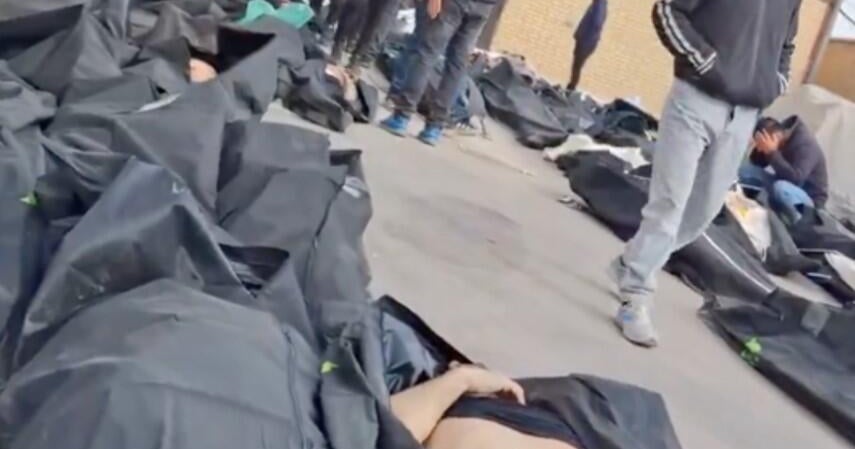
More than 12,000 people are feared dead after protests in Iran, as video shows queues of bodies at a mortuary.
British Foreign Secretary Yvette Cooper told parliament on Tuesday that the UK government believed “up to 2,000 people may have been killed, with many more dead. I fear the number could be much higher
Information coming out of Iran on Tuesday suggests that the crackdown by authorities to end more than two weeks of widespread anti-government protests has been far deadlier than reported by activists outside the country. With phone lines open to calls from inside the Islamic Republic, two sources, including one from inside Iran, told CBS News on Tuesday that at least 12,000 and possibly as many as 20,000 people have been killed.
It has been incredibly difficult to piece together the truth, as Iran’s fundamentalist rulers have cut off internet access and phone service in the country for the past five days. After a fifth day of complete internet shutdown in Iran, some Iranians were able to make phone calls outside the country on Tuesday, but calling into Iran from outside remained impossible.
A source inside Iran who was able to make the call told CBS News on Tuesday that based on reports from medical officials around the country, activist groups working to compile the full death toll from the protests believe the death toll was at least 12,000 and possibly as high as 20,000.
The same source said that security forces were visiting several private hospitals in Tehran and threatening staff to hand over the names and addresses of people who were injured in the protests.
CBS News has not been able to independently verify the massive death toll reported by the source, which is several times higher than the numbers privately reported by most activist groups recently — though those groups have always made clear that their numbers are underestimates.
The opposition Iran International Television Network reported on Tuesday that their information indicated approximately 12,000 deaths. A Washington source with contacts in Iran told CBS News on Tuesday that a reliable source had told him the death toll was likely between 10,000 and 12,000.
Iranian authorities have not provided regular official estimates of total deaths from the unrest. Reuters on Tuesday quoted an unnamed Iranian official as saying that nearly 2,000 people have been killed since protests began on December 28 and blamed foreign-influenced “terrorists” for the violence, even suggesting that agitators were paid to spread chaos.
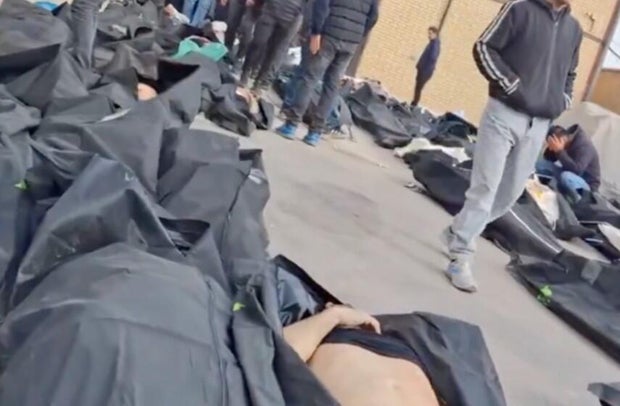
CBS News has verified that the video posted online Tuesday shows the bodies of hundreds of people killed during protests at a mortuary in a Tehran suburb. The video shows forensic personnel documenting gruesome injuries on bodies and crowds of people trying to identify the dead.
A new video shows badly injured bodies lining up at a mortuary.
An Iranian activist and blogger, who identifies himself only as Wahid online, first posted the shocking 16-minute clip. Wahid reported receiving the video from a source who travelled nearly 600 miles to upload it during a communications blackout.
Graphic videos show people injured by bullets and gunshots, along with other wounds, and piles of blood-stained clothes inside the mortuary complex.
The protests – which have prompted President Trump’s threats of US military intervention – began in late December over anger over a new rise in the cost of living in Iran’s sanctions-hit economy. They quickly turned into mass rallies in all 31 provinces of Iran, with thousands of people chanting slogans calling for the downfall of the country’s Islamic rulers.
Even if the lower death toll reported by Cooper in Britain on Tuesday were confirmed, it would exceed the number of officially reported casualties in previous anti-regime protests in Iran since the 1979 Islamic revolution that brought the current government to power.
As protests escalated last week, President Trump warned several times that the US would take action if the Iranian regime killed protesters, without specifying any red lines that might trigger a response or what the response might be.
President Trump tells Iranian protesters that help is coming
Mr. Trump said in a social media post on Tuesday, “Iranian patriots, keep protesting—occupy your institutions!” Protect the names of the murderers and abusers. They will face severe consequences. I have cancelled all meetings with Iranian officials until the senseless killing of protesters stops. Help is on the way.”
He then offered no details about what help the United States might provide to Iran’s long-suppressed domestic opposition.
The president’s national security team was scheduled to hold a meeting at the White House on Tuesday to discuss their options, according to multiple sources familiar with the matter. It was not clear whether the President himself would attend. He has provided information on a wide range of military and clandestine equipment that could be used against Iran, beyond conventional air strikes, according to two Pentagon officials who spoke to CBS News on the condition of anonymity to discuss national security matters.
He described the action as “far worse than we can imagine.”
“The information we are receiving indicates that violent actions have occurred, and the protests are likely worse than we had anticipated,” said Mahmoud Amiri-Moghadam, who leads the Norway-based activist organisation Iran Human Rights.
“The red lines of the entire international community have been crossed,” Amiri-Moghadam said. “We have a mechanism called the responsibility to protect civilians against serious human rights violations, mass killings… The United States, along with the European Union and basically all countries, has a responsibility to stop these atrocities; this extends beyond just President Trump.
He did not call for US military action but urged world powers to “provide Iranians with more means to communicate with the world, because that’s what the regime does – they shut down the Internet. Basically, it’s like solitary confinement. They put the Iranian people in solitary confinement and start torturing and killing them.”
He told CBS News that his organisation had received a video Monday night showing the scene of an alleged attack by security forces that killed 75 people in Mazandaran province, about a three-hour drive north of Tehran. Amiri-Moghadam said he could not share the video or the city where the alleged attack took place because the information “could be tracked,” which would jeopardise his sources.
“This indicates that the extent is much worse than we thought,” Amiri-Moghaddan said.
Internet access and text messaging services in Iran were also blocked on Tuesday, largely maintaining a blackout that began on the evening of January 8, when thousands of people turned out to raise their voices in response to the call of Iran’s exiled Crown Prince Reza Pahlavi.
The protests – and the actions of security forces against them – appeared to escalate rapidly over the course of a few days from that evening.
On Tuesday, Iran’s police chief claimed that the protests were ordered from outside the country and that “terrorists” paid to create unrest were encountered inside Iran.
Iranians want “someone who can oust the Islamic Republic”
Amiri-Moghaddan told CBS News that many Iranians would not believe that story from their leaders.
He said, “The Iranian people are sick of the regime and want out.” “I remember asking many people from different backgrounds, ‘Who would you support?’ And they all basically say we will support anyone who can depose the Islamic Republic. Iran is a country with many types of people and different opinions. “Some people want the monarchy, some are against it, but I think the priority is to remove this regime.”
Pahlavi has said he is ready to return to lead Iran, even though he has not been there since his father, the US-backed Shah, fled nearly 50 years ago amid intense public outrage over his rule. He told CBS News’ Norah O’Donnell on Monday that the Iranians “need action.”
He said, “The best way to ensure that fewer people are killed in Iran is to intervene early so that this regime finally collapses and brings an end to all the problems we are facing.”
Pahlavi said he had spoken with the Trump administration, but he did not provide any details of those conversations.
Amiri-Moghaddan said that the “absolute majority” of Iranians “do not want a regime like that; more than 80%.”
But he said the 80% were “divided broadly into three groups: those who want the Shah’s sons, those who oppose the monarchy, and those who are undecided.”