

Is small the new big?
 AFP via Getty Images
Arvind Srinivas, the CEO of Perplexity, recently stated in a podcast that modest smartphones could eventually render powerful data centres obsolete.
Speaking to host Prakhar Gupta, the AI chief argued that people will eventually use powerful, personalised AI tools that will run on the hardware already inside their devices.
It will rely on AI instead of transmitting data from huge data centres and using remote computers to perform tasks, which is typically the case now.
Apple’s AI system, Apple Intelligence, already runs some features on special chips inside the company’s latest line of products. The tech giant says this means its AI tools can work more quickly and also keep private data more secure.
Microsoft’s Copilot+ laptop also includes on-device AI processing.
But these are all premium-priced gadgets. In general, many current devices do not have that capability. AI requires powerful processing that is beyond the means of standard devices.
“The long-term question is whether and when powerful and efficient AI can run on local devices,” says Jonathan Evans, director of consultancy company Total Data Center Solutions.
The data centre industry is certainly not shrinking in terms of demand. But is it getting smaller in other ways?
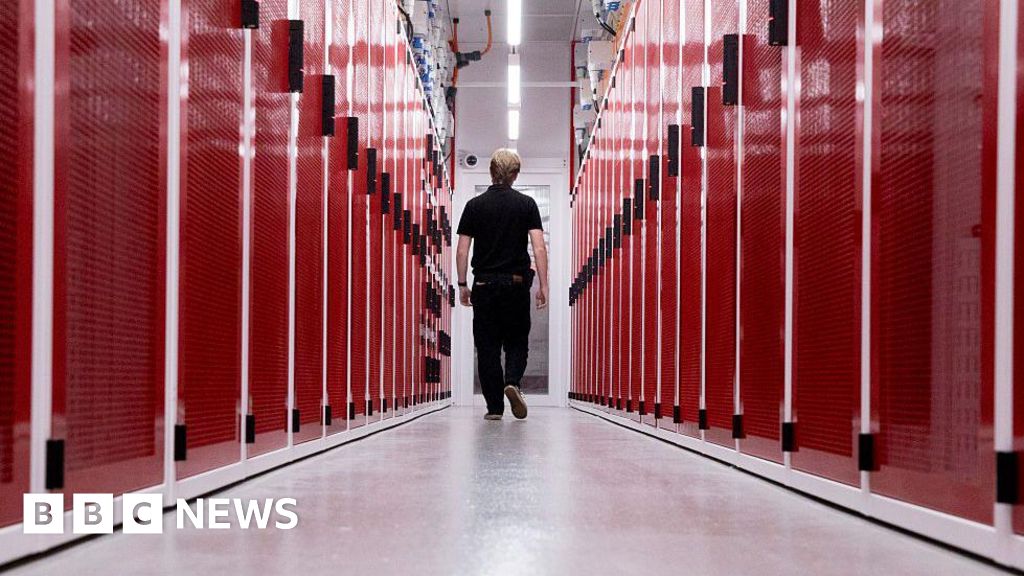
Data centres are traditionally huge buildings filled with powerful computers that perform a vast number of digital tasks, from video streaming and online banking to AI processing and data storage, in addition to running AI.
It’s possible that everything you log in online uses a data centre somewhere in the world. Big companies own them; small companies lease capacity inside them.
a small data centre in Devon.
A few years ago, I learnt about the operation of a small data centre in Devon, UK, which was the size of a washing machine. Not only did it generate computing power, but its heat also heated a public swimming pool.
This was the first time I encountered a data centre that wasn’t a giant warehouse, and I was initially very sceptical about the whole thing.
Since then I have heard many other examples. In November 2025, a British couple revealed that they were heating their home with a small data centre located in their garden shed.
A month later, I had dinner with a university professor who told me he had a GPU under his desk – a powerful computer processor used to run AI. As the GPU processed data, it also kept his office warm.
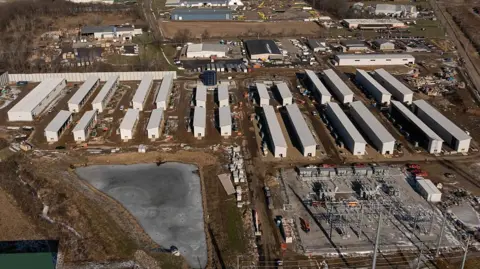
At the same time, tech companies are investing billions of dollars in giant data centre plants around the world. There are almost 100 new data centre projects in progress in the UK alone. Data centres are energy-hungry, and there are significant concerns about their environmental impacts.
Nvidia’s CEO, Jensen Huang, calls data centres “AI factories.” The argument in their favour is that we need them to enable rapidly developed AI technology.
For a long time, the AI field insisted that there was an apparently exponential “scaling” law that meant that the more computing power you threw at AI, the better it would get – although the pace of advancement seems to have slowed down.
However, I’m increasingly hearing voices in the tech sector questioning the logic of housing all this within remote and massive data centres.
Evans says there is a case for “smaller “edge” data centres near larger populations,” which will reduce latency and result in faster response times.
“Small is definitely the new big,” says Mark Bjornsgaard. He founded DeepGreen – the company that built the swimming pool data centre.
He believes that every public building should have a small data centre that, where necessary, should work with each other in a larger network and provide heating as a by-product.
“London is just a giant data centre that hasn’t been built yet,” he says.

 AFP via Getty Images
Amanda Brock, head of trade organisation OpenUK, agrees. “The data centre myth will be a bubble that will burst over time, I think,” she tells me. However, she refrained from providing a specific date for this event.
He believes that abandoned buildings and closed stores should be repurposed into small data centres.
Some people are looking a little further than high streets and cities: space.
“Space offers a unique opportunity to rethink data infrastructure, where small, scalable data centres in orbit can provide efficiency, performance and resiliency,” says Avi Shabtai, CEO of Ramon Space, the firm developing the technology.
Back on terra firma, Brock agrees with Perplexity’s Srinivas that fewer data centres will be needed, and instead she thinks “processing will move to a handheld device, or a set-top box, or a router in your home.”
This may be even more likely if not only data centres are shrinking but AI tools are shrinking as well.
There’s a giant hype surrounding big language models – huge, powerful AI models trained on vast amounts of data, which drive the AI chatbots we use to generate content. But we have also become aware of their tendency to make mistakes.
This is due in part to their incredibly broad range.
As AI ethics campaigner Ed Newton Rex once told me, an AI tool designed to recognise cancer symptoms doesn’t even need to be able to write song lyrics in the style of Taylor Swift.
 AFP via Getty Images
Businesses are increasingly agreeing and instead choosing custom enterprise AI tools: more expensive but trained on their own data, not used in training other products, and tailored to accomplish specific tasks for the company.
These smaller, personal devices perform more accurately and may require less computing. It is also more likely that all of it can be stored on the premises.
“I’ve talked to a lot of people who aren’t seeing the benefits of using generic AI tools,” says Dr Sasha Lucioni, AI and climate lead at machine-learning firm Hugging Face.
“We are already seeing a paradigm shift from larger models with huge resources to smaller models being more optimised and run more locally and tailored for business use.”
But will too many small data centres pose a national security headache?
“The counterargument here is that hitting smaller targets has less impact on them,” says computer security expert Professor Alan Woodward of the University of Surrey.
“Large hubs can be large points of failure, as we have seen recently with the giant AWS [Amazon Web Services]. The centres are going down.”
There’s also an environmental benefit to moving away from large data centres, which he says are “taking up more and more resources,” says Lucioni. “It is wise not to use them all the time.”



One thought on “Is small the new big?”
Comments are closed.