

How & Why China’s BYD is Set to Overtake Tesla as the World’s Top EV Seller
Introduction
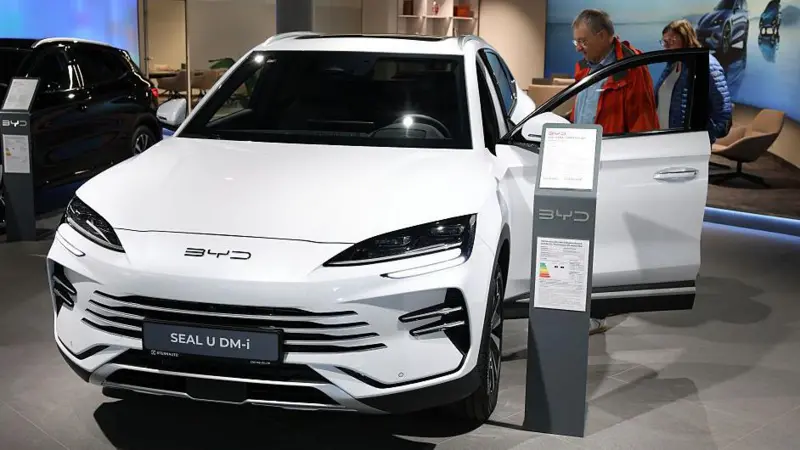
China’s BYD is set to overtake Elon Musk’s Tesla as the world’s biggest seller of electric vehicles (EVs), marking the first time it has outpaced its American rival for annual sales.
On Thursday, BYD said that sales of its battery-powered cars rose last year by almost 28% to more than 2.25 million.
Tesla, which is due to reveal its total sales for 2025 later on Friday, last week published analysts’ estimates suggesting that it had sold around 1.65 million vehicles for the year as a whole.
The US firm has faced a tough year, with a mixed reception to new offerings, unease over Musk’s political activities, and intensifying competition from Chinese rivals.
Chinese firms, such as Geely, MG, and BYD – now the country’s largest electric car company – have put pressure on Western rivals by pricing their vehicles below established brands.
1. The Numbers Don’t Lie: Defining the “Overtake”
First, let’s clarify the metrics. BYD sells both pure battery electric vehicles (BEVs) and plug-in hybrids (PHEVs), collectively called New Energy Vehicles (NEVs). Tesla sells only BEVs.
In Q4 2023, BYD sold over 525,000 BEVs, surpassing Tesla’s 484,500 deliveries. This single-quarter victory proved BYD’s capability to outpace Tesla in their core segment. Despite Tesla holding the BEV crown for the full year 2023, BYD’s relentless growth—over 70% year-over-year—has significantly narrowed the gap. In the broader NEV category, BYD has been the undisputed global leader for two years running, selling over 3 million vehicles in 2023.
The trajectory is undeniable. China’s BYD is set to overtake Tesla in annual BEV sales, with most analysts projecting it could happen as early as 2024.
BYD overtaking Tesla.
2. Who is BYD? The giant battery turned into an auto-behemoth.
Many outside China ask, “Who is BYD?” Founded in 1995, BYD (Build Your Dreams) started as a battery manufacturer. This origin serves as a strategic advantage for the company. Unlike traditional automakers or even Tesla, which depend on partners such as Panasonic and CATL, BYD maintains vertical integration. It produces its own advanced Blade Batteries, semiconductors, and motors. This control over the most critical and expensive parts of an EV provides massive cost advantages and shields it from supply chain disruptions.
3. The Strategy Behind the Ascent
How did BYD achieve this dizzying climb? Three strategies are key:
- Dominance at Home: BYD commands over 35% of China’s EV market, the world’s largest. It offers an unparalleled lineup—from the affordable Seagull (under $11,000) to luxury Yangwang models—catering to every segment.
- The Unbeatable Price Advantage: Vertical integration lets BYD produce EVs at a lower cost. This allows for aggressive pricing that pressures competitors globally, making EVs accessible to a much wider audience.
- Aggressive Global Expansion: BYD is no longer just a Chinese player. It’s rapidly expanding in Europe, Southeast Asia, Australia, and Latin America, establishing manufacturing hubs and challenging local incumbents.
4. Tesla’s Position: Not a Decline, But a Catch-Up
It’s crucial to frame the situation correctly. Tesla is not collapsing; it delivered a record 1.8 million vehicles in 2023. The story is that China’s BYD is set to overtake Tesla by executing on a different, highly effective model. Tesla remains the premium, high-tech innovator, focusing on profitability per vehicle and software. BYD is the volume-driven manufacturing powerhouse, flooding the market with quality options. A formidable, scaled competitor now confronts the pioneer.
5. What This Means for the Global EV Market
This shift signals a new, more competitive era.
- Consumers Win: More choice, faster innovation, and potential price reductions across the board.
- Legacy Automakers Are on Notice: If they thought catching Tesla was hard, BYD sets a new benchmark for speed, scale, and cost.
- Battery is King: BYD’s success proves that leadership in core battery technology is paramount. The battery pack increasingly dictates the future of autos.
Conclusion
The data and trajectory are clear. China’s BYD is set to overtake Tesla as the world’s top EV seller, marking one of the most significant power shifts in the automotive industry in over a century. This does not signal the end of Tesla’s journey but rather the start of a fierce, worldwide competition for leadership in EVs. Ultimately, this fierce competition will accelerate the world’s transition to sustainable transportation—and that’s a win for everyone.
FAQ Section
Q: Has BYD officially overtaken Tesla?
A: Yes, in Q4 2023, BYD outsold Tesla in pure battery-electric vehicle (BEV) deliveries. In annual BEV sales for 2023, Tesla remained ahead, but BYD’s growth rate positions it to likely take the annual crown in 2024.
Q: What is BYD’s best-selling electric model?
A: In China, the BYD Song (SUV) and Qin (sedan) series are top sellers. For global markets, models like the Atto 3 (Yuan Plus), Dolphin, and Seal are gaining rapid popularity.
Q: Does BYD sell cars in the USA?
A: Not yet for consumers. BYD currently sells electric buses and trucks in the U.S. and has a strong commercial presence. Passenger car sales are a possibility but face political and tariff challenges.
Q: Why are BYD cars often cheaper than Teslas?
A: The primary reasons are BYD’s vertical integration (owning their battery supply chain), lower manufacturing costs in China, and a strategic focus on the mass market across multiple price points.



One thought on “How & Why China’s BYD is Set to Overtake Tesla as the World’s Top EV Seller”
Comments are closed.