

EU and Mercosur block sign major trade deal, rejecting ‘tariffs’ and ‘isolation’
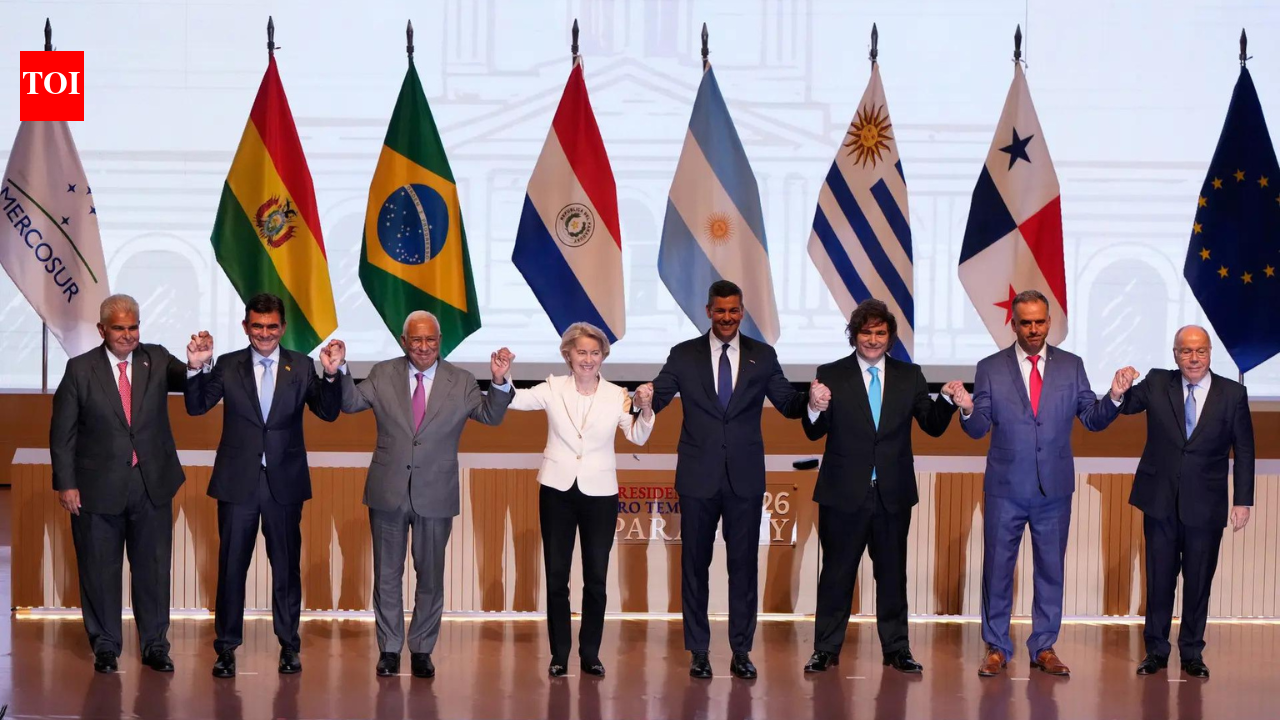
Asuncion: South American and European Union officials signed a major trade deal on Saturday, which they welcomed as a powerful message at a time of tariff threats, global uncertainty and protectionism.
The agreement between the 27-nation European Union and Mercosur ‘s members Brazil, Argentina, Uruguay and Paraguay creates one of the world’s largest free trade areas after 25 years of difficult negotiations.
It was given a new impetus amid the widespread use of tariffs and trade threats by the administration of US President Donald Trump, which has prompted countries to scramble for new partnerships.
Trump on Saturday threatened to impose tariffs of up to 25 per cent on several European countries unless he regains control of the Danish territory Greenland.
We choose fair trade instead of tariffs; we choose productive long-term partnerships instead of isolation.”
EU chief Ursula von der Leyen said at the signing ceremony in Asuncion, Paraguay. Paraguayan President Santiago Peña also praised the treaty as “a clear signal in favour of international trade” in “a tension-filled global landscape.”
The European Council head, Antonio Costa, said the deal was contrary to “the use of trade as a geopolitical weapon.”
And Brazilian Foreign Minister Mauro Vieira said the deal was “a major challenge for a world plagued by unpredictability, protectionism, and coercion.”
Brazilian President Luiz Inácio Lula da Silva – the key architect of the agreement – could not attend the ceremony due to scheduling conflicts and met von der Leyen in Rio de Janeiro on Friday.
where he praised it as a victory for multilateralism. In Paraguay, leaders said the treaty would bring jobs, prosperity and opportunities to people on both sides of the Atlantic.
The EU and Mercosur account for 30 per cent of global GDP.
‘It’s not fair.’ Together, the EU and Mercosur account for 30 per cent of global GDP and more than 700 million consumers.
The treaty eliminates tariffs on more than 90 percent of bilateral trade, but it still needs approval from the EU Parliament and ratification by each Mercosur nation.
It is expected to be implemented by the end of 2026. The deal will boost European exports of cars, wine and cheese.
while making it easier for South American beef, poultry, sugar, rice, honey and soy to enter Europe.
This has angered European farmers, who have turned tractors around in cities such as Paris, Brussels and Warsaw, fearing an influx of cheap goods produced with low standards and banned pesticides.
“We have good quality Irish beef and good standards, and in South American countries, they don’t have the same standards.”
aid farmer Trisha Chatterton, 50, at a protest in Ireland earlier this month. “
This is not fair,” said Louis, a 24-year-old cattle farmer from Belgium who took part in the December protests, which turned ugly as protesters set fire to piles of tyres and threw potatoes at police.
Major power Germany, as well as Spain and the Nordic countries, strongly supports the deal, eager to boost exports as Europe grapples with Chinese competition and a tariff-happy administration in the White House.
Even in South America, some people are cautious about the treaty’s impact.
Trade and investment researcher Luciana Ghiotto told AFP that Argentina estimates the demise of the local automotive industry could lead to the loss of 200,000 jobs.
To address these concerns, the European Commission announced a crisis fund and safeguard measures that would allow for the suspension of preferential tariffs in the event of a harmful increase in imports.
However, Argentina’s libertarian President Javier Milei warned against quotas and protections, which would “significantly reduce the economic impact of the agreement and go against
its essential purpose.” According to EU estimates, European exports to Mercosur are expected to increase by 39 percent.
while Mercosur exports to the EU may increase by 17 per cent. By 2040, the agreement is projected to boost EU GDP by 77.6 billion euros and Mercosur GDP by 9.4 billion euros.


One thought on “EU and Mercosur block sign major trade deal, rejecting ‘tariffs’ and ‘isolation’”
Comments are closed.