

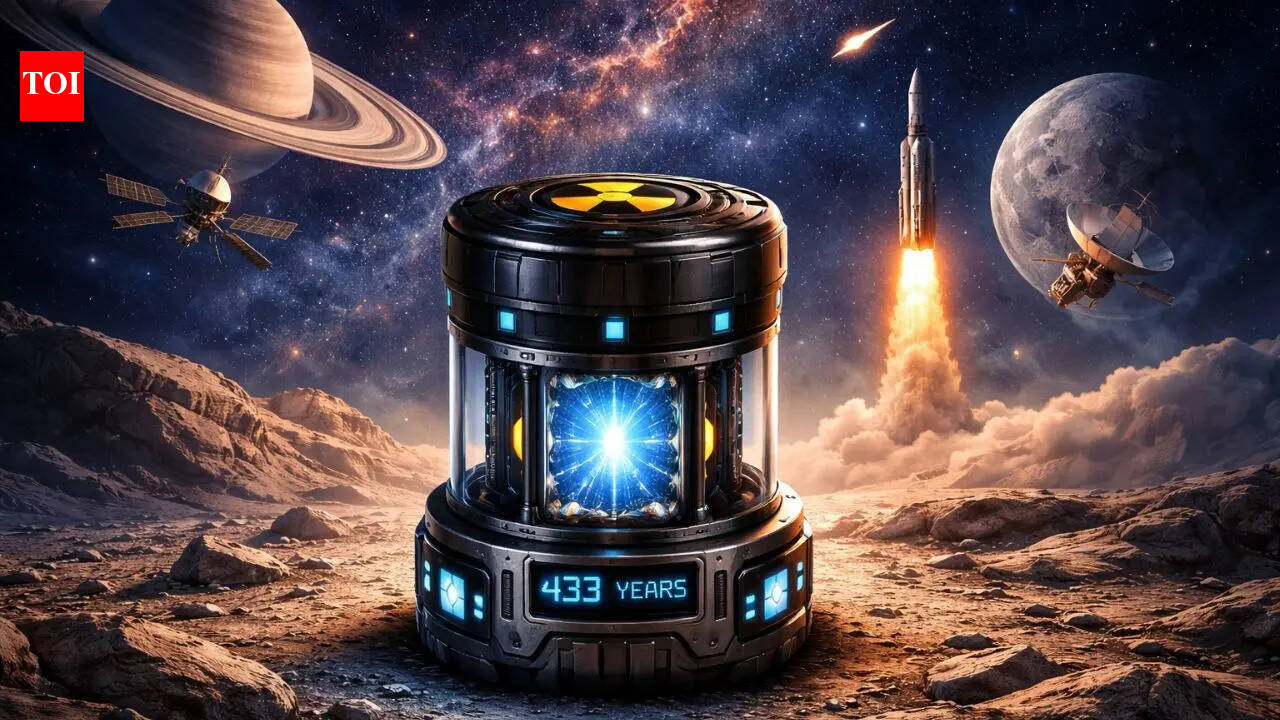
This nuclear battery can last for 433 years and power the next era of deep space exploration.
Space missions depend on power systems that can operate far from sunlight and without maintenance. Solar panels struggle in deep space, where light grows weaker with distance. That limitation has led agencies to rely on nuclear-based energy sources for decades. These systems, known as radioisotope power systems, have quietly supported missions operating in the Solar System. Spacecraft such as Voyager 1 and the Perseverance rover continue to operate using this technology. The concept is not new, but developments surrounding alternative isotopes are attracting renewed attention. The work, led by NASA in collaboration with the University of Leicester, aims to determine how long future missions could operate. A nuclear battery that could last for centuries is no longer just theoretical.
Plutonium-238 space nuclear battery: primary fuel used in space nuclear batteries
For decades, plutonium-238 has been the primary fuel used in space nuclear batteries. As mentioned, its half-life is approximately 88 years, meaning that its energy output slowly decreases over time. Missions operated by Oak Ridge National Laboratory and Idaho National Laboratory depend on this isotope for production and supplies. It remains the backbone of current deep-space power systems. Spacecraft such as the Curiosity rover continue to function using plutonium-based systems. The stable decay of the isotope provides enough heat to sustain instruments, communications systems, and onboard electronics for long periods. Production resumed after a period of limited production, supported by coordinated efforts across national laboratories. Due to the complexity of material handling and production, the supply is carefully managed.
americium-241 and its half-life was extended
Attention is now turning to americium-241 as a possible alternative. Its half-life is approximately 433 years, much longer than plutonium-238. This property means that the isotope retains usable energy for a long time. It does not necessarily produce more power at a given time, but it decays slower. Research involving Los Alamos National Laboratory focuses on improving production methods and evaluating safety and performance. Early-stage studies suggest it may be suitable for long-duration missions where extended power availability is required. According to a NASA report, testing of Americium-241 is still going on. It has not replaced plutonium in operational spacecraft. The evaluation process includes material stability, heat generation efficiency, and long-term reliability under space conditions.
How do nuclear batteries produce energy?
Radioisotope power systems, commonly referred to as ‘RPS’, utilise the natural decay of radioisotopes. As radioisotopes decay, heat is produced. This heat is then used to produce electricity through special means. This process continues continuously, i.e., there is no recharging in it nor is it dependent on the sun. It can operate in the dark, in the cold or in extreme conditions. Inside the radioisotope power system, the radioisotope is in a solid ceramic state. This method reduces hazards by keeping the radioisotope stable. The heat produced is then transferred to a converter, which uses it to produce electricity. The electricity produced is constant, not pulsed. These are small, reliable and long-lasting power sources, best suited for missions where reliability rather than the quantity of power produced is paramount.
Free-piston Stirling converters in space nuclear batteries
The heat produced by radioactive decay must be converted into useful electrical energy. The conversion is done using free-piston Stirling converters. Free piston Stirling converters have moving parts that float in the system. The moving parts are driven by temperature differences, and the motion is converted into electricity. The system is designed for low wear and tear, and the components remain floating in the system, making it suitable for long-term use in microgravity. Free piston Stirling converters have been tested, and results show that the system can operate for long periods of time without maintenance. According to reports, this system can work continuously for more than a decade.