

Adding to the historic surge, gold crosses $5,000 for the first time
 Hiba Kola/Reuters
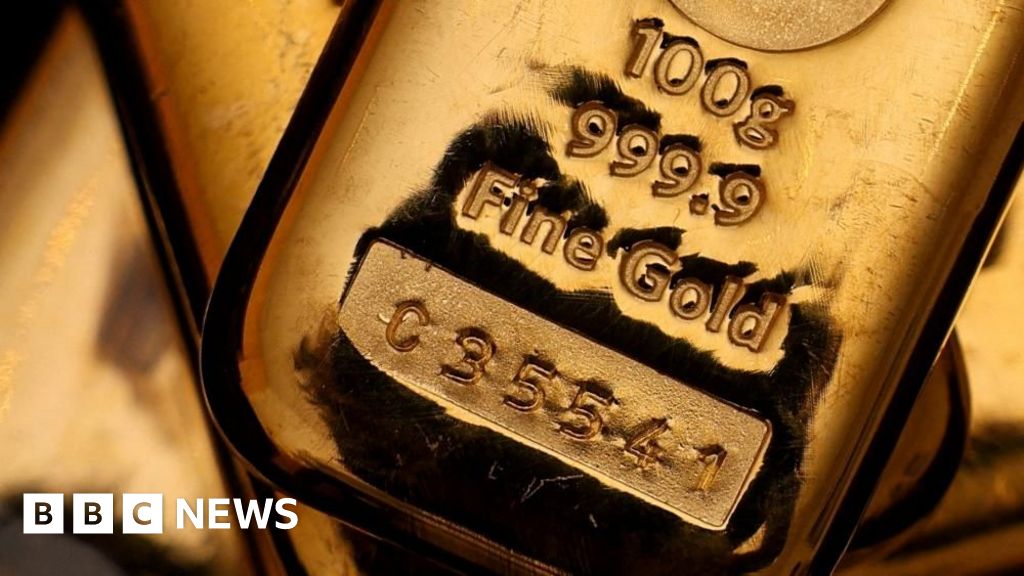
Gold prices rose above $5,000 (£3,659) an ounce for the first time, extending a historic rally that saw the precious metal rise more than 60% in 2025.
It comes as tensions between the US and NATO over Greenland add to growing concerns about financial and geopolitical uncertainty.
Markets are also worried about the trade policies of US President Donald Trump. On Saturday he threatened to impose 100% tariffs on Canada if it strikes a trade deal with China.
Investors view gold and other precious metals as safe-haven assets during uncertain times. On Friday, silver rose above $100 an ounce for the first time, building on a nearly 150% increase over the past year.
Demand for precious metals has also been driven by several factors, including higher-than-usual inflation, a weaker US dollar, purchases by central banks worldwide, and the expectation that the US Federal Reserve will cut interest rates again this year.
The wars in Ukraine and Gaza, along with Washington’s capture of Venezuelan President Nicolas Maduro, have also contributed to the increase in gold prices.
The greatest appeal of gold is its relative scarcity.
According to the World Gold Council trade association, only about 216,265 tonnes of the metal have been mined so far.
This is enough to fill three to four Olympic-sized swimming pools. Most of it was extracted from the earth since the 1950s, as mining techniques advanced and new deposits were discovered.
The US Geological Survey estimates that 64,000 tonnes of gold can still be mined from underground reserves, although the supply of the metal is predicted to stagnate in the coming years.
“When you have gold, it’s not tied to someone else’s debt like bonds or equities, where company performance will impact performance,” said Nicholas Frappel, global head of institutional markets at ABC Refinery.
“It’s a really good diversification tool in a very uncertain world,” he said.
‘People go to sleep.’
Gold saw a blockbuster year in 2025, with its biggest annual gain since 1979 as investors turned to the precious metal.
Gold has repeatedly hit new record highs as financial markets are spooked by concerns including Trump’s tariffs and fears over artificial intelligence-related stocks pushing the price higher.
“I think a big part of this is our extreme uncertainty about U.S. policy,” said Nikos Kavalis of research consultancy Metals Focus.
Although economic concerns can help push up the price of gold, it also rises when investors expect interest rates to be cut.
Low rates typically mean lower returns on investments like bonds, so investors look to assets like gold and silver.
The US Federal Reserve is expected to cut its key interest rate twice this year.
“It is inversely correlated because the opportunity cost of keeping the money [government bond] is really not worth it anymore, so people turn to gold,” said Ahmed Asiri, research strategist at Pepperstone.

 getty images
It is not that only investors are buying gold.
Central banks added hundreds of tonnes of bullion to their reserves last year, according to the World Gold Council.
“There is a very clear move away from the US dollar that is giving gold a huge advantage,” Kavalis said.
Gold has seen a rise earlier this year, but Frappell warned that its price could also fall due to a “news-driven” market.
“There should be room for unexpected news that could be really positive for the world and not necessarily positive for gold,” he said.
But not everyone is buying gold just for investment reasons.
In many cultures, the metal is purchased during festivals or given as gifts at ceremonies such as weddings.
In India, the annual Diwali festival is considered an auspicious occasion to purchase precious metals to bring wealth and good fortune.
According to US investment bank Morgan Stanley, Indian households own 3.8 tonnes of gold, which is equivalent to 88.8% of the country’s gross domestic product (GDP).
Neighboring China is the world’s largest single consumer market for gold, with many believing that buying it brings good luck.
“We often see a seasonal increase in demand around Chinese New Year, which we are seeing to some extent at the moment,” Kavalis said, referring to the upcoming Year of the Horse, which starts in February.



One thought on “Adding to the historic surge, gold crosses $5,000 for the first time”
Comments are closed.