For years, geopolitical analysts had warned us that the most dire of all scenarios for the world economy was the closure of the Strait of Hormuz.
Well, now, in practice, that is exactly what has happened. Shipping through this narrow channel, the gateway to the Persian Gulf, has declined to near zero. This situation has become a reality.
And yet the funny thing is that in some respects the world looks no different than it did before. There was hardly any change in the US benchmark stock index S&P 500. The FTSE 100 is down slightly but still somewhat higher than a month ago. All the turmoil raises the question: wouldn’t it be as bad as everyone was fearing?
The closure of the Strait of Hormuz affected the world economy.
However, talk to people who understand energy markets and the economic geography of the Gulf and its customers, and a very different story emerges. True, the effects of the shutdown may take some time to be felt, but it could be completely destabilising for both the Gulf countries and the wider world, potentially leading to economic instability, increased energy prices, and geopolitical tensions.
Harbinger of high inflation
Starting with the wider world, the sharp rise in gas prices is a harbinger of higher inflation in the coming months. For a long time, countries like the UK had assumed that Qatar would be the most reliable of all suppliers of natural gas. Now, LNG tankers that once carried Qatari gas around the world cannot access the Gulf, and Qatari gas fields are no longer operational.
For many Asian countries, from India and Pakistan to South Korea and Taiwan, such an outcome is a devastating prospect. Most of them have very low gas reserves, so in the coming months they will struggle to secure enough methane, which is a type of natural gas, to keep their power stations and heating systems running. That, in turn, would push up prices around the world, including in Europe, which is also reliant on LNG (liquefied natural gas) to fill some of the gap left by Russian gas after some of its pipeline supplies were shut off following the invasion of Ukraine. The longer the Strait remains closed and Qatar does not pump gas, the deeper the crisis will get.
Everyday goods depend on Gulf production
And it’s not just gas. Qatar is also responsible for one-third of the world’s helium. Without helium, MRI scanners cannot function and some quantum computers cannot function, because they rely on the gas to cool their magnets and circuits. The Gulf provides about half the world’s sulphuric acid, without which you can’t make explosives or refine copper. In short, you can expect the disruption in the Gulf to spread to the wider world with each passing day.
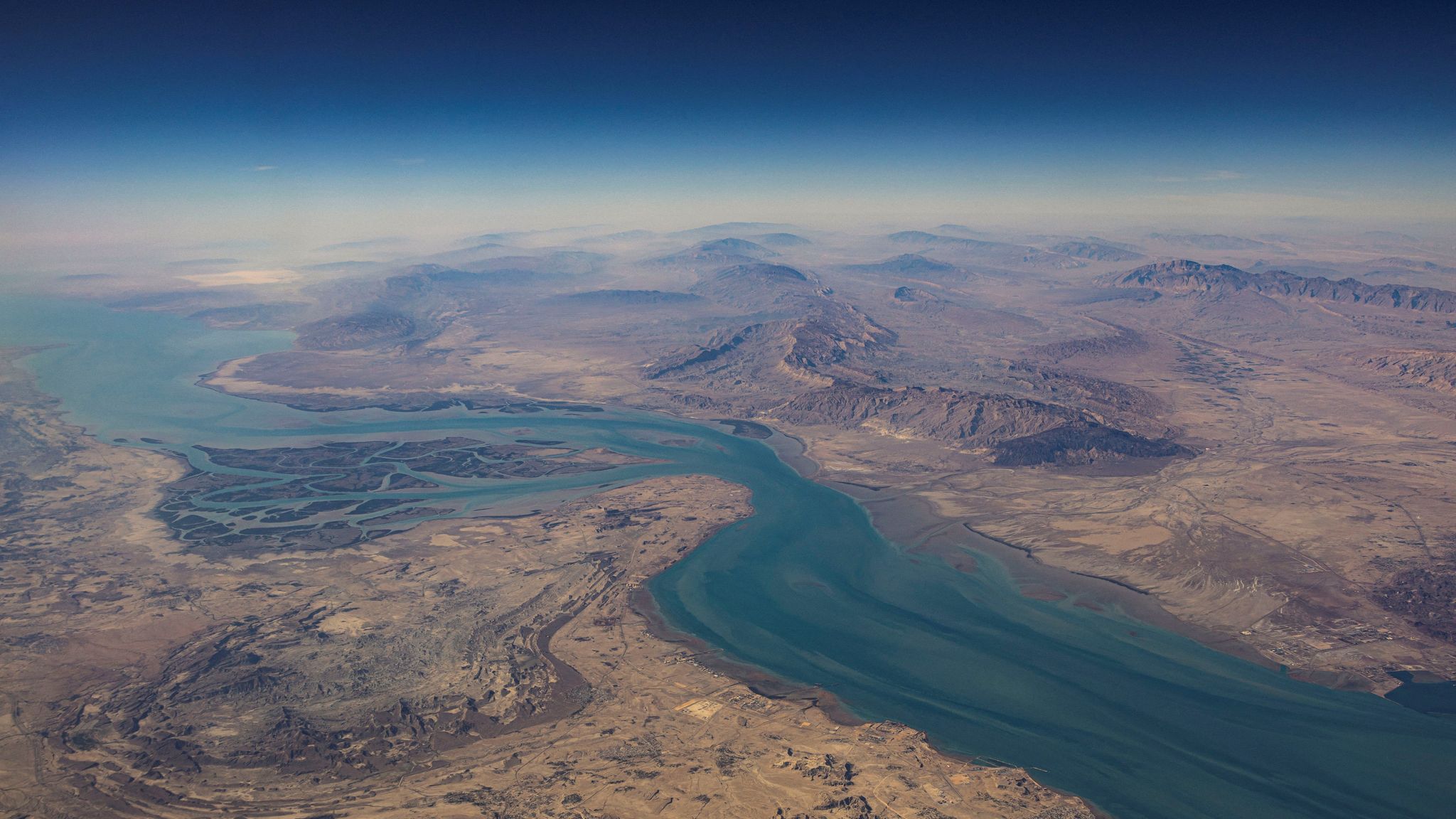
An aerial view shows the Iranian coasts and Qeshm Island in the Strait of Hormuz in 2023. File photo: Reuters
But the consequences for people trapped inside the bay are even more serious. In an ideal world, they would have enough pipelines to get their oil out of the Gulf, but in practice, there is nowhere near enough pipeline capacity. The result is that without tankers to ship the oil, the crude coming from beneath the earth in Saudi Arabia, Kuwait, Iraq and Abu Dhabi will have nowhere to go.
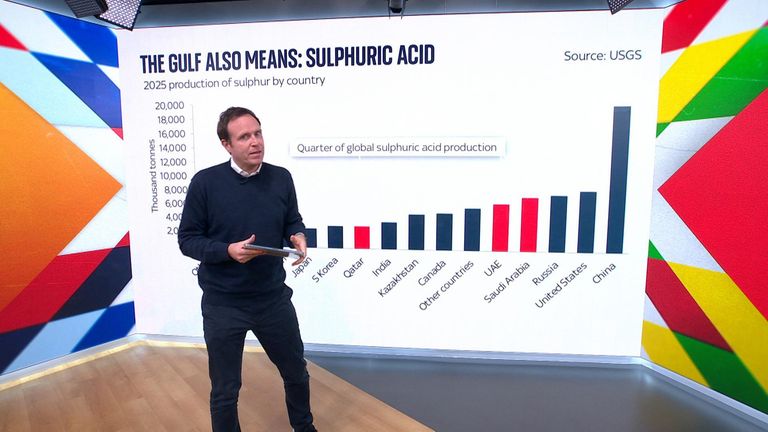
Ed Conway explains what happens when oil runs out of the Strait of Hormuz.
Big questions for people and environment
These countries have a limited amount of storage for that oil, which raises the question: What will happen when that storage runs out in a few days? The short answer is that they either have to shut down their oil fields—something that could permanently damage them—or they burn or spill the oil as soon as it comes out.
Then there are deeper questions about what such an event means for a region dependent on immigrants. What if and when those immigrants, most of whom never imagined living under the threat of aerial bombardment, leave the country? What impact does such an event have on the Gulf model?
The answers to the above questions are all unappealing. Neither is particularly encouraging for the global economy. They’re all, to put it mildly, pretty scary. This is why we should all hope that the Strait of Hormuz does not remain closed for long. The longer it remains closed, the more likely it is to become a nightmare.