

Activist ship’s collision with krill trawler off Antarctica called ‘deliberate attack’
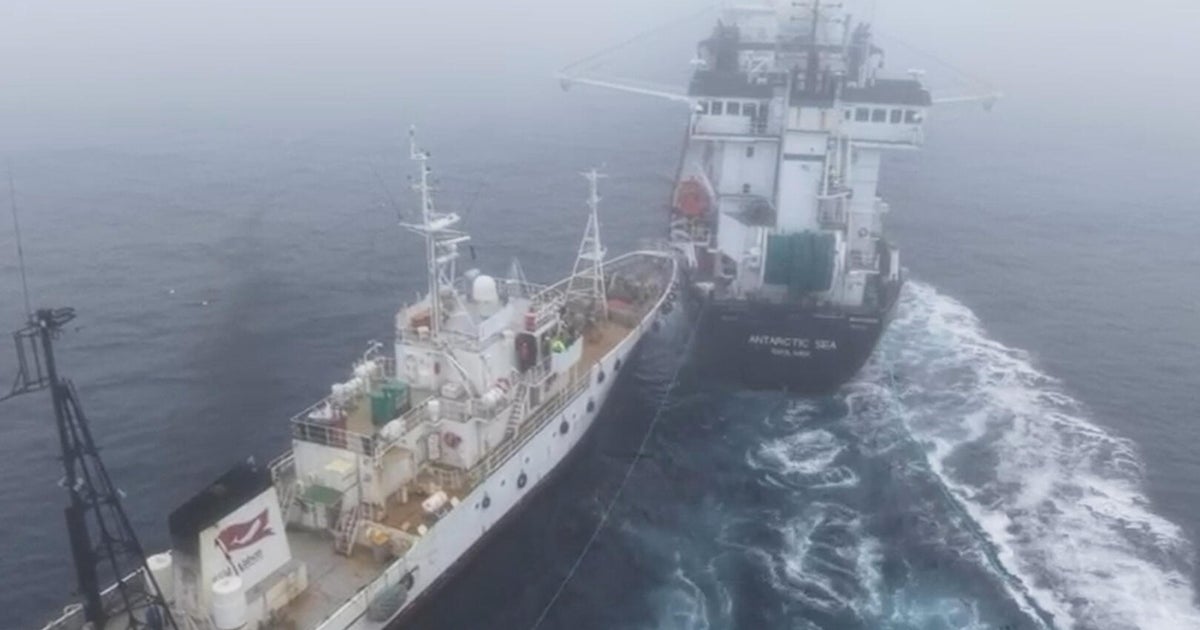
A ship operated by a group founded by anti-whaling activist Paul Watson collided with an industrial krill trawler in Antarctica in what the ship’s Norwegian owner said was a “deliberate attack” that endangered its crew and could have caused disaster in the same environmentally sensitive waters the activists claim they seek to protect.
A two-minute video provided to The Associated Press by the Aker QRILL company shows the moment on Tuesday when the M/V Bandero, operated by the Capt. Paul Watson Foundation, approaches the fishing vessel’s stern and strikes its port side at a slight angle.
The confrontation underscores a growing battle in the cold waters of the Southern Ocean over the future of Antarctic krill, a shrimp-like crustacean central to the whales’ diets and a vital buffer against global warming that is also in demand for use in health supplements, fish food and other products.
Aker said Wednesday that Bandero came within centimetres of hitting his ship, a Norwegian-flagged diesel tanker, in the Antarctic Sea, endangering a habitat filled with several whale species, seals and seabirds – all of which feed on the Southern Ocean’s abundant but environmentally sensitive krill population.
The company said its multinational team was shocked but unharmed and would take all available legal action.
“Our crew was put at risk in some of the most remote waters on Earth, and only by luck escaped potential environmental damage,” Aker CEO Webbjorn Barstad said in a statement.
“If the steel plates (…) had broken, it could have caused a leak. It was probably just luck that it didn’t cause more damage,” Barstad told Reuters news agency.
In a statement to Reuters, the Captain Paul Watson Foundation said it was “an accidental collision” and that it was committed to “lawful, responsible, non-violent action in protecting marine ecosystems.”.
It has its own news release. The foundation described its actions as “aggressive nonviolence.” It said the crew, led by French activist Lamya Essemlali, managed to disrupt all krill fishing during a five-hour “direct intervention” against two Aker-owned vessels. It also provided images showing crews launching giant metal net shredding devices with the intention of disrupting fishing.
“David-and-Goliath scenario”
Watson himself was not on the ship, which left Australia in February as part of a call by the Watson Foundation Operation Krill Wars.
“During the encounter, the crew spotted Antarctic wildlife in the surrounding waters, including penguins, seals and even a whale, highlighting the extent to which a small ship challenged a powerful industrial krill operation in a David-and-Goliath scenario,” the foundation said in a statement.
Watson founded the global Sea Shepherd conservation movement in the 1970s and for decades gained a fearsome reputation for ramming ships and other aggressive tactics in confrontations on the high seas, which has landed him repeatedly in jail. In 2024, Denmark rejected a Japanese warrant that had detained him for five months in Greenland. Japan’s coast guard had sought his arrest in connection with a 2010 encounter in which he was accused of ordering a captain of his ship to throw explosives at the ship, which the Japanese had named a whaling research ship.
Last year, Interpol removed its most wanted designation. For Watson at the 2010 incident. watson told CBS News. In 2014, a warrant was issued for encroachment, and it was said that “it’s all very political.”
While the Canadian-American citizen has garnered support from Hollywood celebrities in the past, his heavy-handed tactics have divided the movement he started, with allies in France and Brazil rallying behind his newly created namesake foundation, while Sea Shepherd Global and 20 national affiliates focus more on monitoring patrols on the high seas, policy action and supporting law enforcement in poor countries where illegal fishing is rampant.
Fishing for krill in Antarctica reached record levels last season, leading to the premature closure of fishing activity for the first time.
Aker is the world’s largest krill harvester, responsible for more than half the world’s fish catch.
“Krill is taken directly from the feeding grounds of whales, seals and penguins, and the expansion of krill extraction poses a serious threat to the Antarctic ecosystem,” the Captain Paul Watson Foundation said in its statement. “Krill is a foundational species, serving as the primary food for most marine life; without krill, the entire food chain would collapse.”
Remote fishing is managed by the Commission for the Conservation of Antarctic Marine Living Resources, an international organization made up of 27 countries and the European Union.
Any investigation into the incident, including possible criminal prosecution, is likely to begin at the Mongolia-flagged Bandero’s next port of call. Under international maritime law, the overtaking vessel has an obligation to keep clear of any nearby vessel passing by.
Bandero is named after the tequila company of American billionaire John Paul DeJoria, who founded Paul Mitchell hair care products and has been a long-time supporter of Watson’s efforts.



One thought on “Activist ship’s collision with krill trawler off Antarctica called ‘deliberate attack’”
Comments are closed.