
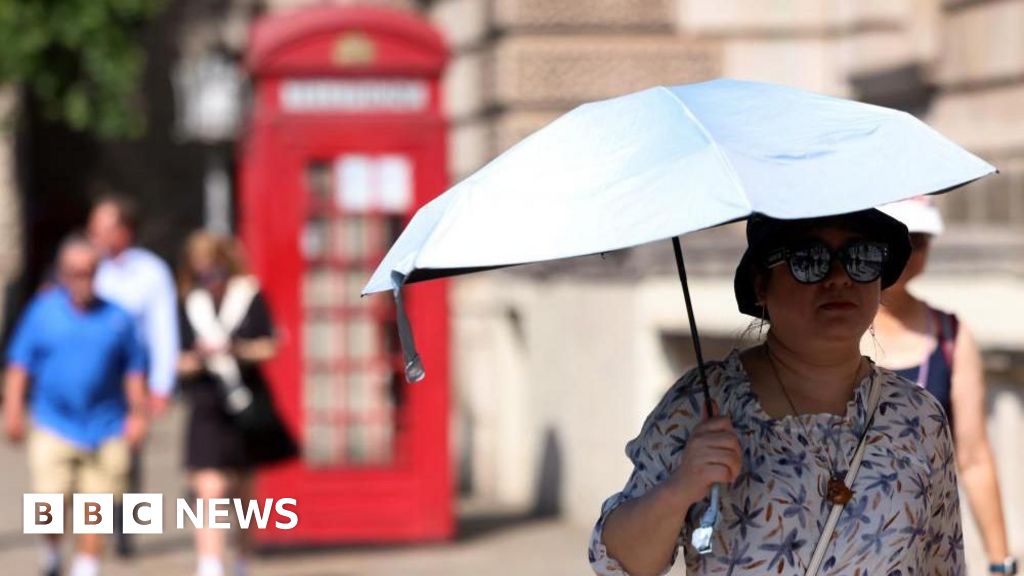
2025 is likely to be the UK’s hottest year on record, says the Met Office.

 EPA
EPAA leading government climate adviser has warned that rising temperatures in the UK will become the new norm. She urged greater preparation for the effects of climate change.
It comes as the Met Office revealed 2025 was on course to be the UK’s hottest year since records began, with climate change continuing to drive higher temperatures.
With just over a week still to go, the average UK air temperature across 2025 is on track to end up at about 10.05°C, which would edge out the current record of 10.03°C from 2022.
“This is our future, encapsulated in data,” Professor Rachel Kyte told the BBC.
“Now the question is, “How are we going to prepare ourselves and build our resilience for this?”
A lack of rainfall and persistent warmth left the country vulnerable to droughts and wildfires through the spring and summer.
While temperatures vary naturally from year to year, scientists could not be clearer that human-caused climate change is driving the UK’s rapidly warming trend.
“The pollution [carbon dioxide] we’ve put in for the last 20–30 years is now what’s driving this warmth, and so not curbing emissions well enough means we’re going to continue to see these kinds of impacts,” Prof. Kyte, the UK’s special representative for climate, said.
She said the UK needed to become “resilient” to the inevitability of higher temperatures through further investment in nature and infrastructure.
“If we don’t invest in our adaptation now, it’s going to cost us way more,” she warned
The UK has experienced 10 of its warmest years on record.
By the end of 2025, the UK’s 10 warmest years on record will all have taken place in the past two decades, in measurements going back to the late 1800s.
“Anthropogenic [human-caused] climate change is causing the warming in the UK as it’s causing the warming across the world,” said Amy Doherty, a climate scientist at the Met Office.
“What we have seen in the past 40 years, and what we’re going to continue to see, is more records broken, more extremely hot years […] so what was normal 10 years ago, 20 years ago, will become [relatively] cool in the future,” she told BBC News.
The Met Office’s projection uses observed temperatures up to 21 December and assumes that the remaining days of the year are 2°C below the long-term December average, with slightly cooler conditions expected over Christmas.
The Met Office can’t say for sure that 2025 will be the hottest year, but it’s likely.
It would be the sixth time in this century that the UK has set a new annual temperature record, following 2002, 2003, 2006, 2014, and 2022.
“The changes we are seeing are unprecedented in observational records back to the 19th century,” said Mike Kendon, another climate scientist at the Met Office.
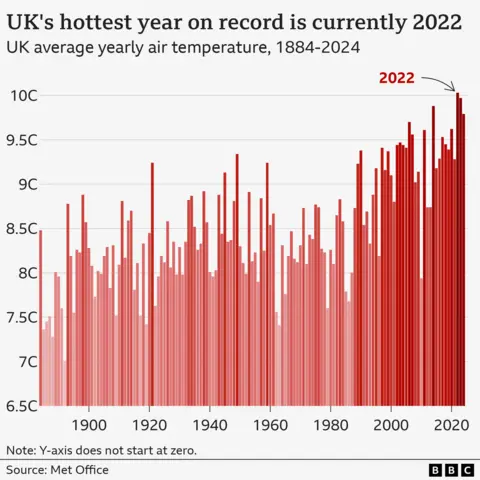
The expected new record of 2025 has been built on persistent heat through the spring and summer.
Those long, hot, sunny days may feel like a distant memory as we head towards Christmas, but both spring and summer were the UK’s warmest ever recorded.
Each month from March to August was more than 2°C above the long-term average between 1961 and 1990.
Temperatures peaked at 35.8°C – well below the highs of more than 40°C seen in July 2022 – but hot spells happened repeatedly.
Four separate – albeit relatively short-lived – heatwaves were declared across much of the country.
The UK Health Security Agency also issued several heat-health alerts through the summer.
Mr Kendon said longer spells of hotter days and nights posed an increased risk to elderly and vulnerable people.
He told the Today programme it would also have an impact on the agriculture sector, influencing which crops farmers are able to grow in the UK.
Spring and summer were also marked by low rainfall. The UK experienced a particularly dry spring, marking its sixth driest since 1836.
Combined with the warm weather helping to dry out the soils, this lack of rainfall pushed large parts of the country towards drought.
The Environment Agency and Natural Resources Wales, respectively, declared official droughts across several regions in England and Wales throughout the summer.
The Scottish Environment Protection Agency also declared “significant water scarcity” in parts of eastern Scotland.
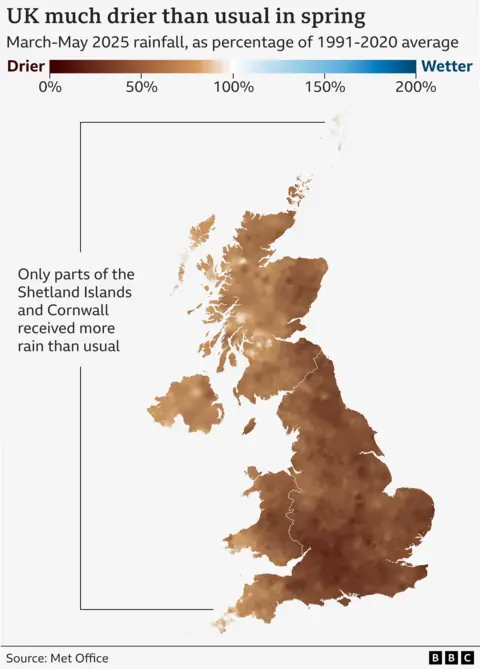
Recent rainfall has eased the situation across much of the country and most areas are no longer under an official drought. But water levels are still below average in some places.
“There’s a giant deficit to be made up, and there’s a giant implication, not just for people who are farming the land [and] growing food, but for our rivers,
our aquifers, and our availability of drinking water,” said Jess Neumann, associate professor of hydrology at the University of Reading.
The repeated swings between drought and flooding were making it very hard for communities to adapt to increasing weather extremes, she added.
The prolonged dry and warm weather also created ideal conditions for wildfires.
By late April, the area of the UK burnt by wildfires had already reached a new annual record, according to data from the Global Wildfire Information System going back to 2012.
More than 47,100 hectares (471 sq km, or 182 sq miles) have now been burned throughout 2025, smashing the previous high of 28,100 hectares in 2019.
Andy Cole, chief fire officer at Dorset & Wiltshire Fire and Rescue Service, said firefighters in his region had responded to more than 1,000 wildfires this year – an “unprecedented” number.
“I’ve been doing this for over 20 years, and we’ve seen a marked increase in the number of fires we’re dealing with in the open,” he told the Today program.
As the UK continues to heat up – driven by humanity’s greenhouse gas emissions – scientists expect it to experience more weather extremes.
“The conditions that people are going to experience are going to continue to change as they have in the last few years [with] more wildfires, more droughts, and more heatwaves,” said Dr Doherty.
“Additionally, the winter months from October to March will become wetter, with any rain that does fall occurring more intensely and in heavier showers, leading to the type of flooding we have observed this year,” she added.
The UK has not been alone in experiencing extreme heat this year. The world is on course for its second or third warmest year ever recorded, according to the European Copernicus climate service.
However, the US and some other major fossil fuel producers are retreating from their net zero pledges, testing the global consensus on addressing climate change.
[Ad_2]
Link to the source