

Joe Ward staved off disaster, beating Artjom Kasparian on a unanimous decision after 10 ferocious rounds at the 3Arena in Dublin.
Ward was a true amateur boxing sensation. At 17, all the way back in 2011, he became Ireland’s youngest ever senior European gold medallist.
Though he became an Olympian, misfortune dogged his amateur career, and his pro start was even worse. He dislocated his knee and lost his professional debut.
This fight at the 3Arena in Dublin was his first since 2024 and his ticket back to the big time.
Ward did begin like he’d never been away. He peppered Kasparian with sharp southpaw punching, popping shots into the body and the head. The Manchester-based hitter even picked up a nick by his right eye.
Kasparian stayed in front of his opponent, though, and in the third round, consecutive right hooks to the jaw tested Ward’s chin, with the visitor then pushing the home hero to his limit.
Please use Chrome browser for a more accessible video player
Kasparian’s solution was to keep on throwing and keep hitting out with heavy shots.
The visitor got himself onto the front foot at the start of the fourth round, landing a double jab and snagging Ward as he stepped in.
Ward rapidly tired, punching with just his arms, his feet rooted to the spot, his head available to be hit. That is not the place to be against a big puncher like Kasparian.
Kasparian kept up a strong assault through the middle rounds of the fight. He was, at times, pummelling Ward and it looked like the Irishman was on the brink of disaster.
But, as well as talent, Ward has heart. He pulled it back, and brought in strong backhands to repel Kasparian in the seventh round.
Ward pounced on the opportunity, getting a second wind. He bounced a one-two off Kasparian’s head in the eighth round and started to dictate the action.
Under pressure Kasparian almost fell through the ropes and the crowd wildly cheered for Ward.
In the ninth round, Ward screwed his right in and slammed his left down again. Kasparian, though, hacked at him with left hooks.
Ward popped in a clean, accurate left cross and Kasparian staggered back a step. He harried Kasparian with a sustained combination before the round was up.
Kasparian banged in a one-two but Ward, marked under his right eye, managed to trade with gusto. Kasparian tried to reel away, but Ward kept on throwing, catching him.
Fiercely determined Kasparian slugged back, but Ward answered in kind and raised both arms in the air at the final bell.
Stevie McKenna, with older brother Aaron starring in the main event, got a memorable evening for his family off to a sensational start.

Please use Chrome browser for a more accessible video player
Stevie McKenna stopped Owen O’Neill with a devastating right hand in the opening round of their contest at Zuffa Boxing 10.
He stormed out to meet Owen O’Neill, loomed over his opponent, and slung out heavy punches. O’Neill hopped backwards, trying to weather the storm. But McKenna did not relent. He stayed on his prey, whacking him with a massive left hook and continuing to strafe him with wide-arm punches.
O’Neill was left with little option but to tuck up beneath the onslaught. That, though, was just an invitation for trouble. A one-two from McKenna landed and a right cross sent O’Neill flying off his feet, crashing down on the canvas. He had to be stopped there and then in the first round.
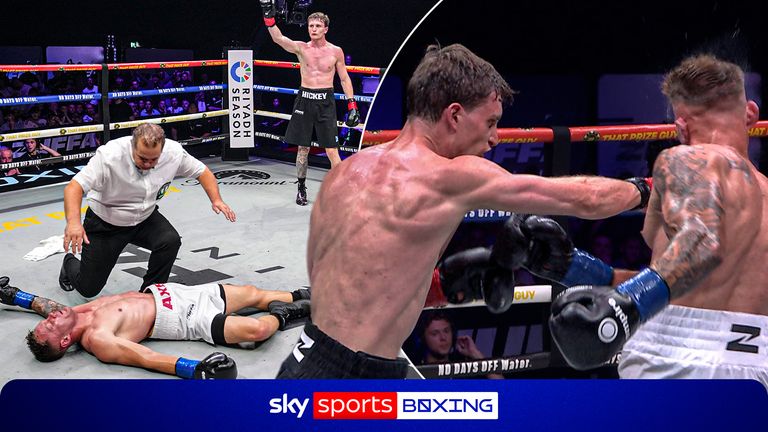
Slick Scottish middleweight prospectSam Hickey scored a second consecutive victory with a monstrous one-punch finish.
Please use Chrome browser for a more accessible video player
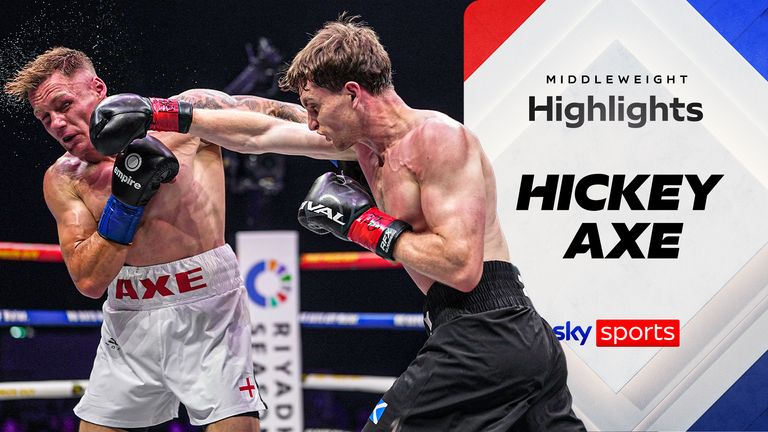
Sam Hickey’s huge right hand knocked out Brad Axe in the seventh round of their contest.
Brad Axe was a competitive opponent, digging in and firing back when Hickey clipped him.
In the third round, Hickey stepped in and landed a short right to the side of the head that dropped Axe to a knee. The bell, though, rang to save him.
But Axe kept himself in the fight and caught Hickey in return. Regularly, though, Hickey finished rounds strongly, driving Axe into the ropes only for the bell to call him off.
Hickey, though, finished matters at the start of the seventh round. Axe bounced in and a booming right greeted him, spinning him round as he flopped down to the canvas. The towel immediately came in as Axe suffered a heavy stoppage.
Please use Chrome browser for a more accessible video player
Watch highlights of Sam Hickey’s clash with Brad Axe from Zuffa Boxing 10 in Dublin.
Romania’s Daniel Buciuc managed to get through six rounds with Louis Greene, though he was in severe trouble in the closing seconds of the bout.
After a quiet first round, Greene closed down Buciuc’s space, hammering his body with hooks. He brought hard, chopping shots through the middle, jolting the Romanian.
Buciuc soon tried to move off, but he couldn’t keep clear. Greene took him to the ropes and Buciuc had to endure salvos of punchers, hefty uppercuts jolting him.
He attempted to tie up Greene but that left him open to the Briton’s overarm right.
Buciuc was hanging on as Greene shook him up in the final half-minute of the contest. With his legs loosening, Buciuc still kept himself upright and got through to the final bell, Greene winning 59-55.
Connor Coyle took a unanimous points decision win after a bruising 10 rounds with the USA’s Mark Beuke. The man from Derry put himself in the ascendancy in the early going of the bout, teeing up some solid right hands that blasted straight into Coyle.
Image: Coyle picked up a cut early in the fight (Photo: Ed Mulholland/Zuffa Boxing)
But the American took his power and a cut opened by Coyle’s right eye to complicate his evening’s efforts.
Beuke stood his ground and kept Coyle honest with heavy hooks that he managed to land with either hand. But his successes came as single blows. Coyle worked better combinations and made sure he finished their exchanges with accurate punching.
Coyle finished the bout bleeding from the nose but reeling off straight punches to push Beuke back, winning 98-92, 98-93 and 97-93.
Patrick O’Connor, a top American cruiserweight prospect with Irish roots, made short work of Spain’s Juan Manuel Moriel.
Measured with his jab, O’Connor quickly took control. He lashed a right over and began to work the body as he ramped up his attack. The American finished a blazing combination of hooks to Moriel’s trunk with a left hook to the head.
Image: Patrick O’Connor maintains his winning run. (Photo: Cooper Neill/Zuffa Boxing)
With O’Connor about to step up his performance, the bout was stopped after the first round, Moriel citing a shoulder injury as he remained on his stool.
The American remains unbeaten in four pro fights, all of those wins coming inside the distance.
Common painkillers, including ibuprofen, could increase the chance of getting sunburn.
Britain’s health watchdog has warned as the country braces for its fifth blistering heatwave of the summer.
The public is urged to take extra precautions if taking the medicine in warmer weather, with temperatures set to soar to 36C next week.
The Medicines and Healthcare products Regulatory Agency (MHRA) said on Friday that drugs like ibuprofen and naproxen could increase sensitivity to the sun, making burns more likely.
Other treatments that can increase sensitivity include antibiotics like doxycycline and tetracycline, acne treatments like isotretinoin and topical retinoids, and antifungal medicines such as voriconazole.
A person drinks from a bottle while sat on sun-scorched grass at Victoria Tower Gardens (AFP/Getty)
Dr Alison Cave, chief safety officer at the MHRA, said: “Some commonly used medicines can affect the body’s ability to stay hydrated, regulate temperature, or protect itself from sun exposure.
“Simple precautions can make a significant difference. Staying hydrated, avoiding the strongest sun during the middle of the day, and using protective clothing and sunscreen can all help reduce risk.”
She noted diuretics, often prescribed for blood pressure or heart conditions, can increase fluid loss and make dehydration more likely.
Meanwhile, some antidepressants and antipsychotics can affect the body’s ability to regulate temperature, and medicines like beta blockers may reduce the body’s response to heat stress.
The body uses several mechanisms to regulate temperature: sweating, blood flow to the skin and fluid balance. But some commonly prescribed drugs interfere with these processes, making it harder to stay cool.
Older adults, people with chronic conditions – especially those with heart or lung disease – and those taking multiple prescription drugs are particularly vulnerable to heat-related illnesses.
The public is urged to take extra precautions if taking the medicine in warmer weather (PA)
Last month, doctors warned people on certain mental health medications to take extra precautions ahead of another heatwave.
Dr Nick Broughton, NHS England’s national director for mental health, learning disabilities and autism, said that people taking antipsychotic medication and antidepressants need to be extra cautious during hot weather, as some of these medicines can make it harder to keep the body cool.
“Most importantly, they should not stop taking their medication suddenly and can speak to their GP, pharmacist or mental health team for advice if they need to,” he said.
New yellow health heat alerts came into force this week as the UK prepares to face its fifth heatwave of the summer.
The alerts run until 9pm on Tuesday across all of England, except the North East and North West.
They warn that the hot weather is likely to affect the wellbeing of the population, particularly those who are vulnerable or have health conditions.
A firefighter works to contain a grass fire which started at Lake Farm Country Park in Hayes on 8 August (AFP/Getty)
The Met Office said temperatures will climb through the weekend as heatwave conditions return, with a high of 36C expected in parts of East Anglia and south-east England by Thursday.
To reduce the risk of medicine-related problems during the summer, people are encouraged to:
Check the patient information leaflet for advice on sun exposure and hydration. This information comes with every medicine and can also be accessed online.
Be aware of signs that the body is struggling in the heat, including dizziness, headaches, unusual fatigue, confusion or reduced urination. Skin that becomes red, sore, blistered or reacts more intensely after sun exposure may also be a sign of increased sensitivity linked to medication.
Do not stop taking prescribed medicines during hot weather without advice. Anyone who is unsure about how their medication may be affected by heat or sunlight should speak to a pharmacist or GP.
About Channel:
Welcome to the official channel of Dunya News Global. Pakistan’s Top News Network delivering the latest from around the globe.
Home to some of the most popular Talk Shows and Journalists such as Hasb e Haal, Mazaaq Raat, Dunya Meher Bokhari Kay Sath, On The Front With Kamran Shahid, Think Tank, Ikhtalafi Note and, more.
Dunya News Live Stream https://dunyanews.tv/live
Follow Our Facebook Page: https://www.facebook.com/dunyanews
Follow our Twitter Page: https://twitter.com/dunyanews
The crisis over the Strait of Hormuz has been the central front in the recent conflict between Iran and the United States. With a new temporary agreement mediated by Oman, the world has seen a significant de-escalation. But does this deal represent a definitive victory for Iran? To answer this question, we must examine what Iran has achieved, what it has conceded, and what the future holds.
What the New Hormuz Deal Actually Says
Recent reports indicate that Iran and Oman are close to finalising an agreement that will reshape the passage of commercial shipping through the Strait of Hormuz. Under this new arrangement, a new single route will replace the temporary northern and southern routes. Critically, part of this new route will pass through Iran’s territorial waters.
Key details of the emerging agreement:
Reopening: The agreement aims to restore navigation in the waterway, effectively ending the blockade that Iran imposed following joint US-Israeli strikes in February 2026.
Duration: It is a temporary arrangement expected to last for 60 days to a few months, providing a cooling-off period.
No Fees: For the initial period of this agreement, Iran has reportedly agreed not to impose transit fees or service charges.
U.S. Role: The U.S. has been an indirect party to these talks through mediators, and reports suggest a return to a previous peace memorandum of understanding (MoU) is contingent on tangible U.S. implementation of its commitments.
Map showing proposed Iran-Oman shipping route through Strait of Hormuz
Why This Could Be Seen as a Victory for Iran
The deal is seen by many analysts as a significant win for Tehran and could be considered a powerful piece of proof that Iran can win this war, at least in the strategic sense.
1. Gaining De Facto Control Over the Strait The most significant achievement for Iran is the recognition of its role in managing the strait. By shifting the route to pass through its territorial waters, Iran has secured a de facto acknowledgement of its authority over the strategic waterway. A researcher from the China Institute of International Studies noted that the core issue of the negotiations was Iran maintaining the “ultimate control” of the strait, even if the exact wording is flexible. This represents a shift from the traditional model where the strait was treated as an international waterway.
2. The U.S. Acknowledges Iran’s Leverage After months of military confrontation, the U.S. found itself unable to quickly neutralise Iran’s asymmetric tactics, such as naval mines, fast attack boats, and coastal missiles. This forced the U.S. into an unusual position: relying on allies and indirect negotiations to resolve the crisis rather than acting unilaterally. This suggests Iran’s strategy of making the strait impassable for its adversaries was effective in forcing the U.S. to negotiate. As one expert put it, U.S. naval escorts now protect ships passing through Iranian-controlled waters, creating a new and unfavourable reality for Washington.
3. Exposing U.S. Vulnerabilities The crisis has arguably been more damaging to U.S. standing than to Iran’s. Iranian Supreme Leader Mojtaba Khamenei stated that a new chapter in the Gulf is “taking shape” following a U.S. “ignominious defeat” in its plan against Iran. The war has also exposed the vulnerability of U.S. Gulf allies, who now see the U.S. military presence as a potential liability rather than a security blanket.
Why the Deal is Not the Final Victory
While the deal is a major diplomatic success for Iran, declaring it “the final proof” of victory is premature for several reasons.
1. It’s Only Temporary The agreement is explicitly labelled “temporary” and lasts only 2 to 4 months. This suggests it’s a stop-gap measure to prevent immediate escalation, not a long-term resolution of the underlying conflict. The core issues, including Iran’s nuclear programme and the future of U.S. forces in the region, remain unresolved.
2. The U.S. Has Not Formally Endorsed It The deal is between Iran and Oman. While the U.S. is likely involved indirectly, it has not signed or formally approved the arrangement. This means the U.S. could choose not to recognise Iran’s claims or the new route in the long term, which could potentially re-ignite the conflict. As one analyst noted, the U.S. “accepting” the deal is different from “recognising” it, which could lead to future challenges, particularly over the issue of fees after the 60-day grace period.
3. Economic and Military Pressures Persist Despite this diplomatic breakthrough, Iran’s economic situation remains dire. The country is still under heavy sanctions, and the economic damage from the conflict will take months to repair. Furthermore, U.S. President Trump has stated that if diplomacy fails, military options are still available. The underlying power imbalance in favour of the U.S. military remains unchanged.
4. “Winning” the War vs. “Not Losing” It Iran’s strategy has been one of resilience—it has managed to inflict economic pain and show its strategic importance without suffering military defeat. This is a victory of a sort, but it is a victory of surviving a war rather than winning it in the traditional sense. The conflict has likely set the country back economically and politically, and the “bright future” of the Gulf that Iran envisions without the U.S. presence is still a distant goal.
Commercial vessels travelling through the Strait of Hormuz
Conclusion
Is the new Hormuz deal the final proof that Iran can win this war? The agreement shows that Iran has successfully used its geographic leverage to force the U.S. into a negotiation it sought to avoid. Iran has achieved a key strategic objective: a clear role in managing the world’s most important oil chokepoint.
However, a temporary agreement is not a final victory. The war is not over; it has simply entered a new, perhaps less volatile, phase. Iran has shown that it can start a crisis and make the costs of war high, which is a form of power. But the final chapter of this confrontation is still being written. For now, the New Hormuz Deal is proof of Iran’s resilience and strategic capability, but it is more of a powerful bargaining chip than a final triumph.
The Iran-Oman shipping route has moved a significant step closer after Tehran said the two countries had reached an understanding on the geographic coordinates of a proposed maritime corridor through the Strait of Hormuz.
Iranian Foreign Ministry spokesperson Esmaeil Baghaei said on August 5 that Tehran and Muscat had agreed on the coordinates envisaged for the shipping route and were working on a joint announcement. However, the arrangement was still being finalised and did not represent an unconditional reopening of the strategic waterway.
That distinction matters. The Strait of Hormuz is one of the world’s most strategically important maritime passages, and developments affecting traffic through it can have consequences far beyond Iran and Oman. Energy markets, shipping companies, insurers and governments are therefore closely following the negotiations.
What Has Iran Actually Announced?
According to Tehran, Iran and Oman have reached a mutual understanding regarding the geographic coordinates of the proposed route. Baghaei said a joint statement containing the main considerations and areas of agreement was in the final stages of review and drafting.
This means reports describing the matter as a completely finished shipping agreement should be treated carefully.
The negotiations have made meaningful progress, but important operational and security questions remain. Reuters reported that regional officials said some details were still under discussion.
Iran has also stressed that an Iran-Oman agreement by itself would not automatically guarantee security throughout the Strait of Hormuz.
A map showing Iran, Oman and the Strait of Hormuz would be particularly useful.
Why Is the Strait of Hormuz So Important?
The importance of the Iran-Oman shipping route becomes clearer when looking at the geography.
The Strait of Hormuz connects the Persian Gulf with the Gulf of Oman and the Arabian Sea. Iran sits on its northern side, while Oman occupies territory on the southern side.
That location makes the strait critical to international energy and commercial shipping.
Disruption in the waterway can affect oil and gas markets, freight costs, maritime insurance and global supply chains. Even expectations of improved shipping conditions can influence energy prices.
Recent signs of progress in the Iran-Oman negotiations have therefore attracted considerable attention from international markets.
Iran and Oman Have Been Negotiating for Weeks
The latest announcement was not unexpected.
Iran and Oman have been holding technical and political negotiations over navigation arrangements in the Strait.
In a joint statement on June 23, both governments reaffirmed their commitment to safe passage through the strait in accordance with applicable international law while also emphasising their sovereignty and sovereign rights over territorial waters.
Further negotiations took place in July. Iranian officials said discussions covered common principles and operational mechanisms for managing safe shipping while respecting the rights of both coastal states.
The agreement on geographic coordinates therefore represents another stage in a longer negotiating process.
What Could the New Shipping Arrangement Look Like?
This issue is one of the most sensitive parts of the negotiations.
Iran previously rejected an Omani proposal that Tehran described as effectively dividing control of the temporary route equally between the two countries. Iranian Deputy Foreign Minister Kazem Gharibabadi instead said Tehran wanted one shipping lane entirely within Iranian-controlled waters and part of another lane under Iranian control.
Reuters subsequently reported that the emerging proposal could give Tehran control over ships entering the Gulf through the Strait of Hormuz.
That makes the arrangement more than a technical question about drawing coordinates on a maritime chart. It potentially touches on sovereignty, navigation rights and regional security.
commercial tankers travelling through the Strait of Hormuz.
What Does the Agreement Mean for Global Shipping?
If implemented successfully and accompanied by sufficient security guarantees, a functioning route could provide greater predictability for commercial vessels.
For shipping companies, predictability matters enormously. Uncertainty surrounding a strategic waterway can lead to higher insurance premiums, scheduling problems and additional risk-management costs.
A stable arrangement could therefore benefit the following:
Oil and LNG shipments
Container shipping
Regional imports and exports
Maritime insurance
Gulf ports and logistics businesses
International supply chains
However, shipping companies will want more than a political announcement. They will need clear navigation procedures and credible assurances that vessels can transit safely.
Oman Has a Crucial Diplomatic Role
Oman’s involvement is particularly important because it is both a coastal state on the Strait of Hormuz and an established diplomatic intermediary in regional disputes.
Muscat has maintained channels of communication with Iran and strong relationships with Western and Gulf governments.
That puts Oman in an unusual position: it has a direct geographic interest in navigation through the strait while also being able to facilitate politically sensitive negotiations.
The Omani government has previously publicly reaffirmed its commitment alongside Iran to safe passage through the Strait of Hormuz.
A photo of Muscat, an Omani port, or Iranian-Omani diplomatic talks would work well
Why Markets Are Watching Closely
The negotiations are about ships, but their economic consequences potentially reach petrol stations, factories and households around the world.
When a major energy transport corridor is disrupted, traders may price in additional geopolitical risk for oil and gas.
Conversely, signs that shipping conditions could normalise may ease some of that pressure. Recent progress in negotiations has already raised hopes that the wider situation could stabilise.
Still, markets are likely to remain sensitive until the terms of any arrangement become clearer and commercial shipping can operate reliably.
Is the Strait of Hormuz fully reopened?
This situation is where news reports need careful wording.
No final, unconditional reopening should be inferred simply from Tehran’s announcement about the route coordinates.
Iran says the two sides have agreed on the geographic coordinates of a route and that a joint announcement is being prepared. But Tehran has simultaneously cautioned that such an agreement would not by itself guarantee the security of the waterway.
Questions also remain about the exact management of the corridor and the wider political arrangements surrounding it.
The immediate next step is expected to be completion of the Iran-Oman joint statement.
Thereafter, attention will shift toward how the arrangement works in practice. Governments and shipping companies will be looking for details concerning navigation procedures, security arrangements and the responsibilities of Iran and Oman.
The response of other governments will also be important. The negotiations involve a waterway with enormous international significance, so an agreement between the two coastal states is unlikely to end the wider diplomatic debate.
A container vessel or oil tanker sailing at sunset would make a strong final visual before the conclusion.
Frequently Asked Questions
What is the Iran-Oman shipping route? It is a proposed maritime route through the Strait of Hormuz being negotiated by Iran and Oman to manage commercial shipping through the strategically important waterway.
Have Iran and Oman reached an agreement? Iran says the two sides have reached an understanding on the geographic coordinates of the proposed route and are finalising a joint announcement. Some operational details have still been under discussion.
Why is the Strait of Hormuz important? It is a critical maritime connection between the Persian Gulf and the Gulf of Oman and is particularly important for international energy shipments.
Does the agreement guarantee safe shipping? Not necessarily. Iran’s Foreign Ministry has explicitly said that an agreement between Iran and Oman would not, on its own, guarantee security in the waterway.
What happens next? The two governments are expected to finalise their joint statement while technical and political details surrounding the shipping arrangement continue to receive scrutiny.
Conclusion
The negotiations for the shipping route between Iran and Oman represent an important development for one of the world’s most strategically sensitive waterways. Tehran says Iran and Oman have agreed on the geographic coordinates of a proposed route through the Strait of Hormuz, bringing the two neighbours closer to a formal arrangement.
However, the announcement should not be confused with a complete resolution of the dispute. Security guarantees, operational arrangements and the wider political questions surrounding control of the strait remain crucial.
For global markets, even progress toward a stable shipping corridor matters. If Iran and Oman can translate their understanding into a workable and secure arrangement, the effects could extend well beyond the Gulf—potentially providing greater certainty for energy shipments, international trade and global supply chains.
London is bidding to host the world’s largest international Pride festival in 2032 as the city marks 60 years since its first official Pride march.
WorldPride is held every other year and brings together people from across the globe to celebrate LGBTQ+ diversity, identity, and belonging.
The event is being held in Amsterdam this year and will then be celebrated in Cape Town in 2028, before London hopes to take the reins in 2032, with The Independent acting as one of its media partners.
London’s bid coincides with the 60th anniversary of the city’s very first Pride march in 1972.
which was a response to New York’s Stonewall riots. The number attending was just a fraction of the estimated 1.5 million who attended this year’s Pride in London event.
Thousands gathered in London for Pride in July (PA Wire)
The bid was announced on Thursday at a special reception during WorldPride Amsterdam at the British Council, with the launch of a design competition and global photography campaign.
Members of the LGBTQ+ community from across the globe have been invited to submit photographs celebrating identity, allyship and belonging. These photos will be transformed into a living mosaic created from thousands of community photographs that hope to tell the story of pride in all its forms.
The bid also invites creatives across the UK to submit an original logo design. If London is successful in its bid, the winning design will become London’s official WorldPride 2032 bid logo.
The logo design will be unveiled at the end of October through an immersive installation across Outernet London’s world-famous digital screens, with photos from the campaign on show, with the designer receiving a £3,000 prize. Entries, to be submitted via the Pride in London website, will close on 25 September and the winner will be announced at the start of October.
The Independent marched at this year’s Pride in London (Supplied)
Rebecca Paisis, the interim CEO of Pride in London, which is co-leading the bid with Outernet and UK Black Pride, has said that community is a core part of the bid.
“Pride has always been powered by community,” she added. As we launch London’s bid for WorldPride 2032, we want our community to help shape its future from the very beginning.
“We’re looking for bold, inspiring designs that capture London’s unique spirit and photographs that celebrate Pride in all its forms across the world. As we approach the 60th anniversary of London’s first Pride march, this project gives every generation an opportunity to leave their mark on what could become one of the defining moments in our movement’s history.”
The Independent and The Standard are official news media partners of the bid and will contribute photography from decades of Pride coverage to help tell the story of London’s LGBTQ+ journey as part of the final artwork and create a tangible bridge between Pride’s past and its future.
Beth Gordon, The Independent’s brand marketing and communications director, said: “The Independent and The Standard have proudly documented London’s Pride movement for decades.
As steadfast campaigners for LGBTQ+ communities, we are delighted that images from our archives will help tell this remarkable story, preserving the history of Pride while contributing to its future.”
London hopes to host WorldPride in 2032 (Pride in London)
The Independent has partnered with Pride in London for five years during Pride Month, building on the publication’s long history of LGBTQ+ campaigning and reporting. Its team joined thousands of marchers and took part in the Pride in London parade on 4 July this year.
Kicking off Pride Month in June, The Independent published its Pride List, continuing a decades-long tradition of championing LGBTQ+ figures in Britain across entertainment, sport, business, law, fashion, politics, campaigning and the arts.
Comedian Alan Carr topped the list following his unforgettable victory on The Celebrity Traitors in November last year, followed by one of the Women’s Rugby World Cup winners, Meg Jones; transgender rights advocate and healthcare worker Stephanie Lynette; drag queen Bimini; and Green Party leader Zack Polanski.
The mayor of London and TripAdvisor are also supporting the London World Pride 2032 bid.
Gut health has shifted from the sidelines of wellness culture into the mainstream, yet a new IFIC Spotlight Survey: Americans’ Perceptions Of Gut Health finds that consumer enthusiasm has outpaced consumer understanding. Nearly two-thirds of Americans (64%) consider gut health a high or extremely high priority, yet how they define it is deeply personal, often shaped more by tangible everyday experiences than less immediate outcomes.
For most people, gut health is synonymous with digestion. Proper digestion and absorption of nutrients was the most common definition (36%), and when asked what gut health affects most, Americans overwhelmingly pointed to everyday digestive outcomes: digestive comfort (48%), regular bowel movements (38%), and nutrient absorption (33%). Far fewer people connected gut health to broader outcomes that are increasingly linked to the gut, such as immune function (20%), mental or emotional health (20%), brain function (12%), or skin health (10%).
“Consumers are clearly telling us that gut health matters to them; it has become a high priority in how people think about their overall wellness,” Wendy Reinhardt Kapsak, MS, RDN, president and CEO of IFIC, said in a statement. “For many people, gut health is more of a feeling and less a defined concept — ‘I don’t feel bloated, so my gut is healthy.’ That’s a great starting point for food and nutrition professionals, where they can then broaden the conversation to include the many benefits associated with gut health.”
Gut Health By Vibes: A Personal Definition
The survey suggests Americans largely assess their gut health by how they feel rather than by clinical measures. More than eight in ten (84%) rated their gut health over the past 30 days as good, very good, or excellent — and the actions they have taken reflect an intuitive, self-directed approach. In the past year, Americans say they have most often supported their gut health through lifestyle changes: improving their overall diet (31%), increasing fibre from foods (30%), and becoming more physically active (29%). Far fewer turned to specialised tools such as functional foods or beverages (13%), healthcare professional consultation (12%) or testing kits (5%).
More than half (54%) said they limit or avoid certain foods or beverages to support their gut. Among those who do, the most commonly restricted items are highly processed foods (45%), fatty foods (42%), alcohol (42%), and sugary foods or beverages (40%). Americans view gut health as largely within their control, ranking poor diet (50%) and stress (37%) as the most detrimental influences, while fewer point to factors they have less control over, such as ageing (17%), hormonal changes (13%) or environmental exposure (10%).
“What stands out in this data is that gut health is being defined by vibes — it’s personal, it’s intuitive, and it’s often conflated with digestion,” Monica Amburn, MS, RDN, LDN, vice president, food safety & nutrition at IFIC, said in a statement. But digestion is only one aspect of gut health. The science points to six domains of gut health, including digestive physiology, the microbiome, the gut barrier, the gut-brain axis, endocrine function, and immune function. When consumers equate ‘feeling normal’ with a healthy gut, they see only a small slice of something much bigger. That’s not a criticism of consumers; it’s a signal of where clearer communication is needed.”
A Moment Of Momentum For The Science
The findings arrive as gut health gains formal recognition. For the first time, the Dietary Guidelines for Americans, 2025–2030, explicitly reference the gut microbiome and recommend fermented foods to support gut health. The International Scientific Association for Probiotics and Prebiotics (ISAPP) also recently published the first international consensus statement defining gut health and identifying its six domains: the gut microbiome, gut barrier, gastrointestinal physiology, the gut-brain axis, immune function and metabolism.
And interest is climbing alongside the science. According to the 2025 IFIC Food & Health Survey, 37% of Americans now seek gut or digestive health benefits from their foods and beverages, a 7-percentage-point increase since 2022.
Where Consumers Turn For Answers
When it comes to trusted information about gut health, Americans place the greatest confidence in information sources with scientific or clinical expertise: healthcare professionals (74%), scientific studies (65%), and health-focused websites (63%). Food and beverage brands (34%), AI chatbots (34%), and non-expert influencers (25%) drew the lowest levels of trust, underscoring both the appetite for credible guidance and the role professionals can play in filling the gap.
“The science of the gut microbiome is still evolving, and that’s precisely what makes this moment so exciting,” added Reinhardt Kapsak. “There’s a real appetite among consumers to understand what’s happening inside their bodies — not just to feel better day to day, but to reduce their risk for chronic disease and live longer, healthier lives — and the research is beginning to catch up to that curiosity. It’s an exciting opportunity to help people connect their everyday dietary choices to a more profound understanding of their health.”
Rangers manager Derek McInnes is still looking for his first win after they fell to a 2-1 defeat to Jagiellonia Bialystok in Europa League qualifying. McInnes made five changes from their Premiership draw with Dundee United and they made the dream start in Poland as Guilherme Montoia’s own goal put them 1-0 up.
But Manny Fernandez returned the favour by turning Kajetan Szmyt’s cross into his own net, and the Jagiellonia midfielder then took advantage of some poor Rangers defending to fire in a second before half-time.
Image: Guilherme Montoia’s own goal gave Rangers an early lead in Poland
McInnes brought on Cammy Devlin, Nico Raskin and Findlay Curtis for the second half. Despite improving the side’s attacking threat, they were unable to convert it into goals.
Image: Kajetan Szmyt made it 2-1 to Jagiellonia Bialystok
Szmyt went close to a hat-trick with a shot straight at Rangers goalkeeper Ivor Pandur, then Jesus Imaz missed a brilliant chance to extend the hosts’ lead when he sent his effort wide.
Gers substitute Lawrence Shankland failed to poke home a loose ball to level the match before Curtis’ stoppage-time volley crashed off the post.
Rangers have a lot to do at Ibrox next week. The winners will face Larne or Iberia 99 in the Europa League play-off round, with the losing side dropping into the Conference League play-offs.
The key moments from the Chorten Arena
4: GOAL! Rommens sends in a low cross that is just out of Chermiti’s reach, but it comes off Montoia and goes in.
13: GOAL! Disaster for Rangers as Szmyt’s ball from out wide comes off Fernandez and ends up in the back of the net.
21: GOAL! Szmyt fires in on the rebound after Pandur denies Imaz.
61: CLOSE! Raskin plays a brilliant ball to Curtis, but Curtis can’t get his effort on target.
68: LET OFF FOR RANGERS! Imaz is through but somehow misses the target.
86: BIG CHANCE! Shankland blocks Fernandez’s header from the corner but fails to poke home the loose ball.
90+3: OFF THE POST! Rangers inches away!! Shankland nods the ball back for Devlin but his volley crashes off the woodwork.
Late chances give confidence
Sky Sports’ Alison Conroy:
It was another disappointing result for Rangers in Europe.
Their second-half performance will give them confidence that they can improve at a sell-out Ibrox next week if they can avoid more defensive lapses.
The two goals they conceded were completely avoidable, much to Derek McInnes’ frustration.
Image: Daisuke Yokota made his Rangers debut in Poland
Big players started the game on the bench. Their introduction coincided with a much-improved showing, giving the manager decisions to make ahead of Hibernian in the Premiership on Sunday before their return leg.
New signing Daisuke Yokota was thrown in at the deep end less than 48 hours after joining the Ibrox side and he tried to get involved. Another week of training for him and his fellow summer signings could be very beneficial.
A University of Cambridge professor has resigned from his post after the university placed him under investigation following a row over plagiarism.
Professor Jason Arday, a professor of sociology of education who became Cambridge’s youngest Black professor in 2023, stepped down on Wednesday evening.
His resignation followed the university’s launch of an inquiry into his “academic qualifications and honorary appointments.”
In a letter addressed to colleagues, published on the Good Law Project’s website, Professor Arday stated: “While criticism is an inevitable part of academic life, what I have experienced has gone far beyond scholarly disagreement.
The relentless accusations, speculation and public commentary have had a serious impact on me and on those I love.
This departure comes shortly after the University of Cambridge announced its investigation into “new information” regarding Professor Arday’s credentials.
Professor Jason Arday’s resignation letter in full:
“It is with profound sadness that I write to resign, with immediate effect, from my position at the University of Cambridge and Jesus College.
“When I accepted the extraordinary honour of becoming Professor of Sociology at Cambridge, it was, without question, the greatest professional privilege of my life.
“To become the youngest Black professor in the university’s history was something I could scarcely have imagined as a child growing up with a diagnosis of autism, unable to speak until I was eleven years old.
“The response from so many people across the world was overwhelming. Thousands celebrated not simply my appointment, but what it represented: that talent, perseverance and hope can triumph over even the greatest adversity.
This departure comes shortly after the University of Cambridge announced its investigation into ‘new information’ regarding Professor Arday’s credentials (St Mary’s University Twickenham)
It has been the privilege of my life to teach my students, learn alongside them, and witness their curiosity, kindness and ambition. They have given me far more than I could ever have given them.
“Sadly, the years since my appointment have also been marked by an unrelenting level of public scrutiny and personal attack.
“While criticism is an inevitable part of academic life, what I have experienced has gone far beyond scholarly disagreement. The relentless accusations, speculation and public commentary have had a serious impact on me and on those I love.
“I have tried to continue because I believe deeply in the values of higher education, in rigorous scholarship, and in the transformative power of universities. I have tried because of my students, my colleagues and the countless people who have written to tell me that my journey gave them hope.
“But there comes a point when the personal cost becomes too overwhelming.
“I have a family. I want to be present for them. I want to reclaim some peace, some privacy and some semblance of an ordinary life. I no longer wish to feel as though I am living under a constant spotlight, where every aspect of my life is subject to public examination and judgement.
“For my own wellbeing, for my family, and for those who have stood by me throughout this difficult period, I have concluded that the only way to bring this chapter to an end is to step away.
“This decision should not be interpreted as a loss of faith in scholarship or in the values that first brought me to Cambridge. Nor should it be mistaken for an acceptance of the narratives that have surrounded me. It is simply the decision of someone who has reached the limits of what any person should reasonably be expected to endure.
“To my students: thank you. Teaching you has been the greatest honour of my academic career. Your brilliance, compassion and determination give me enormous hope for the future.
“I offer my deepest gratitude to my colleagues and to the many thousands of people from every corner of the world who have supported, defended, written to, and believed in me when it mattered most. Your kindness has carried me through some of the darkest moments of my life.
“This is not the end of my work. It is simply the end of this chapter.
“I need time to heal. I need time to simply be myself again. And when that time comes, I will return.
“I will return stronger, wiser and with the same determination that has always defined my journey. There is still so much work to do, and I look forward to doing it alongside so many of you in the years ahead.
“For now, however, I ask only for understanding, for compassion, and for the space to begin again.”
Ants and mammals use related brain signalling systems that help control caregiving behaviour. Ants also change their social roles as they grow older, making them useful for studying how parenting evolved and how behaviour shifts as their brains age. The findings could eventually offer clues about similar processes in mammals, including humans.
For much of evolutionary history, many animals reproduced and then left their offspring to survive alone. A study published in Nature now offers a possible explanation for how caregiving emerged from those distant, nonparental beginnings.
By studying clonal raider ants, researchers found that evolution may not have created entirely new brain systems for parental behaviour. Instead, it appears to have adapted ancient neural pathways that originally regulated hunger and feeding, giving them a new role in social care.
“Our work is a prime example of how evolution seldom invents things from scratch,” says Daniel Kronauer, head of the Laboratory of Social Evolution and Behaviour at Rockefeller. “Evolution takes what it has and works with that, sometimes in very surprising ways.”
How Evolution May Have Built Parenting
Parental care appears in many forms across the animal kingdom. Mammals feed their young with milk, birds protect and maintain nests, and ants tend developing larvae. Scientists have long wondered how such complex caregiving behaviours evolved from ancestors that offered minimal care.
One leading idea is that evolution reused biological systems that already existed. Earlier research in mammals suggested that certain neuropeptides, which are small molecules used by the brain to communicate, may have shifted from regulating hunger to encouraging parental behaviour.
Proving that connection has been difficult. Fruit flies and roundworms, two widely used animals in neuroscience research, do not care for their offspring. Mice do provide extensive parental care, and scientists have identified several neuropeptides involved in this behaviour, but the mouse brain is highly complex.
Kronauer’s team found that some of the neuromodulatory mechanisms involved in caregiving overlap in ants and mice. This makes ants a potentially valuable research model. An ant brain contains about 60,000 cells, compared with roughly 100 million in a mouse brain, so scientists may be able to study the underlying circuits in much greater detail and at a faster pace.
Tracking Caregiving One Ant at a Time
The researchers created an automated behavioural system that placed individual ants with individual larvae. This setup allowed the team to monitor hundreds of caregiving interactions.
They then identified and synthesised many of the chemical messengers found in the ant brain. Each molecule was tested to see whether it changed the ants’ caregiving behaviour.
Ant colonies have a strict division of labour that is heavily dependent on age. Younger ants generally remain inside the nest and care for larvae. As they grow older, they are more likely to leave the nest and forage for food.
The researchers wanted to understand how changes in brain chemistry control this transition. They studied where the most promising molecules were produced, how their levels changed over an ant’s lifetime, and what happened when their activity was increased or reduced.
The team also compared ants that had been fed with ants that had been deprived of food. This allowed the scientists to test whether the signals involved in caregiving were still connected to the ancient feeding circuits from which they may have evolved.
“We annotated the neuropeptidome of this ant, the complete set of neuropeptides,” says Kay. “There were 70 that we could identify. It took a lot of hard work, but now we have a set of molecules that we can investigate in numerous ways.”
Two Brain Molecules Shape Ant Behavior
The results showed that caregiving in ants remains closely tied to the brain systems that regulate hunger. Two signalling molecules appeared to push behaviour in opposite directions, depending on the ant’s age and internal conditions.
Neuropeptide F (NPF) encouraged ants to care for larvae. Allatostatin A (AstA), in contrast, made ants more likely to leave the larvae and begin foraging.
Young ants naturally had higher levels of NPF and lower levels of AstA in important areas of the brain. Older ants showed the reverse pattern. That shift matched the insects’ normal progression from nursing larvae inside the nest to gathering food outside it.
When researchers altered the activity of either molecule, the ants changed their behaviour. These results demonstrated that the neuropeptides were not merely associated with caregiving but could actively influence whether an ant nurtured larvae or went searching for food.
Hunger Can Push Ants Toward Caregiving
The same molecules also responded to hunger, just as related signals do in mammals. Starved ants developed higher levels of NPF and lower levels of AstA, making them behave more like carers.
After the ants were fed, the chemical balance reversed. They became less focused on tending larvae and more inclined to forage.
“We learnt that parental behaviours build on the neural circuitry for feeding, and that makes some sense,” Kronauer says. “Parental behaviour is largely about feeding — not just yourself, but also your offspring.”
The findings support the idea that parental care evolved by adapting brain systems that were already responsible for finding and consuming food. Rather than inventing caregiving from nothing, evolution may have expanded feeding behaviour so that animals became motivated to provide nourishment to their offspring as well as to themselves.
A Shared Blueprint for Parenting
The researchers now plan to identify the specific neural circuits affected by NPF and AstA. Mapping those pathways could reveal how chemical signals translate into caregiving behaviour.
Mammals appear to use some of the same neuropeptides when caring for their young. Comparing the relevant circuits in ants and mammals may therefore help scientists uncover a shared biological strategy for parenting that crosses widely separated branches of the animal kingdom.
“It amazes me that similar parenting behaviours have evolved so many times in so many distinct animal lineages,” says Kay. “Our paper suggests that the evolutionary routes to these sorts of behaviours are far more constrained than we may have naively imagined. That’s very exciting, as it may eventually lead to a blueprint for how these complex social behaviours evolve.
Ants Could Also Reveal How Brains Age
Clonal raider ants may be useful for more than studying parenting. Their predictable transition from carers to foragers could also help researchers investigate how healthy ageing affects the brain and behaviour.
Much of ageing research focuses on severe disorders that appear late in life. Scientists know far less about the gradual changes that occur in a healthy brain across an individual’s normal lifespan.
Because age-related changes in ant behaviour are essential to the organisation of the colony, ants offer a natural system for studying how brain chemistry reshapes social roles over time. The researchers believe that similar chemical mechanisms may also influence age-related behavioural changes in other animals.
“There’s a lot of research and funding invested in studying late-stage neurodegenerative diseases, but we actually know very little about how the brain changes throughout the normal healthspan of an individual,” says Kronauer. In ant colonies, these dynamics are central to the organisation of their society. Our discovery provides a striking demonstration that neuromodulators can produce age-dependent changes in behavioural proclivities in ants, and I suspect that this is also the case in other animals, including humans.