

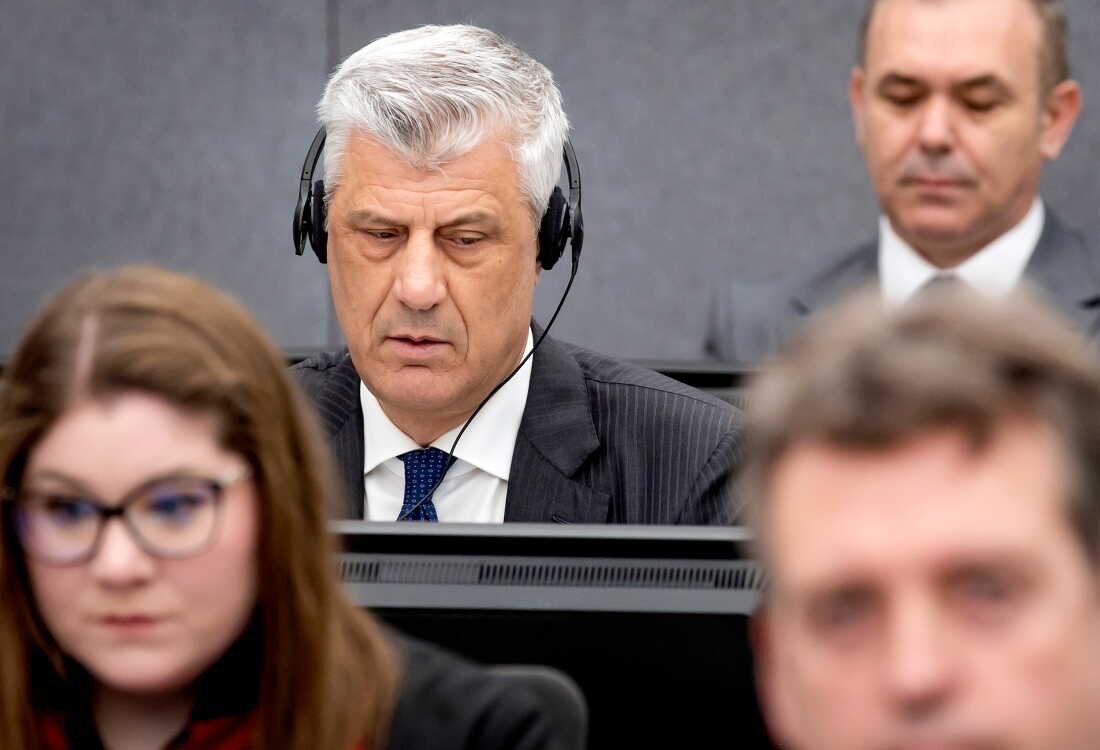

Hashim Thaci’s War Crimes Conviction Leads to 25-Year Sentence
Former Kosovo President Hashim Thaci has been sentenced to 25 years in prison after judges in The Hague found him criminally responsible for war crimes committed during the Kosovo conflict in the late 1990s.
On Wednesday, 16 September, the Kosovo Specialist Chambers delivered the landmark judgement.
Thaci, 58, was convicted alongside three other senior former members of the Kosovo Liberation Army: Kadri Veseli, Rexhep Selimi and Jakup Krasniqi.
The judges found the four men criminally responsible for the war crimes of arbitrary detention, cruel treatment, torture and murder.
According to the court, the crimes involved hundreds of victims during the conflict.
However, the panel acquitted all four defendants of crimes against humanity because prosecutors failed to prove beyond a reasonable doubt that the required widespread or systematic attack against a civilian population had occurred.
The verdict represents one of the most significant judgements concerning alleged crimes committed by senior KLA figures during Kosovo’s 1998-99 conflict with Serbia.
What Was Hashim Thaci Convicted Of?
The Hashim Thaci war crimes conviction involved four categories of offences.
The Kosovo Specialist Chambers found the defendants criminally responsible for the arbitrary detention of 385 people, the cruel treatment of 49 people, the torture of 303 detainees and the murder of 96 individuals.
The victims included people considered opponents of the KLA’s political or military objectives.
According to the court, they included Kosovo Albanians associated with rival political or military organisations, people suspected of having connections with Serbian or Yugoslav authorities, and members of ethnic minorities, including some Serbs and Roma.
The judges concluded that Thaci and his co-defendants made significant contributions to a common criminal purpose targeting perceived opponents of the KLA.
Thaci received a sentence of 25 years in prison, with credit for the time he has already spent in detention.

Three Other Former KLA Leaders Also Convicted
Thaci was not the only former senior KLA figure convicted.
Three other defendants received prison sentences.
Kadri Veseli was sentenced to 18 years, while Rexhep Selimi received 13 years.
Jakup Krasniqi was sentenced to 25 years, the same sentence imposed on Thaci.
All four will receive credit for the time they have already spent in detention.
The men had denied the charges against them during the lengthy proceedings.
Their trial began in April 2023 following years of investigation and legal preparation.
Judges Acquit Defendants of Crimes Against Humanity
One particularly important part of the judgement concerns the charges on which the defendants were not convicted.
The indictment included six counts of crimes against humanity: persecution, imprisonment, other inhumane acts, torture, murder and enforced disappearance.
But the trial panel found the defendants not guilty of crimes against humanity.
According to the court, prosecutors had failed to establish beyond a reasonable doubt that there was a widespread or systematic attack directed against a civilian population, which is a necessary legal element for those offences.
The defendants were also acquitted in connection with several specific alleged war-crime incidents.
This distinction is important when reporting the verdict.
The court found Thaci guilty of war crimes, but it did not convict him of every charge prosecutors had brought.
Prosecutors Had Sought a Much Longer Sentence
Prosecutors had requested significantly harsher punishment.
They sought sentences of 45 years for the defendants, arguing that the seriousness and scale of the crimes justified lengthy imprisonment.
The judges ultimately imposed lower sentences.
For Thaci, the final sentence was 25 years.
The difference reflects the court’s findings on the evidence, including its decision to acquit the defendants of the crimes-against-humanity counts and certain alleged war-crime incidents.
Thaci and the other defendants have appeal rights under the court’s procedures.
The judgement therefore represents a major legal milestone, but further proceedings could follow.
Who Is Hashim Thaci?
Hashim Thaci is one of the most influential figures in Kosovo’s modern political history.
During the 1998-99 Kosovo conflict, he became a prominent leader of the ethnic Albanian Kosovo Liberation Army, which fought Serbian and Yugoslav forces.
Thaci later became one of Kosovo’s leading politicians.
He led Kosovo’s delegation during the Rambouillet peace negotiations in France in 1999 and went on to play a central role in the country’s post-war political system.
After Kosovo declared independence from Serbia in 2008, Thaci served as prime minister.
He later became president of Kosovo.
For supporters, particularly within Kosovo’s ethnic Albanian majority, Thaci became closely associated with the struggle for independence.
For critics and prosecutors, however, unresolved allegations surrounding abuses committed during the conflict demanded judicial examination.
That divide helps explain why his trial and conviction remain intensely controversial.
Why Did Thaci Resign as Kosovo President?
Thaci resigned from the presidency in November 2020 after the Kosovo Specialist Chambers confirmed an indictment against him.
He said at the time that he was stepping down to protect the integrity of the presidency while he faced the allegations.
He was subsequently transferred to detention in The Hague.
Thaci has remained there during the proceedings.
His resignation marked a dramatic fall for a politician who had spent years at the centre of Kosovo’s political life and had regularly met senior Western leaders.
The trial began on 3 April 2023.
Prosecutors closed their case in April 2025, and the defence presented evidence later that year.
The evidentiary proceedings formally concluded in December 2025.
Closing arguments took place in February 2026 before judges began deliberating over the enormous evidentiary record.
The Trial Involved an Enormous Amount of Evidence
The scale of the proceedings helps explain why the verdict took years to reach.
According to the Kosovo Specialist Chambers, the panel considered evidence from approximately 270 witnesses, both orally and in writing.
Judges admitted 5,467 exhibits into evidence.
The transcript of the proceedings extended to more than 29,000 pages.
A total of 134 witnesses testified directly in court, including prosecution witnesses, victims’ witnesses and defence witnesses.
There were also 156 participating victims represented during the proceedings.
The sheer quantity of evidence led judges to extend the deadline for delivering their decision, allowing them to conduct what the court described as a fair, comprehensive and reasoned assessment.
What Were the Crimes Connected To?
The case centred on crimes committed during Kosovo’s violent conflict and its immediate aftermath.
The prosecution alleged that perceived KLA opponents were detained and abused at locations across Kosovo and in parts of northern Albania.
The court found that the criminal purpose targeted people viewed as political or military opponents.
These included Kosovo Albanians associated with rival organisations such as the Democratic League of Kosovo and the Armed Forces of the Republic of Kosovo.
Other victims were suspected of cooperating with Serbian or Yugoslav authorities.
Some members of minority communities were also targeted.
The judgement emphasised individual criminal responsibility rather than putting an entire ethnic group or independence movement on trial.
The Kosovo War Remains Deeply Sensitive
The verdict touches one of the most politically and emotionally sensitive periods in recent Balkan history.
The Kosovo conflict took place mainly between 1998 and 1999.
The KLA sought independence from Serbia, while Serbian and Yugoslav security forces conducted operations against the insurgency.
The conflict caused widespread displacement and civilian suffering.
NATO launched an air campaign against Yugoslavia in March 1999 after diplomatic efforts failed to end the violence.
Serbian forces withdrew from Kosovo later that year, and the territory came under international administration.
Kosovo eventually declared independence in 2008.
Serbia still does not recognise Kosovo as an independent state.
That unresolved political dispute remains one of the major sources of tension in the Western Balkans.
.
Why Was the Kosovo Specialist Chambers Created?
The Kosovo Specialist Chambers was established in 2015 following international pressure to investigate allegations concerning crimes committed by members of the KLA.
Although the institution is part of Kosovo’s legal system, it is based in The Hague in the Netherlands and staffed by international judges, prosecutors and other personnel.
One reason for locating proceedings outside Kosovo was concern about witness protection and potential intimidation.
The court has always stressed that its purpose is to determine the individual criminal responsibility of defendants rather than judge the legitimacy of Kosovo’s struggle for independence.
That distinction has been particularly important because many Kosovars regard former KLA commanders as national heroes.
Verdict Sparks Strong Reaction in Kosovo
The proceedings have been deeply controversial inside Kosovo.
Thousands of supporters of Thaci and other former KLA commanders had rallied ahead of the judgement.
For many supporters, the former commanders represent the armed struggle that eventually led to Kosovo’s independence.
Some have criticised the tribunal, arguing that it unfairly concentrates attention on alleged KLA crimes while failing to reflect the broader context of atrocities committed during the war.
Others, including victims’ advocates and international human-rights organisations, have argued that alleged crimes should be investigated regardless of the political status or wartime affiliation of those accused.
Security was heightened around the time of the verdict amid expectations of demonstrations.
The reaction shows how differently people across Kosovo and the wider Balkans continue to remember the same historical events.
What Happens Next?
The legal process may not be completely finished.
Thaci and the other defendants can challenge the trial judgement through the appeals process.
Any appeal could examine questions about legal interpretation, evidence and the findings of the Trial Panel.
Thaci also faces a separate case concerning alleged offences against the administration of justice.
That proceeding is distinct from the war-crimes case.
He and the other accused in that case have entered not-guilty pleas.
It is therefore important not to treat allegations in the separate proceeding as facts unless and until a court determines them.
Could the Verdict Affect Kosovo-Serbia Relations?
The judgement comes against the background of continuing tensions between Kosovo and Serbia.
Serbia still rejects Kosovo’s declaration of independence, while Kosovo regards itself as a sovereign state.
The European Union has spent years trying to normalise relations between Belgrade and Pristina.
Progress has repeatedly stalled amid disagreements over political recognition, the status of Serb communities in Kosovo and security incidents.
The Thaci verdict concerns individual criminal responsibility for wartime crimes rather than Kosovo’s legal status.
Nevertheless, because Thaci played such an important role in Kosovo’s independence movement, the judgement is likely to remain part of the wider political debate surrounding the country’s history.
Conclusion
The Hashim Thaci war crimes conviction marks one of the most consequential judgements involving a senior figure from the Kosovo Liberation Army.
The former Kosovo president has been sentenced to 25 years in prison after judges found him criminally responsible for arbitrary detention, cruel treatment, torture and murder.
The court found that the crimes collectively involved hundreds of victims, including 96 people who were murdered.
At the same time, the judgement was not a complete victory for prosecutors.
Thaci and his three co-defendants were acquitted of crimes against humanity because judges found that the prosecution failed to prove an essential legal requirement for those charges beyond a reasonable doubt.
Thaci has consistently denied wrongdoing and is entitled to appeal.
For Kosovo, the judgement is likely to reopen difficult debates about the 1998-99 conflict, the KLA’s legacy and how wartime crimes should be remembered.
For the victims and their families, it represents the culmination of a legal process that has taken many years.
And for the wider Balkans, the verdict demonstrates that the consequences of the wars of the 1990s continue to shape politics, justice and historical memory more than a quarter of a century later