
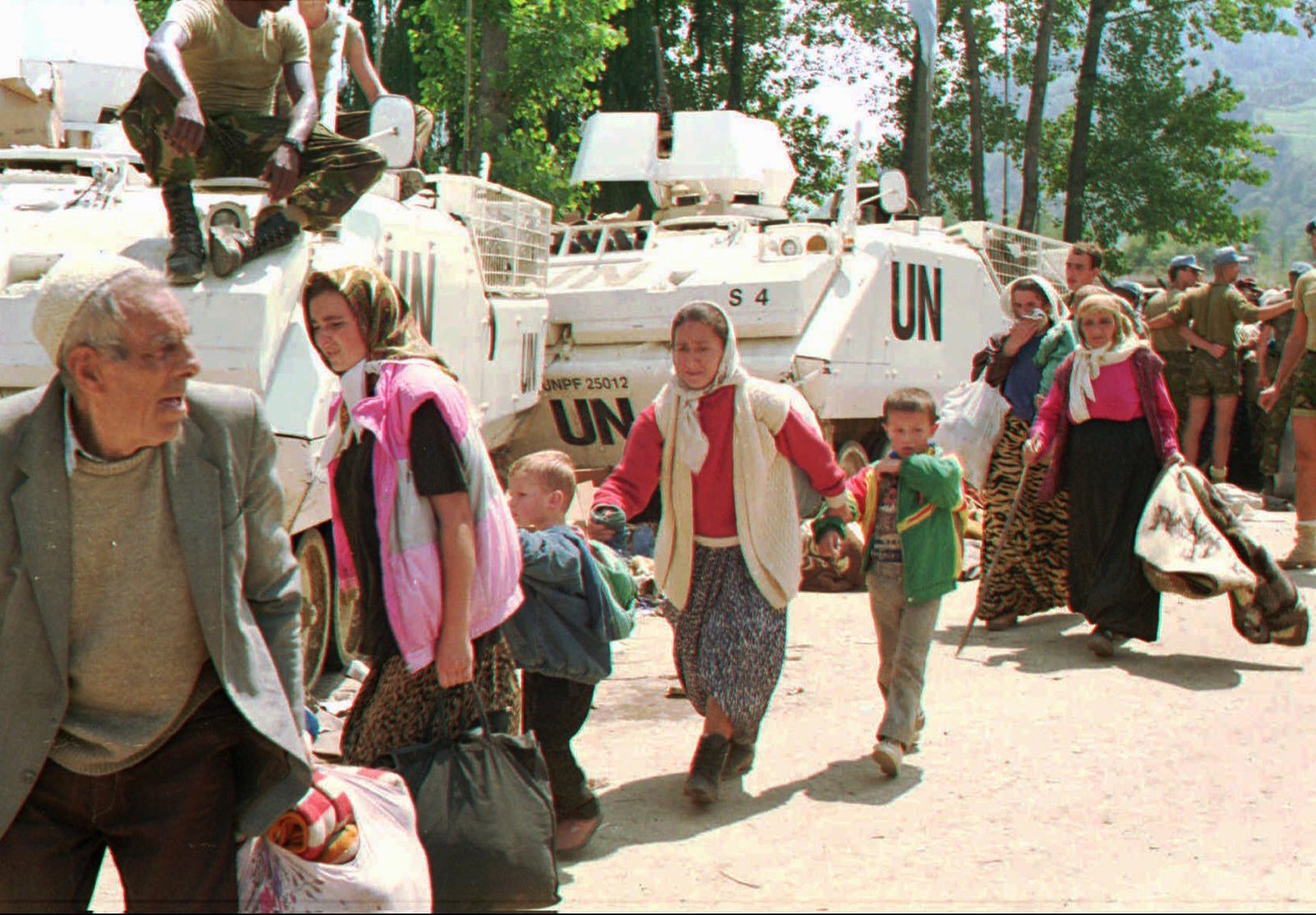

Thirty years since the war there ended, Bosnia and Herzegovina is still scarred by the ethnic cleansing campaigns which tore through the country, killing about 100,000 people and displacing well over two million.
The 1992–1995 war, triggered by ethnic tensions and competing nationalist projects in the wake of the violent breakup of Yugoslavia, was marked by the systematic targeting of civilians and culminated in the 1995 Srebrenica genocide – the worst atrocity to be perpetrated in Europe since World War II.
Recommended Stories
list of 3 itemsend of list
When and why did the war in Bosnia begin?
Bosnia was one of six republics of the Socialist Federal Republic of Yugoslavia, a federation created during World War II and held together for decades under President Josip Broz Tito.
After Tito’s death in 1980, economic collapse and rising nationalism, particularly in Serbia and Croatia, led to demands for independence across the republics.
Slovenia and Croatia declared independence in 1991, with Macedonia following in early 1992, accelerating Yugoslavia’s disintegration.
On March 1, 1992, Bosnia and Herzegovina held a referendum in which 99.7 per cent of participating voters backed independence.
Most Bosnian Serbs boycotted the vote, however, and instead formed their own “Serb Republic” structures, which later became the Republika Srpska (RS) entity within Bosnia.
Bosnia’s push for independence was also unfolding against the backdrop of Serbia’s aggressive separatist policies under Slobodan Milošević, who sought to unify Serb-populated areas in Bosnia and Croatia.
The European Community recognised Bosnia and Herzegovina as an independent state on April 6, 1992. That same month, Bosnian Serb forces, supported by the Yugoslav People’s Army and paramilitaries, launched coordinated attacks within the country to seize territory and expel non-Serb communities.
On April 5, the capital city of Sarajevo came under siege by Bosnian Serb forces, in what became the longest blockade of a city in modern European history. For nearly 43 months, the attacking forces shelled residential areas, cut off electricity and water, and tightened their grip on the capital, killing about 11,000 people.
Soon after that assault began, the United Nations Security Council imposed sweeping sanctions on Serbia and Montenegro for supporting efforts to carve up Bosnia and Herzegovina. In October 1992, Croat forces also attacked Bosniak (Bosnian Muslim) areas around Prozor in southwest Bosnia, marking the start of a separate Croat-Bosniak conflict that brought its campaigns of ethnic cleansing.
How many people were killed and displaced?
The Bosnian authorities commissioned a post-war research project, which estimated that about 104,000 people, primarily civilians, lost their lives. Roughly two-thirds of those killed were Bosniaks.
International and Bosnian sources estimate that about 2.2 million people, more than half of the pre-war population, were forced from their homes as refugees or internally displaced. Most have never been able to return.
Which atrocities led up to the genocide in Srebrenica?
From the start, the war was characterised by systematic ethnic cleansing – particularly of Bosniaks – killings, mass rape, forced displacement and the destruction of cultural and religious sites. Here are some of the key events during the war.
1992 – Ethnic cleansing and the siege of Sarajevo.
Prijedor and the camps: In the northwestern region of Prijedor, Bosnian Serb authorities set up detention camps, including Omarska, Keraterm and Trnopolje.
Thousands of Bosniak and Bosnian Croat civilians were beaten, tortured, raped, and killed in these camps.
Research by the International Criminal Tribunal for the Former Yugoslavia (ICTY) described the crimes as “widespread and systematic”, targeting non-Serb citizens of the country.
Foca and Visegrad: In eastern Bosnia, Bosniaks were killed or expelled, and women and young girls were subjected to organised rape. The ICTY’s Foca case established rape and sexual enslavement as crimes against humanity.
Siege of Sarajevo: The capital, a multiethnic city, was surrounded by Bosnian Serb forces, who shelled residential areas and used snipers to target civilians on the streets.
in markets and in water queues. An estimated 11,000 people, including more than 1,000 children, perished during the siege, which lasted from April 1992 to February 1996.

1993 – ‘Safe areas’ established but massacres continue
With peace efforts failing, the UN declared Srebrenica in eastern Bosnia a “safe area” in April 1993, followed by Sarajevo, Tuzla, Zepa, Gorazde and Bihac a month later. But atrocities continued.
Ahmici massacre: In April 1993, Croat forces killed more than 100 Bosniak civilians in the village of Ahmici, central Bosnia, and burnt homes and mosques. ICTY judgements called it one of the worst acts of ethnic cleansing in the area.
Rape camps: The ICTY and rights groups also documented that rape was used as an instrument of terror, particularly in Foca – now located in Republika Srpska in the southeast of the country – where women and girls were held in “rape camps”.
Market attacks and pressure for intervention occurred between 1994 and 1995.
Sarajevo remained under siege. In February 1994, a mortar attack on the Markale market killed 68 civilians and wounded many more. A second mortar strike occurred at the same market.
in August 1995 killed 43 people. ICTY judgements and UN investigators have blamed Bosnian Serb forces for these attacks.
These and other attacks on so-called “safe areas” raised pressure on NATO and Western governments to act, setting the stage for heavier air attacks against the Bosnian Serb leadership later in 1995.
Sniper ‘safaris’ during the siege of Sarajevo
During the siege of Sarajevo, citizens were subjected to “sniper safaris”—so named as a grotesque reference to hunting expeditions— in which foreigners paid Bosnian Serb units to join them and shoot civilians from positions overlooking the city.
Following a recent Italian investigation, prosecutors in Milan are examining whether wealthy visitors from Italy and other countries travelled to Sarajevo on organised “tours” to shoot civilians for sport.
No one has yet been convicted for organising or taking part in these “safaris,” but the allegations highlight the extreme dehumanisation that accompanied the siege of the city.
It is believed that citizens from multiple countries took part. In 2022, Miran Zupanic, a Bosnian film director, released the documentary Sarajevo Safari, which investigated wealthy foreigners who had participated, including some from the United States and Russia.
Moreover, in 2007, former US Marine John Jordan testified to the ICTY that “tourist shooters” had come to Sarajevo.
How did the 1995 Srebrenica genocide happen?
By 1995, Srebrenica, a town in eastern Bosnia, had become a refuge for tens of thousands of Bosniaks fleeing surrounding villages.
which had been raided and ransacked by Bosnian Serb forces hunting them. The enclave was overcrowded and had become dependent on irregular UN aid convoys, and Bosnian Serb forces controlled the surrounding areas.
The UN declared Srebrenica a protected zone and stationed a small Dutch peacekeeping unit there, but the enclave remained under siege. Radovan Karadzic, the leader of the Bosnian Serbs, issued a directive in March 1995 to completely cut off Srebrenica.
In early July 1995, Bosnian Serb forces advanced on the enclave. On July 9, Karadzic’s forces were ordered to seize Srebrenica, and on July 11, Ratko Mladic, a Bosnian Serb military leader known as the “Butcher of Bosnia”, entered the town.
Over the following days, Bosnian Serb units separated men and boys from women and younger children.
More than 8,000 Bosniak men and boys were executed at sites in and around Srebrenica, and their bodies were dumped in mass graves. About 20,000 women, children, and elderly people were forcibly expelled.
The ICTY and the International Court of Justice later ruled that these killings constituted genocide.
How and when did the Bosnian War end?
Western governments had been reluctant to intervene decisively earlier in the war, but the genocide at Srebrenica forced a shift in approach.
NATO launched a sustained air campaign against Bosnian Serb forces in August and September 1995, marking a pivotal moment that paved the way for the Dayton Peace Agreement, which formally ended the war.
US-brokered talks brought the leaders of Bosnia and Herzegovina, Croatia, and the then-Federal Republic of Yugoslavia to an airbase near Dayton, Ohio, in the US.
On November 21, 1995, they agreed to the General Framework Agreement for Peace in Bosnia and Herzegovina.
better known as the Dayton Peace Agreement, which preserved Bosnia as a single state divided into two main entities – the Federation of Bosnia and Herzegovina and the Republika Srpska.
The agreement was formally signed in Paris on December 14.
What were the Dayton Accords?
The Dayton Peace Agreement was meant to do more than just end active fighting, and it reshaped the post-war political system.
Bosnia today has a highly decentralised structure of government, with two political entities as well as the third, self-governing Brcko District, shared between the other two, and layers of state-level institutions.
The Dayton Agreement dedicates an entire section to refugees and those displaced during the war. It says that “all refugees and displaced persons have the right freely to return to their homes of origin” and to have property restored or compensated.
But many experts describe the agreement as flawed in practice, as implementation has been partial at best.
While many people did return to their homes and hundreds of thousands of property claims were processed, significant numbers of Bosniaks were never able to return to their pre-war homes.
There were many reasons for this, including the presence of minefields, the fact that their housing had been destroyed, fear, economic hardship, and lingering, deep-rooted ethnic tensions.
Today, entire communities, particularly survivors of the Srebrenica genocide, remain in exile or have simply had to resettle elsewhere in countries such as the US and Australia.
Has anyone been held to account for the atrocities committed during the war?
In 1993, the UN created the ICTY to prosecute serious violations of international humanitarian law committed in the Balkans. The tribunal lasted 24 years, from 1993 to 2017.
Witnesses and survivors testified about the atrocities over more than two decades, leading to the indictment of 161 individuals. Ninety of those were sentenced.
19 were acquitted, 20 had their indictments withdrawn, 17 died before conviction, 13 were referred to other courts, and two were retried.
Four types of crime were recorded at the tribunal – genocide, crimes against humanity, violations of laws/customs of war and grave breaches of the Geneva Convention.
Among the people tried by the tribunal were:
Radovan Karadzic –
The tribunal tried Radovan Karadzic, who was the wartime leader of the Bosnian Serbs. In 2016, he received a life sentence for genocide, crimes against humanity and war crimes, including his role in Srebrenica and the siege of Sarajevo.
In 2021, he was transferred to the high-security prison, HMP Parkhurst, on the Isle of Wight, off the south coast of England, UK.
Ratko Mladić – the Bosnian Serb military commander. In 2017, he was also sentenced to life imprisonment for genocide and other crimes. He is being held in the UN Detention Unit in The Hague, Netherlands.
Bosnian Croat leaders – several were convicted for crimes against Bosniaks during the Croat-Bosniak conflict.
Dozens of officials have also received long prison sentences for crimes linked to the Srebrenica genocide, though many survivors say justice remains far from being done.